404 – Museum Not Found
In Athens, a digital museum has gone haywire: images have lost their stories and labels have been swapped. Young people have 75 minutes to save cultural memory.
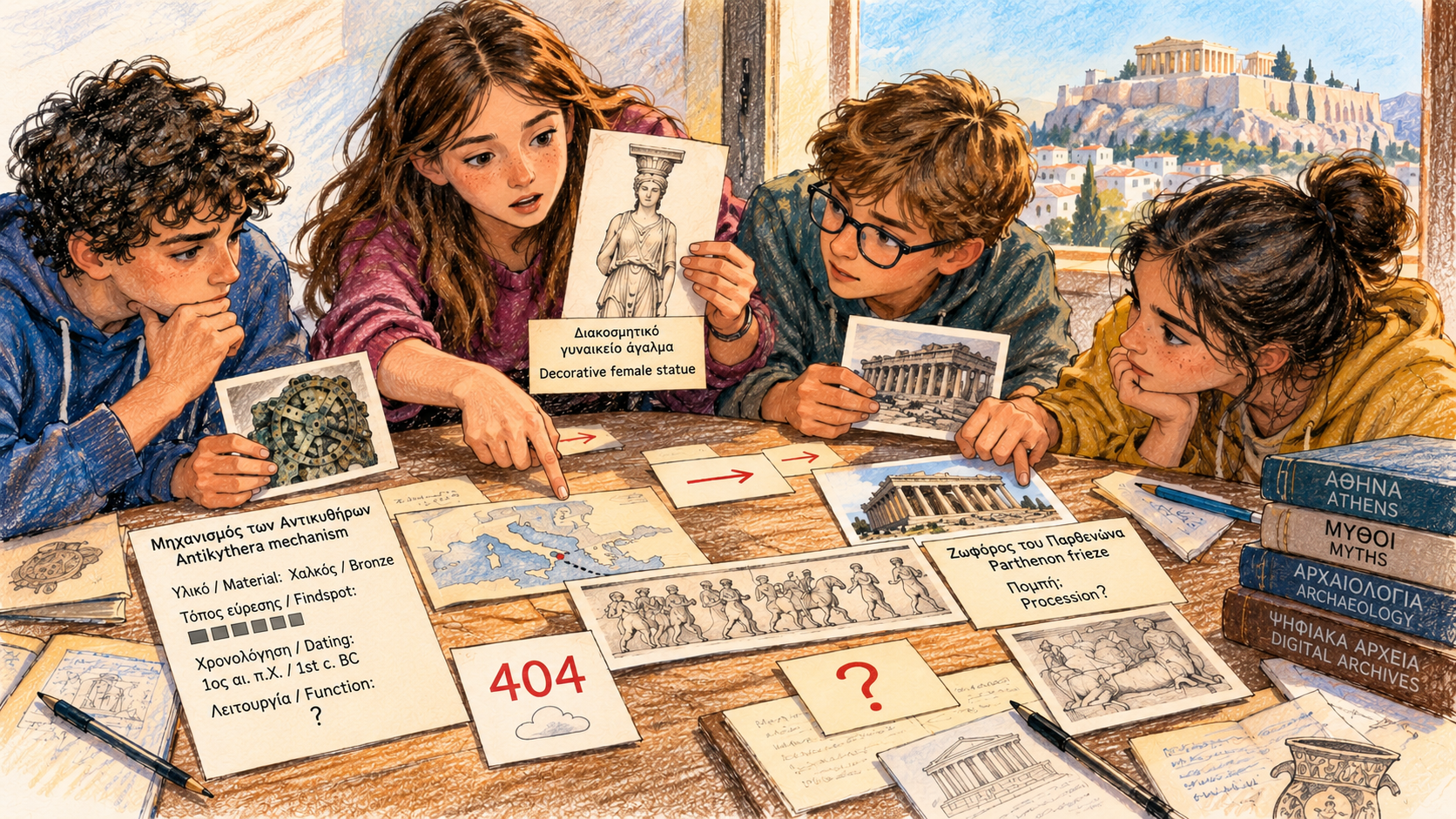
75 minutes left. Then part of human history will be gone.
The museum does not actually exist. It has no entrance, no galleries and no display cases. Instead, it supposedly owns something real museums could only dream of: every work of art and archaeological object in the world. They are all stored in one enormous cloud.
And that cloud has just broken down.
On Sunday at ETERON in Athens, up to 15 children and young teenagers aged ten to fourteen will face a rather unusual problem. A first group will already have tried to save the Cloud Museum at BIOS on Saturday. Anyone who missed that round gets another chance on Sunday. Images have lost their stories, labels have changed places and figures have ended up in narratives where they do not belong. In 75 minutes, the system will reboot. Anything still marked as problematic will be deleted.
The game at TRANSEUROPA Festival is called “ERROR 404: SAVE THE CLOUD MUSEUM”. It is neither a computer game nor a museum tour, but an analogue tabletop workshop inspired by escape rooms. Participants examine mysterious artefacts, decipher visual clues, reconstruct fragmented myths and look for connections between things that at first seem unrelated. The organisers call them the world’s first “digital archaeologists”.
They do not reveal which puzzles will actually be on the table. That would be a rather bad idea for an escape room. So let us build our own broken Cloud Museum.
ERROR 01
An image shows six young women carved in marble. One carries this label: Decorative female statue, Athens. Sounds right, doesn’t it?
Not quite. A Caryatid from the Erechtheion on the Acropolis is a female figure, but she is also architecture. The six Korai stood in place of columns and supported the roof of the south porch. Calling one merely a decorative statue does not delete the image. The date might still be correct. The location might be correct too. What disappears is precisely the information that explains why this woman is standing there.
Now imagine another database copying the wrong description. A learning platform uses it. Later, perhaps an AI is trained on it. The original error does not become any larger, but it gains more and more ways to travel.
ERROR 02
Next file. A few greenish-brown pieces of bronze from an ancient shipwreck.
Material: Bronze
Findspot: Shipwreck
Age: more than 2,000 years
Function: █████████████████
Oops. The Antikythera Mechanism is still there, but the very information that makes it extraordinary has disappeared. Numerous gears worked together inside it, allowing the device to calculate astronomical phenomena and calendar cycles.
A photograph, then, is not the same thing as knowledge about what it shows. An object can be preserved completely while a crucial part of its story is lost.
Hang on. Where did it just say where those bronze fragments were found?
Findspot: █████████
Now something else is missing. Archaeology really does work rather like this: an object on its own tells us far from everything. Where was it found? What was beside it? What is it made of? How old is it? What might it have been used for? The more context disappears, the harder its story becomes to reconstruct.
ERROR 03
This time the cloud reports no error. STATUS 200 – OK. Reassuring. Or is it?
What happens if a fragment of the Parthenon frieze has a completely wrong description underneath it? The file is found. The image appears. The text is there. No red warning light flashes. At least an error saying “404 – not found” is honest: we know something is missing. It is much harder when a system tells us: Everything is fine.
That is why “SAVE THE CLOUD MUSEUM” is more than a matching game with ancient objects. Participants do not simply have to find something. They have to decide which information belongs with which other information – and how they can tell that their solution is sound.
They need neither brush nor shovel for that. Yet it involves a great deal of what archaeologists actually do: examine traces, compare evidence, establish connections and reconstruct the best-supported story possible from incomplete information.
That fits TRANSEUROPA Festival 2026, whose theme this year is “reclaiming the cloud(s)”. In Athens, the festival explores digital spaces, knowledge and shared commons. The Cloud Museum turns questions that can sound enormous into an adventure for ten- to fourteen-year-olds.
And somewhere in Athens on Sunday afternoon, the countdown begins. 75 minutes. We do not know which images have been mixed up, which myths have fallen apart or which artefacts need saving. Only the people sitting at the table will find out. That is how it should be.
A good museum should keep a few secrets. As long as someone there still knows where to find them.