Yesterday’s Future – and the Day After Tomorrow
In Antwerp, the Metropolis Academy invites young people to imagine 2126 through art and technology. A journey from Jules Verne and Fritz Lang to artificial intelligence.
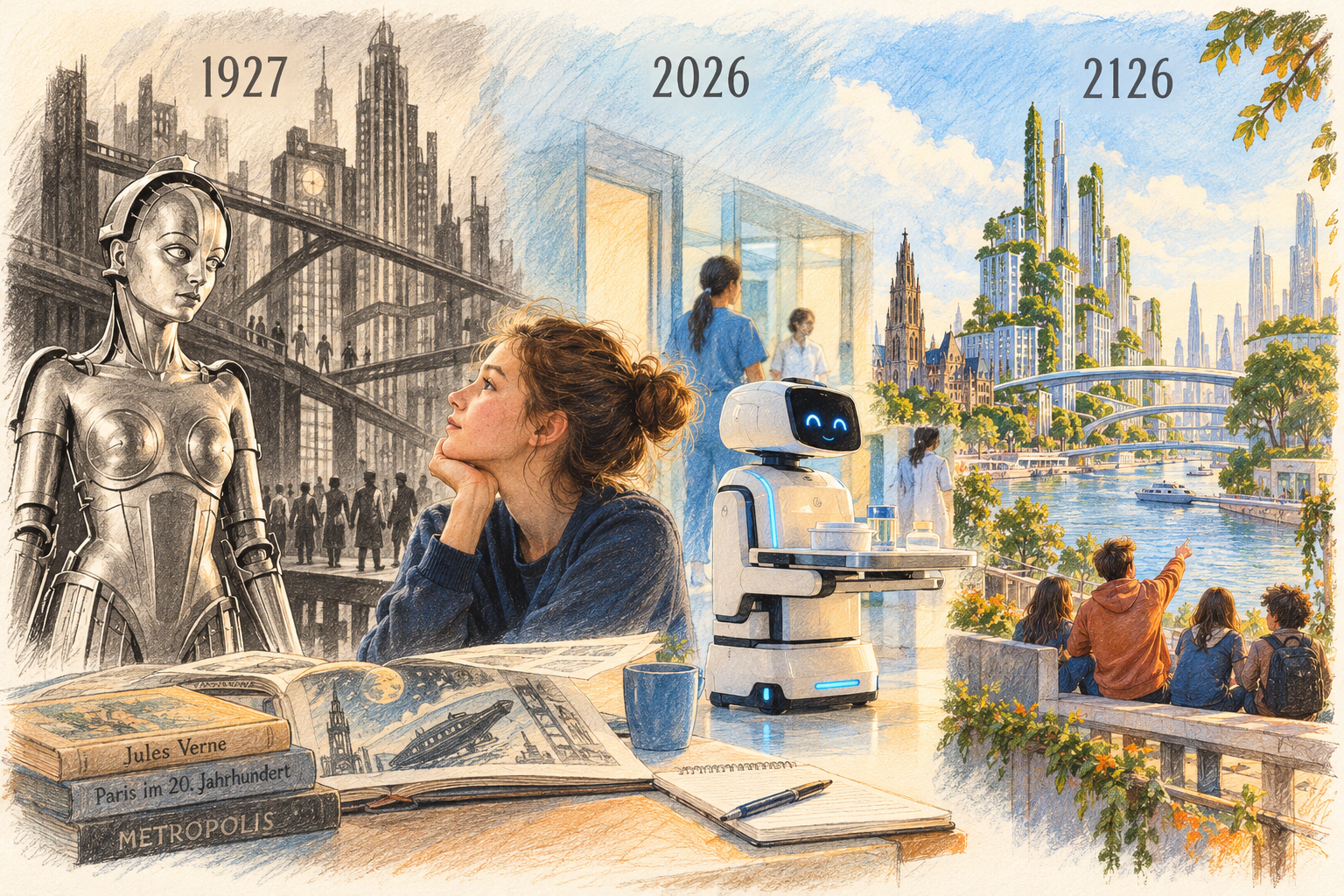
Looking ahead to 2126
How will people live a hundred years from now? Will machines take work off their hands? Will cities be greener, societies fairer and borders less important? Or will entirely new problems emerge, problems for which we do not yet even have words?
On 19 October, Antwerp’s Metropolis Academy turns its attention to 2126. Young people are invited to explore visions of the future and develop ideas of their own. This is not about scientific forecasts but about the possibilities of art: theatre, music, images and stories can bring into being worlds that do not yet exist. The idea is hardly new. More than a century and a half ago, it fascinated a French writer whose imagination captivated generations of readers.
A future that arrived too early
Jules Verne sent his fictional characters to the Moon and on journeys beneath the sea. His stories took shape in an age when steam engines, railways and experiments with electricity fired the imagination. The world seemed full of technological possibilities. But Verne had another side.
In 1863 he wrote Paris in the Twentieth Century, imagining a society in 1960 where technology dominated daily life, commercial success determined social standing and art and literature were increasingly pushed aside. His publisher, Pierre-Jules Hetzel, rejected the manuscript. He considered the story too pessimistic and unlikely to succeed. The novel remained in a drawer and was not published until 1994.
There is a remarkable irony here: by the time readers finally encountered Verne’s vision of the future, the year in which it was set was already more than three decades in the past. And Verne’s question had lost none of its relevance: what does a society gain through technological progress, and what might it lose along the way?
A city of machines
On 10 January 1927, a film premiered in Berlin that would become one of the most influential works in cinema history: Fritz Lang’s Metropolis. Enormous skyscrapers, multilayered roads, gigantic machine halls and an artificial human being shaped its vision of a future city. A privileged society lived high above the workers, while deep underground people kept the machines running.
The technology seemed overwhelming. Yet the real threat lay not in the machines themselves but in the social conditions under which they were used. The humanoid robot that could take on the appearance of a woman became one of early science-fiction cinema’s most famous figures. Here was a machine that could not only relieve people of work but also deceive them, long before computers existed in the modern sense.
Between curiosity and fear
What connects Jules Verne and Fritz Lang? Both explored technological possibilities extending beyond their own times. Both also asked questions about the people who would have to live with those possibilities.
Perhaps this is a recurring pattern in the way humans imagine the future: curiosity and fear go hand in hand. Curiosity asks what might be possible. Fear asks what the consequences might be. Without curiosity, many discoveries would never have happened. Without the ability to anticipate danger, we might welcome some inventions far too carelessly.
Art has a particular freedom here. It need not prove technical feasibility or deliver reliable predictions. It can exaggerate hopes, make fears visible and leave contradictions unresolved.
The Roaring Twenties – a European awakening
When Metropolis premiered in Berlin in 1927, many European cities were experiencing a period of renewal. In Paris, Berlin, Brussels and Antwerp, new technologies, modern architecture, film, music and social upheaval were transforming everyday life.
Antwerp was part of this development too. Its port connected the city to the world, while trade and industry shaped daily life. At the same time, artists and architects experimented with new forms of expression. Modernism asked not only what the world might look like, but also how people might live together in the future.
Yet the Roaring Twenties did not shine equally brightly everywhere. The First World War had left deep scars. Economic growth and social insecurity existed side by side. New machines promised prosperity, while rationalisation and social inequality aroused fears.
The global economic crisis of 1929 was still to come. But the contradictions between technological progress and human needs were already visible. Metropolis condensed these tensions into a dark vision of the future, one that could be understood far beyond Germany.
The future has become the present
Almost a hundred years later, much has changed. Computers have become part of everyday life. Machines manufacture products with a precision once unimaginable. Artificial intelligence can write texts, generate images, translate languages and hold conversations with people.
Yet the humanoid robot from Metropolis has not simply become reality. The most powerful AI systems do not need a human-shaped body. We encounter them on screens, in software and increasingly as invisible parts of technological processes.
In hospitals, service robots already carry out transport tasks, moving medicines or medical supplies from one ward to another, for example. At the same time, robots are being developed for military operations. A machine that eases the burden on nursing staff and one deployed in war embody very different ideas about what technological progress should serve. The crucial question is therefore not just what machines can do, but what people choose to use them for.
And yet some questions from 1927 sound remarkably familiar: who decides how new technologies are used? Who benefits from them? What work should remain in human hands? And how can we prevent technological progress from deepening social inequalities? Perhaps Fritz Lang would have marvelled at our present. Perhaps he would also have recognised quite a lot.
Back to Antwerp – and onward to the 22nd century
Now it is the turn of Antwerp’s young people. The Metropolis Academy invites them to consider a future as distant to them as 2026 was to the audiences watching Fritz Lang’s film.
Their visions need not come true. Jules Verne did not simply predict the future either, and Metropolis was never intended as a technical blueprint. What matters is that people can do more than wait for the future: they can shape it in their minds. They can ask which developments they welcome, which they fear and what kind of world they want to live in.
Perhaps the people of 2126 will look back at our visions of the future. They may smile at some of our fears and marvel at some of our hopes. And perhaps they will discover that, beneath all the technological changes, two deeply human qualities have hardly changed at all: curiosity about the unknown and concern for what matters to us.