A Baroque Palace with a Future
First their workshop travelled to young people. Now Christian Zöllner and Sebastian Piatza are turning an almost 300-year-old Baroque palace into a place where young people can spend more time making, designing and experimenting.
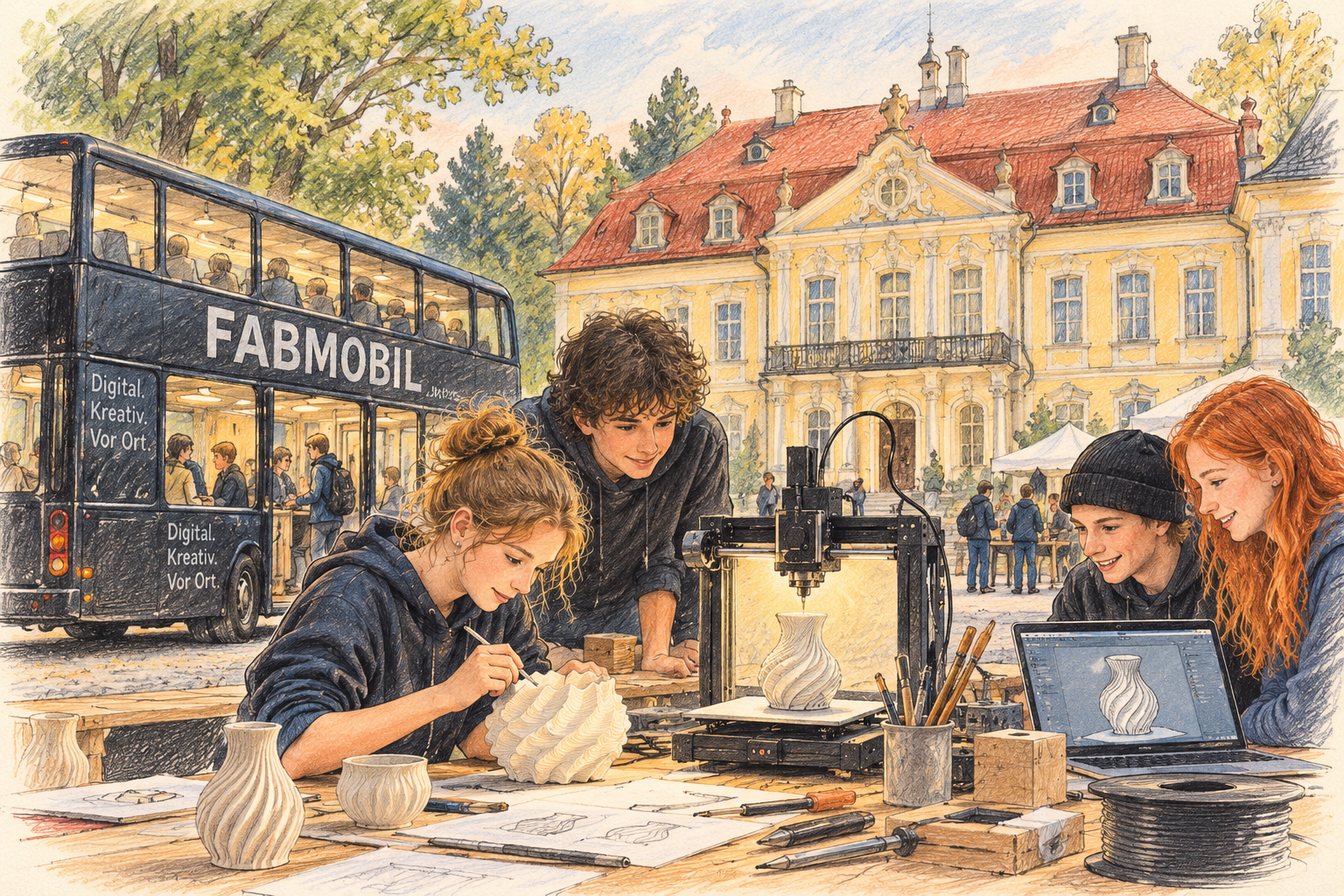
OBERLICHTENAU/DRESDEN – A black double-decker bus travels through Upper Lusatia. There are no tour groups inside. Instead, it carries 3D printers, computers and other equipment that young people can use to code, try virtual reality or explore robotics.
This is the FABMOBIL. “Fab” comes from “fabrication” – making or manufacturing things. A FabLab is a workshop where digital tools are used to design and produce objects. With the FABMOBIL, the workshop was given wheels: since 2016, Christian Zöllner and Sebastian Piatza have been taking technology to young people in rural areas.
The idea solves a simple problem. If you live far from a larger city, there may not be a 3D printer or laser cutter just around the corner. So the workshop comes to you.
But even a double-decker bus eventually reaches its limits.
What does not fit on a bus
What happens when an afternoon project needs to last several days? When you do not just want to discover a 3D printer but revise your own design again and again? Or when a workshop also needs somewhere to sleep, eat and work together?
Zöllner and Piatza found a rather Saxon answer: they bought a palace.
The Baroque palace at Oberlichtenau near Pulsnitz was built between 1726 and 1730 in the Saxon late-Baroque style. Heinrich Count von Brühl bought it in 1744. It survived damage during the Seven Years’ War and narrowly escaped demolition after 1945. From 1948 until 2005, it housed a children’s home.
Now the palace is to become a place for young people once again – this time as an academy with workshops, labs and accommodation.
The emerging “Academy for Applied Futures” is planned to include digital workshops and a maker lab, along with seminar and event spaces and places to stay. Plans mention 25 guest beds. Hellerau also lists greenhouses and the academy’s own energy systems. Workshops, summer schools and residencies are planned. Some parts already exist, while others are still being built; work currently includes repairing the roof, creating accommodation and setting up workshops.
So the travelling laboratory is not simply becoming a larger laboratory without wheels. It is becoming a place where people can stay.
Sewing next to the 3D printer
“Future” does not mean everyone is expected to spend all day staring at screens.
Sigrun Krause, who develops programmes for children and young people in Oberlichtenau, told MDR about planned summer camps where young people could camp, work with 3D printers, sew and develop their own designs. Workshops are already being set up in one of the palace’s two cavalier houses.
That is an important difference. The FABMOBIL lets young people encounter technologies and try them out. At the palace, that experience is intended to develop into longer-term work. The Zukunftsorte network explicitly describes the project as developing experience from mobile digital education into permanent educational programmes and partnerships with schools and universities.
And the word “fabrication” regains its literal meaning here: this is about making things.
Ceramic 3D printing is a particularly good example. Instead of melting a plastic filament, as many ordinary 3D printers do, a workable ceramic material can be built up layer by layer into an object, which is then processed further and fired.
Clay meets computer.
And in Saxony, of all places, that combination is not as exotic as it might sound.
The printed trunk
Meissen is roughly an hour’s drive from Oberlichtenau. Porcelain has been made there for more than 300 years. And even this famous porcelain tradition has encountered 3D printing.
In the “RestaurAM” research project, the Meissen State Porcelain Manufactory, Dresden State Art Collections, the Fraunhofer Institute for Ceramic Technologies and Systems and other partners investigated how small missing parts of historic porcelain objects could be digitally reconstructed and produced using additive manufacturing.
One of those parts was a trunk.
A historic elephant-head vase had an elephant’s head serving as a handle, but its trunk had broken off. The missing piece was digitally reconstructed and newly produced in porcelain using a ceramic 3D-printing process. The replacement trunk is about ten centimetres long.
Modern manufacturing technology can therefore give an old porcelain elephant its trunk back.
Oberlichtenau is not about restoring Meissen porcelain. There is no direct connection between that research project and the new academy. But the example shows rather nicely what can happen in a workshop where traditional materials and digital tools are not treated as opposites.
Who comes up with an idea like this?
Zöllner and Piatza are not hobby tinkerers who happened to acquire a palace. Both come from professional design backgrounds.
Christian Zöllner studied product design at Dresden University of Applied Sciences and graduated with a diploma in 2007. He subsequently worked in design studios in Paris and Vienna, founded the media-art collective VR/Urban and taught at several universities. Since 2018 he has been a professor at Burg Giebichenstein University of Art and Design Halle, working at the intersection of industrial design and design in digital contexts.
Sebastian Piatza is a product designer whose work spans design, media and science. He has led workshops, was also part of VR/Urban and has been project manager of the FABMOBIL since 2017. Together, the two run the design and research studio The Constitute.
Oberlichtenau is not simply a convenient location for them. According to MDR, Zöllner, Piatza and Sigrun Krause grew up in the region. The project therefore brings the two designers back to the area they themselves come from.
Today the bus pulls up once more
The FABMOBIL is not giving up its wheels. Today, from 5 p.m., the black double-decker will be outside Festspielhaus Hellerau in Dresden. Admission is free. The Academy for Applied Futures will also be presented at the opening of the HYBRID Biennale.
Meanwhile, construction continues in Oberlichtenau. The palace is not yet a finished campus. That is part of what makes the project interesting: it is possible to watch a permanent place emerge step by step from the experience of a travelling laboratory.
Almost 300 years separate the construction of the Baroque palace from the idea of experimenting there with robotics, virtual reality, 3D printing, textiles and other materials.
The bus has shown that a workshop can travel. Now the palace is meant to show what becomes possible when it stays.