Cyankali – A Film That Refused to Be Silenced
Berlin presents a restored version of “Cyankali” (1930). A film about poverty, abortion law and censorship returns, with live cello music in passages where the original sound is missing.
Some films disappear because nobody wants to see them any more. Others vanish piece by piece because, in their day, they showed too much. When Cyankali reached German cinemas in 1930, it told the story of a young woman, of poverty, and of a law that left her alone in her hour of need. The film sparked fierce controversy, faced repeated censorship reviews and was banned for a time. Almost a century later, it returns to Berlin – restored, but not complete. A cellist helps it find its voice again where part of its original soundtrack has been lost.
On Wednesday evening, the Deutsche Kinemathek opens its Film Restored festival with the world premiere of the digitally restored Cyankali. This year’s theme is “Risky Business”: films that took risks, and the dangers faced by the materials through which they survive. Few works could bring these two meanings together more powerfully.
Hete Wants to Have a Child
Hete is young, works in an office and loves Paul, a factory worker. When she becomes pregnant, she initially wants to have the baby. They have little money, but hope to build a life together. Then Paul joins the struggle for higher wages and loses his job. What was difficult before now seems almost impossible.
The story unfolds amid the economic crisis at the end of the Weimar Republic. Unemployment, cramped housing and insecurity shape everyday life. For Hete, whether she can have a child also becomes a question of money. Yet under Section 218 of the law at the time, abortion is generally a criminal offence. Doctors turn her away. Eventually she seeks help from an illegal abortion provider, sometimes called an “angel maker”, and receives the poison that gives the film its name: cyanide.
The film is not an abstract argument about the law. It shows how economic hardship, social expectations and criminal legislation converge in one person’s life. That is what makes it so forceful: Hete is not presented as a case study, but as a young woman who begins full of hope and gradually sees her options disappear.
From the Stage to the Screen
The story was written by Friedrich Wolf, a doctor and author whose play Cyankali caused a sensation in 1929. Its premiere at Berlin’s Lessing Theatre provoked passionate reactions. Wolf had brought to the stage a subject fiercely debated in public, while the women directly affected were often scarcely heard.
Just a year later, Hans Tintner adapted the play for the Berlin-based Atlantis-Film company. Grete Mosheim played the young Hete. Cyankali premiered at Berlin’s Babylon cinema on 23 May 1930.
Rather than merely filming a stage play, cinema could show the characters’ social world directly. Factory work, unemployment and the cramped conditions of city life appeared alongside the family tragedy. One young woman’s fate became a portrait of a society in which economic inequality shaped the choices open to people.
A Film Confronts the Censors
The reaction came quickly. The censorship authorities repeatedly reviewed and cut Cyankali, and banned it for periods. Even after it had been screening for weeks, its permission to be shown was challenged again.
The dispute was not simply about the depiction of an abortion. The film’s criticism of the law, its portrayal of working-class poverty and its unmistakable sympathy for Hete were seen as socially dangerous. Censorship decisions raised accusations that the film might incite class hatred or threaten public order.
Today, those interventions tell a second story. Cyankali set out to make visible what many preferred not to see. The cuts and restrictions reveal how fiercely the boundaries of public representation were contested. What was a cinema film allowed to show? Whose daily reality could it take seriously? And when did an artistic narrative become, in the eyes of the authorities, a political threat?
The controversy extended far beyond the cinema. During the Weimar Republic, Section 218 was the subject of heated debate, demonstrations and demands for reform. Wolf’s play and Tintner’s film were among the cultural voices in that struggle.
When Pictures Learned to Speak
Technically, too, Cyankali was made at a turning point. Cinema was moving from silent pictures to sound. Tintner’s film still contains intertitles and long silent sequences, but also music, sound effects and spoken dialogue. Towards the end in particular, the human voice takes on a dramatic force of its own.
This mixture makes the film a remarkable document of its time. For audiences in 1930, sound in the cinema was still a relatively new experience. Characters could suddenly do more than speak through gestures and written intertitles: viewers could hear their voices.
And yet part of the sound has now been lost from this very film, in which speaking and being heard matter so much.
Four Sound Reels Are Missing
For the new restoration, the Deutsche Kinemathek was able to use both the original 35 mm picture negative and the original optical sound negative. Both are historic nitrate film, requiring exceptional care in preservation and handling.
But the material is incomplete. The picture negative has gaps caused in part by earlier censorship cuts and later changes during the film’s archival history. Only six of the original ten sound reels survive. Despite an extensive search, the other four could not be located.
Restoration can stabilise damaged images and make surviving audio accessible. It cannot simply claim to know what passages lost to history originally sounded like.
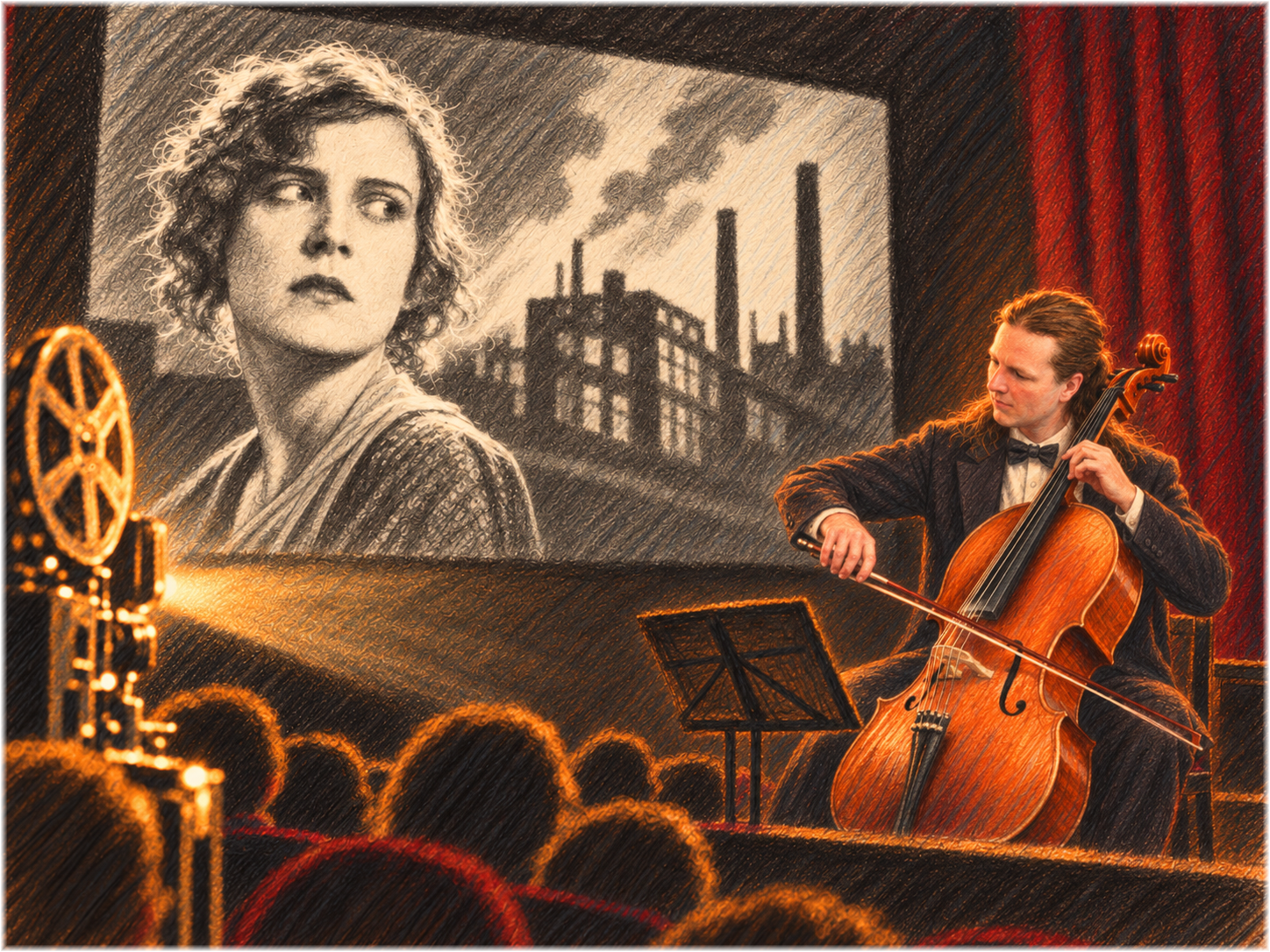
That is why Wednesday evening’s screening will have a special musical accompaniment. Cellist Paul Rittel will perform live in the passages where the original music is missing. His performance does not silently pass itself off as the original soundtrack: it allows the audience to hear that something is missing, while a present-day musician builds a bridge to the surviving film.
In the auditorium, two periods meet: the images and voices of 1930 and a cello playing in 2026.
An Old Question in a Different Present
Anyone watching Cyankali today encounters a society whose living conditions and laws have changed in many ways. In Germany, abortions can now be carried out without criminal penalty under certain conditions. The situation then cannot simply be equated with that of today.
Yet the underlying questions have not disappeared. How free is a personal choice when money, housing and social security are lacking? What roles do the law, medical care and society’s expectations play? And how does public debate change when the people whose lives are at stake are given a voice of their own?
A film from 1930 cannot provide ready-made answers for 2026. But it can show the circumstances in which earlier generations asked these questions – and the resistance they faced.
A Film That Refused to Be Silenced
On 21 October, Cyankali returns to a Berlin screen. The restored version runs for 91 minutes. It is not an original reconstructed in every detail, but a carefully preserved record of what time, censorship and archival history have left behind.
Perhaps that is what makes the evening so significant. Hete’s story was told in 1930 because people wanted to draw attention to a social problem. The film then became the subject of battles over its images, its right to be shown and, eventually, its preservation.
Now those images return to the screen. Where the original music has vanished, a cello is heard. And after 96 years, a film whose history is bound up with prohibition and enforced silence gets another chance to be heard.