Alliances connect countries – artists connect people
Long before the European Union, countries tried to bind themselves together politically. While treaties redrew borders, artists, music, images and ideas were already travelling across Europe.
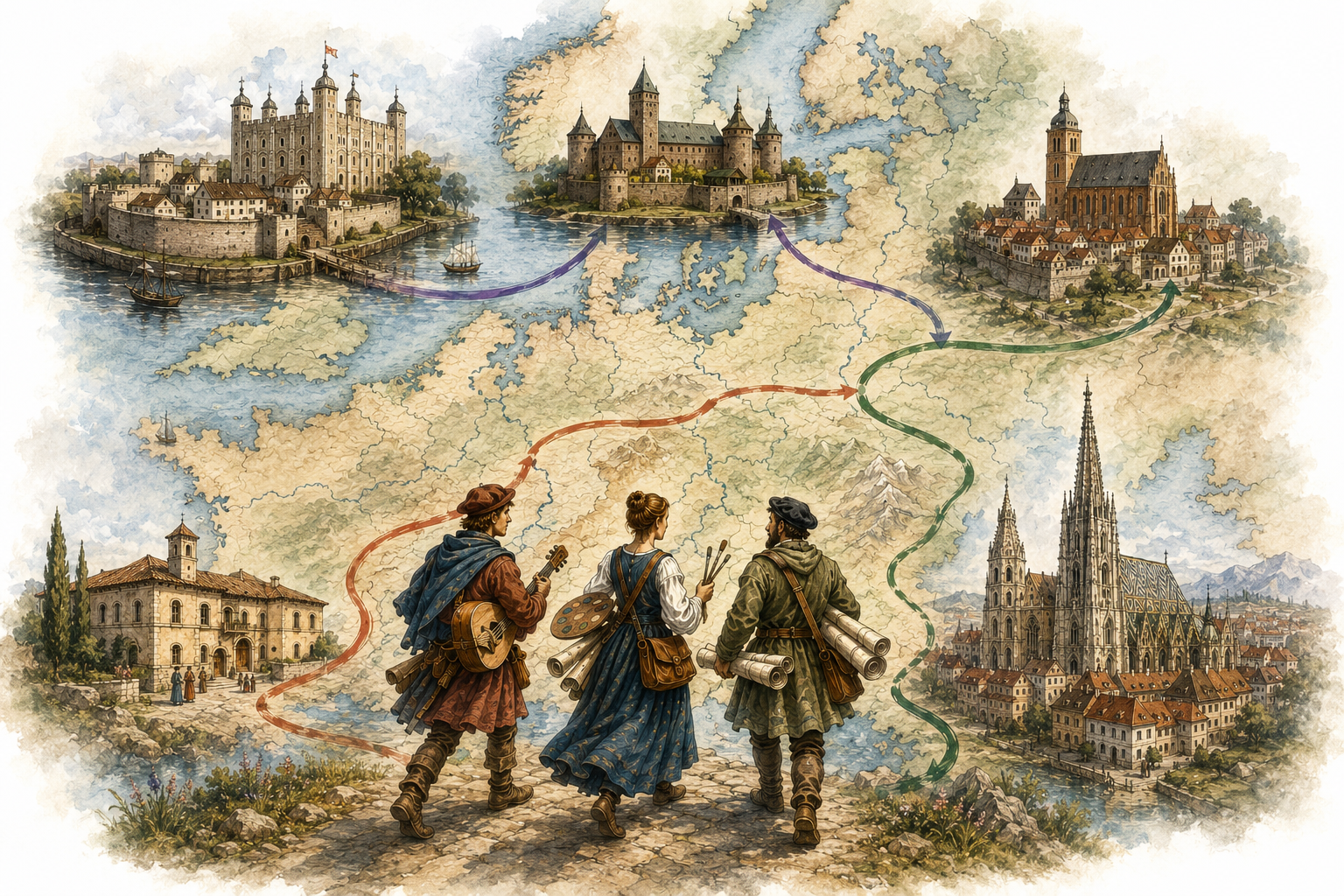
Three kingdoms, but one king. What sounds unusual today was a reality in late medieval Europe: from 1397, Denmark, Norway and Sweden belonged to the Kalmar Union. The countries did not disappear. They kept their own laws, interests and powerful groups, but they shared a ruler.
The idea was far from unique. Again and again, European rulers and countries tried to join together without one realm simply conquering another. Some unions were created by treaties, others by marriages between ruling families. Some lasted for centuries; others fell apart again.
On 7 September, historians will meet at the House of European History in Brussels to examine precisely these kinds of political union. The international conference begins with the Kalmar Union and then turns, among other places, to the Iberian Peninsula and the Habsburg monarchy. Yet while kings married, treaties were signed and borders shifted, something else was happening too: people were moving.
A map is not a wall
A musician hoping to perform at a foreign court did not ask what historians would call that state several centuries later. Painters accepted commissions in other lands, architects carried forms and techniques with them, and books, melodies and stories travelled from city to city.
Political borders could make these journeys harder, while alliances could create new connections. Above all, European cultural history repeatedly shows that ideas are not very good at stopping at a line on a map. This becomes especially clear in the lives of artists who cannot easily be assigned to a single country.
The late Gothic sculptor Gil de Siloé worked in Burgos in the late fifteenth century. Exactly where he came from remains uncertain; sources and scholarship have suggested several possible places of origin. What is clear is that his work brought influences from different parts of Europe into contact with the artistic world of Castile. His son Diego de Siloé later became an important Spanish architect and sculptor himself. One artist arrives – and the next generation already belongs to the art history of another country.
The path of the Italian sculptor and architect Santi Gucci can be traced more clearly. Born in Florence around 1530, he moved to Poland after 1550 and began a successful career there as a court artist. Renaissance forms with roots south of the Alps thus became part of castles, tombs and courtly art far to the east of Europe.
What travels with them?
A musician carried not only an instrument but melodies and ways of playing. An architect brought ideas about what a church, castle or town hall might look like. A painter could learn techniques at another court that later appeared somewhere else again.
And nobody needed to wait for a political union before crossing a border. Artists also travelled between rival or independent countries. Merchants carried stories and songs alongside their goods. Universities attracted people from distant regions, and pilgrimage routes connected places long before anyone imagined open internal European borders.
So it would be too simple to say that alliances came first and cultural exchange followed. Often people were already connected while the political map above them was being redrawn again and again.
The Kalmar Union linked the Danish, Norwegian and Swedish realms for more than a century. On the other side of Europe, the marriage of Isabella of Castile and Ferdinand of Aragon brought together two powerful crowns of the Iberian Peninsula. Farther east, the connection between Poland and Lithuania eventually developed into one of Europe’s largest political entities. Habsburg rule, meanwhile, stretched across territories where very different languages were spoken and different traditions maintained.
None of these unions was an early European Union. Their foundations, power structures and the rights of their inhabitants were far too different, and these were certainly not peaceful times. But they reveal a question Europe has faced repeatedly: How can countries act together while remaining different?
A Europe of many experiments
That is why the look back being attempted by the scholars in Brussels is so interesting. The conference is titled “Political Unions in European History”. It examines political unions from the Middle Ages into the early modern period and also asks how they were remembered later.
The programme includes unions based on legal agreements between the political units involved. In that sense, they offered a form of connection different from simply enlarging a realm through conquest.
Of course, a treaty did not guarantee lasting peace. The Kalmar Union itself experienced serious conflicts over how much power the common ruler should hold and how much the individual countries should decide for themselves. One of the first talks in Brussels on Monday deals precisely with the rise, development and end of that union – from shared interests to struggles between monarchy and estates.
The difficult question, then, was not only whether people wanted to do something together, but also: How much do we want to decide together, and what should remain our own? Europe has produced many different answers to that question.
The lines change, the routes remain
Today, the House of European History stands only a short distance from the institutions of the European Union. That makes Brussels a particularly fitting place for this conference. The EU is not a continuation of the Kalmar Union, Poland-Lithuania or the Habsburg monarchy. Its democratic foundations and institutions belong to a very different age.
But perhaps, beside the history of political alliances, it is worth looking at another history of Europe – one with no founding treaty. While political unions emerged and disappeared, borders shifted and new states were created, artists kept travelling.
A sculptor of uncertain origin worked in Castile. A Florentine created works in Poland. Musicians moved between courts and cities. Architectural styles, images and ideas were adopted, transformed and passed on. With every journey, something important happened: what arrived did not simply remain foreign. It met what was already there, and something new could emerge from that encounter.
The lines on Europe’s political map therefore have to be redrawn again and again. On a map of its culture, that would be much harder.
There, above all, we would have to draw routes.
Because alliances connect countries – artists connect people.