Four centuries of hide-and-seek: a still life is returned to Clara Peeters
A painting long catalogued as anonymous in the storage of Norway’s National Museum is now recognised as a work by the Flemish painter Clara Peeters. Curator Cynthia Osiecki followed a trail of wood, grapes, hazelnuts and tiny reflections.
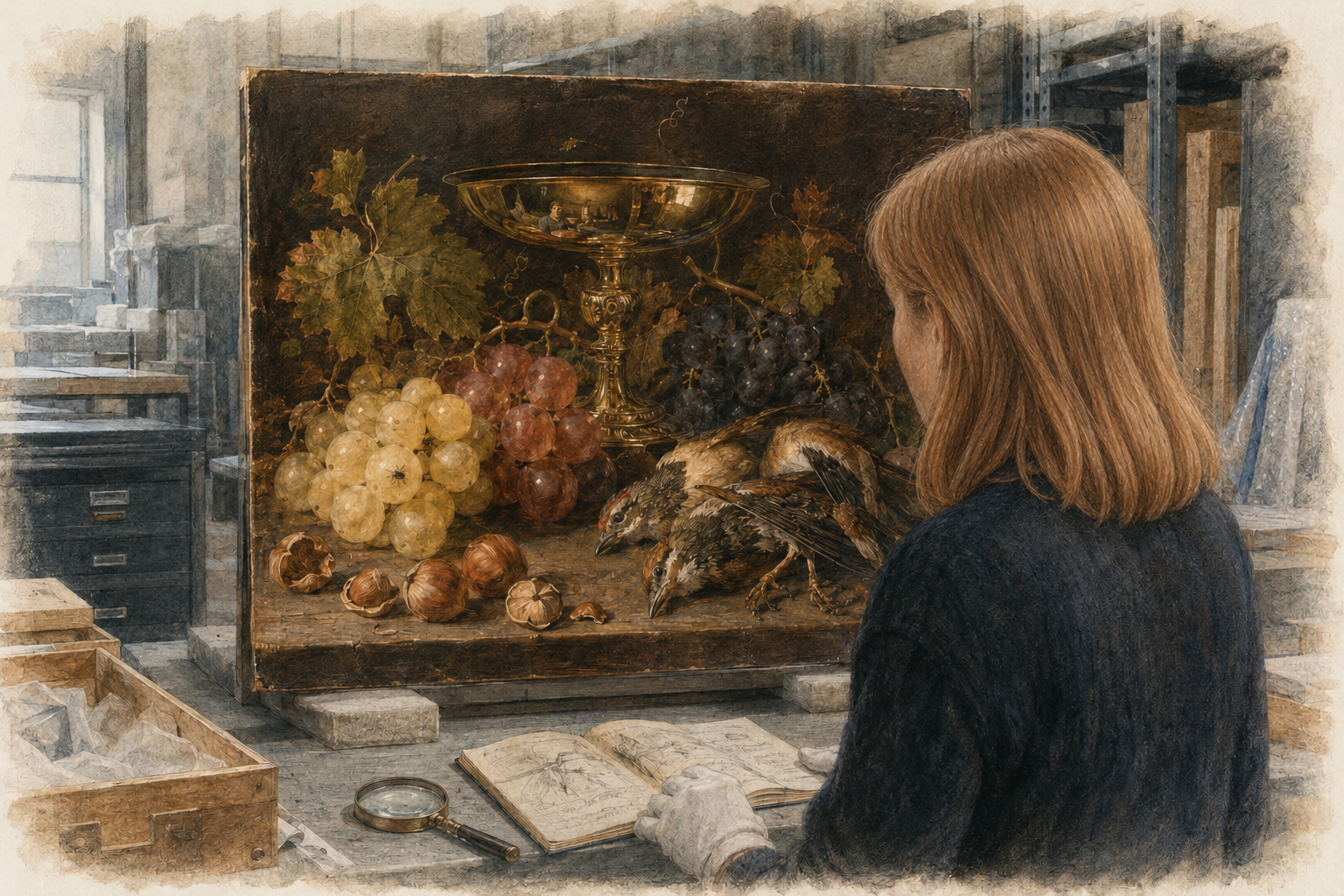
In the storage area of Norway’s National Museum in Oslo was a still life that had attracted little attention for many years. It depicts nine small dead birds, grapes, apricots and hazelnuts, together with a gilded tazza – a shallow dish raised on a tall stem. Even a fly has settled on one of the grapes. Painted around 1620, the work was once attributed to Ambrosius Brueghel. It was later catalogued as the work of an unknown artist and spent most of its time in storage. This was not a deliberate appropriation by Brueghel: the mistaken attribution arose much later in the history of art.
In 2022, curator Cynthia Osiecki encountered the anonymous painting in storage. Osiecki is responsible for Old Masters at the National Museum and specialises in sixteenth- and seventeenth-century Netherlandish and Flemish art. Her professional profile at CODART also leads to Greifswald, where she researches the Renaissance artist Jacob Binck and the spread of art inspired by antiquity in northern Europe.
Osiecki began to suspect that Clara Peeters might be behind the anonymous painting. The wooden panel came from a supplier Peeters used repeatedly. A very similar tazza appears in other works by the artist, while the handling and arrangement of the birds, grapes and hazelnuts also matched her work. Only the signature was missing. Yet woodworm had damaged precisely the lower edge – the area where Peeters frequently placed her signature.
Then came the smallest clues. Peeters repeatedly concealed miniature images of herself in shining vessels, glass and fruit. Possible human outlines can also be detected on some of the grapes in the Oslo still life. Because of old layers of varnish and previous conservation work, it is impossible to determine conclusively whether they depict the artist. The fly on the grape, however, is clearly visible – a tiny demonstration of how closely this painter observed her world. The research behind the new attribution led to the painting being officially recognised as a work by Clara Peeters in 2026.
Surprisingly little is known about the painter’s life. Her earliest signed paintings date from 1607 and 1608, and her activity can be traced into the early 1620s. She probably worked in Antwerp and was among the earliest artists to specialise in still-life painting. Belgium did not yet exist. Antwerp formed part of the Southern, or Spanish, Netherlands – a region whose political and religious boundaries were shaped by the Eighty Years’ War.
Peeters was therefore not simply painting expensive food and vessels. Ripe fruit, dead birds and gleaming metal speak of pleasure, transience and the brevity of life. At the same time, her miniature reflections wrote her own presence into an art world in which women were rarely made visible. Important works by Peeters can regularly be seen at the Museo del Prado in Madrid, the Ashmolean Museum in Oxford and the Metropolitan Museum in New York.
The rediscovered painting is now titled “Still Life with Small Game and Grapes on a Gilded Tazza”. From 8 October 2026 until 7 February 2027, it will be shown in Oslo for the first time as a work by Clara Peeters in the exhibition “Woman Painter”. The exhibition will then travel to Rome.
Perhaps that is the finest turn in this story: Peeters hid herself within her paintings, her name later disappeared behind a mistaken attribution, and Cynthia Osiecki found her again because she decided to look more closely.