The Right Sound for a Historic Place
On Rhodes, eight voices move through the medieval city. Among stone walls, traces of antiquity and the legend of the Colossus, an unusual question arises: is there a right sound for a historic place?
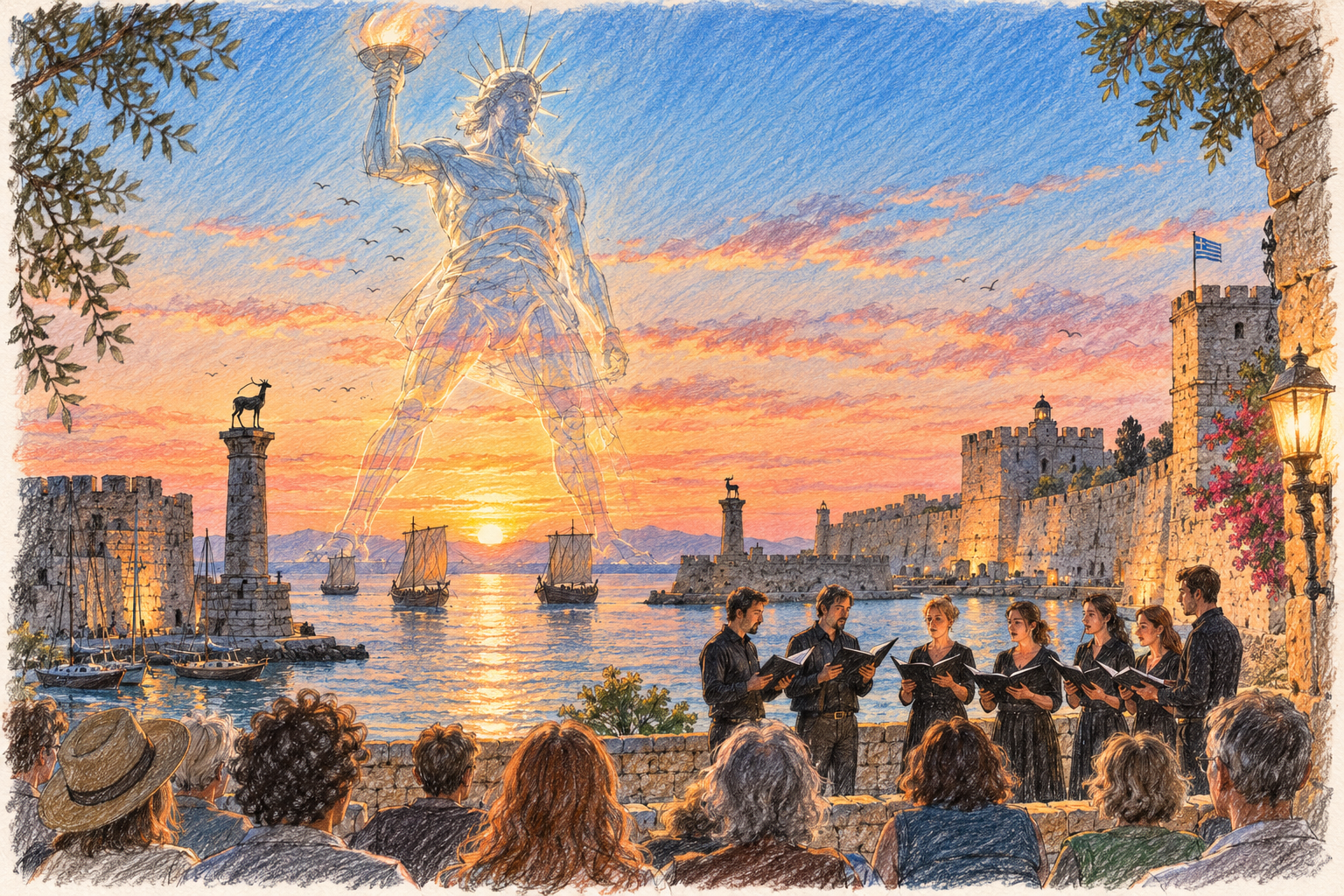
Imagine walking down a narrow lane. High stone walls rise on either side. Eight people begin to sing. A little later, the same eight voices are standing in an open square. Would you hear the same music?
Probably not. The voices have not changed. The place has.
Today the European Polyphony Festival begins on Rhodes. Until 10 October, its programme includes concerts, exhibitions and workshops. On 4 October, the Mikrokosmos vocal octet and classical scholar Spyros Syropoulos will lead a musical and historical walk through the medieval city. Along the way, they will explore how sound travels in different places and acoustic environments.
A city above a city
It would be hard to find a better place for such an experiment. Beneath the streets of the medieval old town lie traces of ancient Rhodes. The city was founded in 408 BC and grew into an important trading centre in the eastern Mediterranean.
Centuries later, the Knights of St John built their fortified city here, with walls, palaces and narrow streets. The Ottomans followed, and later the Italians. Buildings, streets and fortifications still tell stories from very different periods.
Yet the structure that made Rhodes famous even in antiquity is the one that is missing.
The Colossus of Rhodes.
More than 2,200 years ago, the enormous statue of the sun god Helios was counted by ancient writers among the most remarkable sights in their world. Lists like these were, in a way, early collections of places travellers simply had to see.
Travel was, of course, very different from tourism today. But people in antiquity still set out to see famous places, visit sanctuaries or study with respected teachers. One of them is still rather famous: Cicero.
As a young man, the future Roman politician and orator travelled to Rhodes. There he studied rhetoric with Apollonius and philosophy with Posidonius. Plutarch even tells us that Cicero delivered a speech in Greek so that Apollonius could judge his mistakes more accurately.
For an encounter with the Colossus still standing, however, Cicero arrived on Rhodes more than a century too late. The enormous statue had remained upright for only a few decades. By Cicero's time, it had long been lying on the ground.
And it was still a Wonder of the World.
A Wonder we imagine
Even so, almost everyone who has heard of the Colossus of Rhodes has a picture of it in mind: a gigantic man stands astride the harbour entrance. Ships sail between his legs.
Except that it almost certainly never looked like that. Those famous images were created long after antiquity. The surviving evidence is not enough to reconstruct exactly what the Colossus looked like or precisely where it stood.
That gives Rhodes another fascinating layer: we do not visit a historic place empty-handed. We bring our own pictures of its past with us. And sometimes those pictures are themselves centuries old.
What does the place do to the music?
Now the eight voices begin to sing again. In a narrow lane, sound quickly meets stone walls and is reflected back. In an open square, it can spread differently. A large interior can let notes linger for longer. What the singers produce is therefore only part of what we hear. In a sense, the space produces the rest.
That is exactly what the festival's musical and historical walk plays with. The medieval city is not merely a backdrop for the music. Its walls, squares and streets become part of the listening experience. But that leads to a second question.
What does the music do to the place?
Imagine the same lane once more. First you hear a melody that sounds medieval. Then electronic sounds. Finally, someone sings a brand-new composition. The walls have not changed. But does the place still feel the same?
Perhaps in a medieval city we automatically expect “old” music. But why should we?
The festival itself challenges that expectation. On 30 September, the project “Odysseus” explores eight episodes from Homer's Odyssey. In Rhodes, the section “Hades” will be performed. The story is thousands of years old – the music is new. The project deliberately brings the ancient narrative together with contemporary composition.
Something similar happens again on 2 October. French composer Christopher Gibert based his work “Hymnus” on a 13th-century Occitan manuscript. An old text is given a new sound.
And suddenly our original question is not so easy to answer.
Does old history have to sound old?
Perhaps there is no single “right” sound for a historic place. Perhaps new music can make us hear something that we might have missed on an ordinary walk. And perhaps that is even more true of a legendary place.
The Colossus is gone. None of us has heard its world. We do not know what sounds surrounded a visitor walking through the harbour of Rhodes more than 2,000 years ago. Even the famous image of the Colossus in our minds does not come from its own time. Yet we can still try to imagine the place.
People in antiquity made lists of things worth seeing. More than two thousand years later, the festival invites us to discover Rhodes with our ears as well.
What should you have heard at a historic place?
And if you could choose a sound for a historic – or even legendary – place: What would it be?