The town that gave its name to a sea
Adria is now around 25 kilometres from the coast, although an entire sea was most likely named after the town. ADRIKÀ follows water through archaeology, landscape and film, all the way to a Roman boat that really was sewn together.
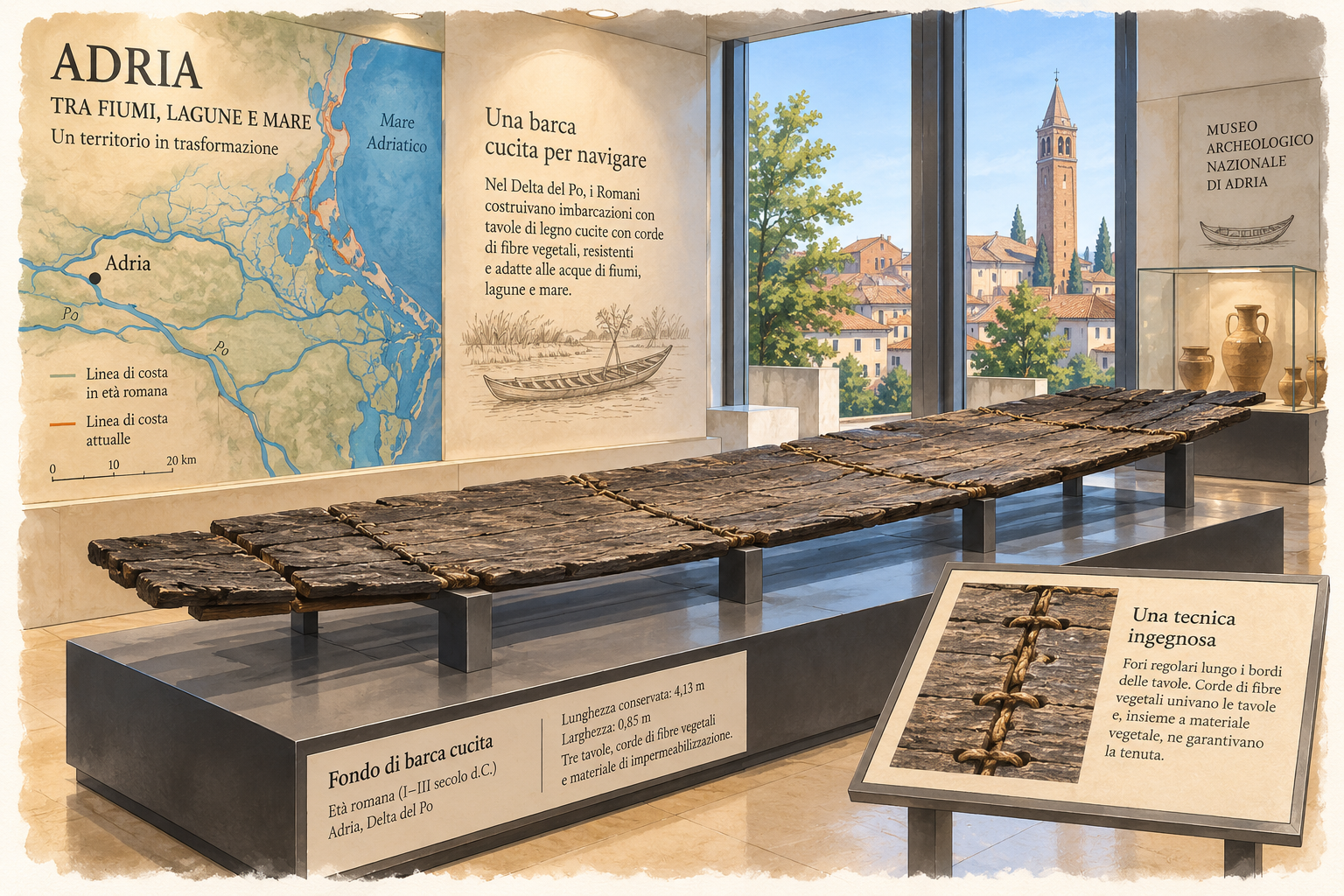
Anyone setting off from Adria for a day at the seaside had better not simply sling a towel over their shoulder and start walking. Today, around 25 kilometres separate this northern Italian town from the Adriatic coast.
That is rather surprising in a place called Adria. After all, the town most likely gave its name to an entire sea: the Adriatic. At first, the name probably referred only to the northern part of what we now call the Adriatic Sea. It gradually spread southwards until it came to describe the whole stretch of water between Italy and the Balkan Peninsula. The story of the name is not entirely settled, however: ancient Hadria, modern-day Atri in Abruzzo, has also been proposed as its origin.
But if Adria was once so closely connected to the sea, where did the sea go?
### When a river changes the map
Some 2,500 years ago, the landscape here looked very different. Adria lay close to a lagoon and was well connected to the sea by waterways. In the sixth and fifth centuries BC, the town developed into an important port. Greek goods travelled from here into the Po Valley; wine, oil, pottery, metals, salt and amber were all part of a trading world that connected Adria with distant regions.
But rivers carry more than water.
The Po and other rivers in the region carry sand, silt and other sediment towards the sea. Over centuries and millennia, this material is deposited. New land forms, river channels shift, lagoons silt up and the coastline moves. Between ancient Adria and the coast of today, old dune ridges can still be found – traces of former shorelines.
The name of the sea remained.
So did the town.
Only the sea moved away.
### Archaeology in a landscape shaped by water
This remarkable landscape is at the heart of ADRIKÀ, the International Archaeological Film Festival in Adria and the Po Delta, from 9 to 13 September 2026. More than 40 events are taking place in Adria and elsewhere in the region: films from different countries, conversations with archaeologists and filmmakers, exhibitions, guided tours, workshops and visits to archaeological excavations.
The theme of the festival's second edition could hardly be more fitting: water.
And this is about more than rivers and the sea. Water also tells stories of journeys, memory and the ways people have used and transformed this landscape for thousands of years.
Sometimes archaeology uncovers things that make you look twice.
A sewn boat, for example.
### Wait – can you sew a boat?
Apparently, yes.
In the early 1980s, the bottom of a Roman river boat was excavated at Corte Cavanella near Loreo. It consists of three wooden planks laid side by side. Along their edges, archaeologists discovered regularly spaced holes.
Cords made from plant fibres had been threaded through them. Together with plant material used for caulking, they held the planks together.
So the boat really was sewn.
The surviving section is just over four metres long and only 85 centimetres wide. Following restoration, it is now housed in the National Archaeological Museum of Adria. For ADRIKÀ, it is almost a symbol: an object that tells of people moving through a waterscape in which Adria was still directly connected to the sea by rivers and lagoons.
### When ancient images learn to move again
ADRIKÀ brings these finds together with a medium that at first seems much more modern: film.
During the festival, the museum opens an exhibition with the Italian title “E l’immagine prese vita” – “And the image came to life”. It traces the long history of human attempts to capture movement in images, from archaeology to the techniques that eventually gave rise to cinema.
ADRIKÀ brings archaeology, film and water together in a place where even the landscape itself tells a story of movement. Rivers shift their channels. Sediment creates new land. A port town gradually loses its coastline. Archaeologists bring a sewn boat back into the light. And films make people, places and finds come alive again before our eyes.
That makes Adria an especially fitting place for a festival about archaeology and water. Landscapes change, but names can travel for an astonishingly long time. The name of this small Italian town stands out in large letters on maps as the name of an entire sea.