The Moment That Travelled Around the World
Fifty years ago, Manel Armengol photographed police violence at a Barcelona demonstration. Now Revela’t, an analogue photography festival in Vilassar de Dalt, is honouring him as the region recovers from heavy rain.
Vilassar de Dalt, 16 October 2026 – Cameras, rolls of film, photographic paper and pictures that tell stories: the international Revela’t photography festival begins its main weekend on Friday in the Catalan town of Vilassar de Dalt. Until Sunday, photographers, artists and visitors with a special interest in analogue photography will meet for exhibitions, workshops and conversations. At the centre of it all is a man whose pictures travelled around the world fifty years ago: Manel Armengol. On Friday the festival will present him with its Silver Distinction.
This year's festival takes place against an unusual backdrop. Heavy rain in early October damaged roads, brought down walls and filled streams with debris across the coastal Maresme region. In neighbouring Vilassar de Mar, a concert and a theatre performance even had to be postponed. Meanwhile, preparations for the festival weekend are continuing in Vilassar de Dalt.
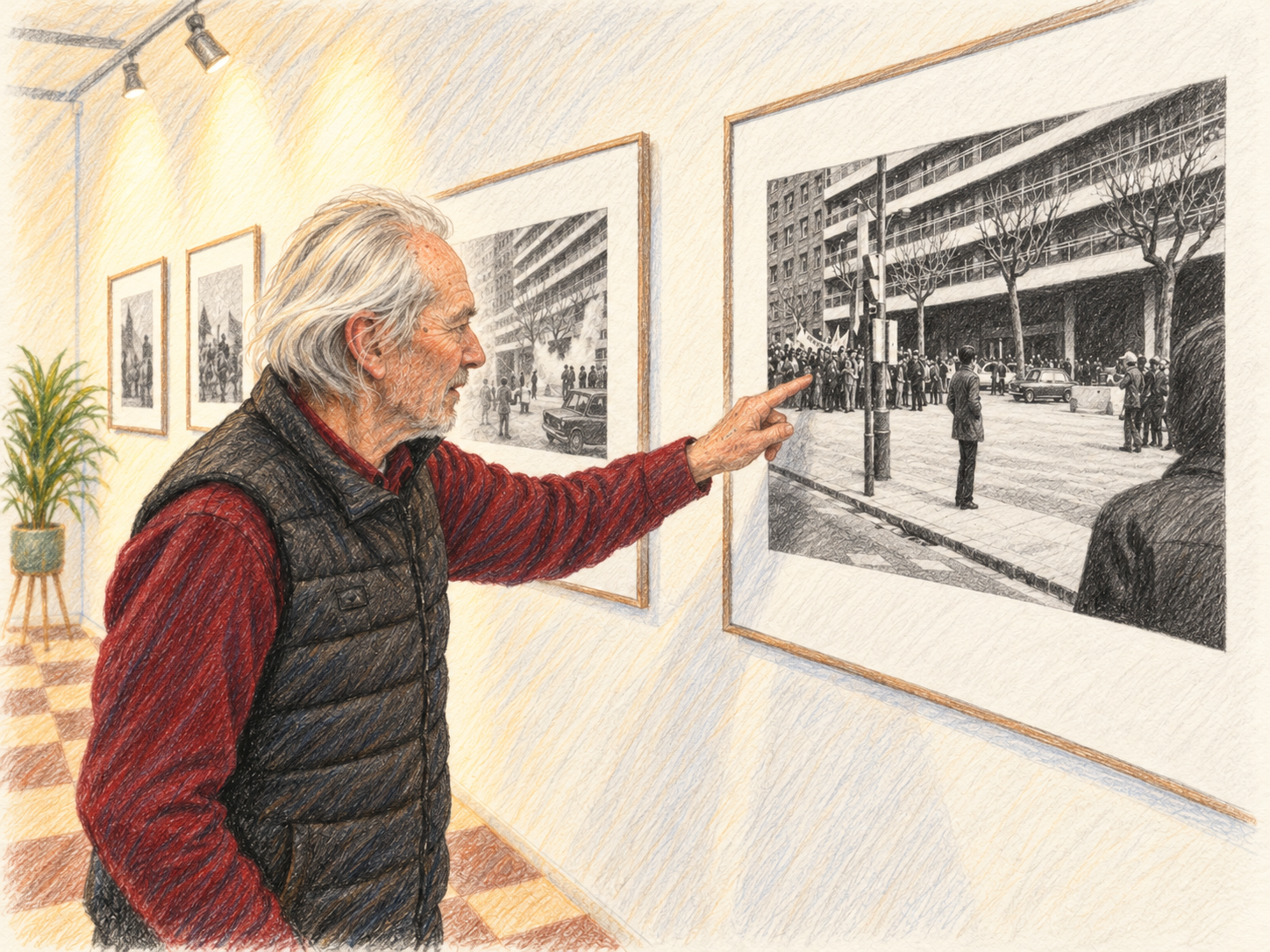
One of its venues is Cal Garbat, a former factory. Here Armengol is showing Manifestacions a Barcelona, 1976, an exhibition that takes visitors back to a time when Spain had only just begun to emerge from decades of dictatorship.
A young man with a camera
Manel Armengol was born in 1949 in Badalona, near Barcelona. In the early 1970s he began working as a journalist, reporting on life in his home town's neighbourhoods. He wrote about social problems and took pictures to illustrate his articles. Nothing then suggested that he would one day become one of Spain's best-known photojournalists.
On 1 February 1976, his life changed.
Just over two months earlier, the Spanish dictator Francisco Franco had died. But the country was far from being a democracy. Political prisoners were still behind bars, and police continued to crack down on demonstrations they did not approve of.
That Sunday, large numbers of people gathered in Barcelona to demand freedom and an amnesty for political prisoners. Armengol was there with his camera.
On the Passeig de Sant Joan he watched police officers charge at protesters. Some people were sitting on the road, trying to protect themselves from the blows. Armengol pressed the shutter.
One of his photographs shows a police officer raising a truncheon over a group of people. Among them is the peace activist Ferran Garcia Faria, holding his hands over his head to protect himself.
It is a disturbing image. It also challenged the idea that state repression had ended with Franco's death.
Pictures that took an unusual route
Armengol wanted his photographs published. But the Barcelona editors to whom he offered them feared political repercussions. Printing the pictures seemed too risky.
So the young journalist looked for another way.
At a newsstand he copied the addresses of foreign newspapers and magazines. He made up packets of photographs and went to Barcelona airport. There he approached passengers flying to Paris, London and other international cities. Some agreed to take his pictures and mail them to newsrooms once they were abroad.
It is an extraordinary story from a time without the internet, smartphones or digital image transfers. Today a picture can reach the other side of the world in seconds. Armengol needed real people to carry his envelopes across a border.
His ingenuity paid off.
The photographs appeared in publications including The New York Times, Paris Match, Time and Der Spiegel. The American newspaper later sent him a clipping of his published photograph and a cheque for 150 dollars.
Suddenly, editors abroad knew his name. What had begun as a journalist's record of a demonstration became a new career. Armengol went on to work as a photojournalist, reporting in the following years from places including the United States, China, Portugal and Algeria.
His 1976 images became important records of what Spain calls the Transición: the transition from dictatorship to democracy.
From police batons to warriors of stone
But Armengol's photographic career was about to take another unexpected turn.
In 1980 he suffered a serious accident. After a long recovery, he gradually left behind the hectic work of press photography and turned towards other subjects.
He was particularly fascinated by the architecture of Antoni Gaudí. Unusually shaped chimneys and ventilation towers rise above the roof of Casa Milà in Barcelona. In shifting light and shadow, they can resemble mysterious figures or sentinels carved from stone.
Armengol turned them into a photographic series, El jardí dels guerrers – “The Garden of the Warriors”. It was published as a book in 1987.
Later he increasingly turned his camera towards nature. He photographed plants, ancient olive trees and landscapes. In Herbarium he explored the patterns and structures of unassuming vegetation. His work on water, wind and Iceland's volcanic landscapes opened up further visual worlds.
The photographer who had once documented violence in Barcelona's streets became an artist who also paid attention to quiet things.
One skill, however, remained unchanged: looking closely.
An ancient olive tree tells a different story from a political demonstration. Yet both can reveal changes that have unfolded over many years.
Fifty years later
Manel Armengol is no stranger to Revela’t. In 2015 he presented an exhibition of landscape photographs at the festival. Now it is honouring his life's work with the Distintiu de Plata, its Silver Distinction.
The timing is deliberate. Exactly fifty years have passed since the demonstrations at which Armengol became an important witness to Spanish history through his camera.
His photographs remind us that Spain's path to democracy was neither automatic nor free of conflict. At the same time, his later work shows just how versatile a photographer's eye can be.
That fits a festival devoted to analogue photography. Working with film means you cannot take endless pictures and check each one on a screen immediately. Exposure, developing and printing are stages in a process that requires attention and patience.
Nor could Armengol inspect his shots on a screen in 1976. He had to recognise the decisive moment before it was gone.
This Friday in Vilassar de Dalt, he takes centre stage at a festival celebrating what this kind of photography can do. Visitors can see his historical photographs and discover an artist whose curiosity led him far beyond news reporting.
Fifty years ago Armengol had to find unusual ways to get his pictures seen. Today those pictures are part of history themselves – and people are still looking at them.