A Gumball for Your Data?
At De Betovering in The Hague, visitors trade personal information for chewing gum. With GUMLAB, Atelier ARI turns the hidden cost of sharing data online into something tangible.
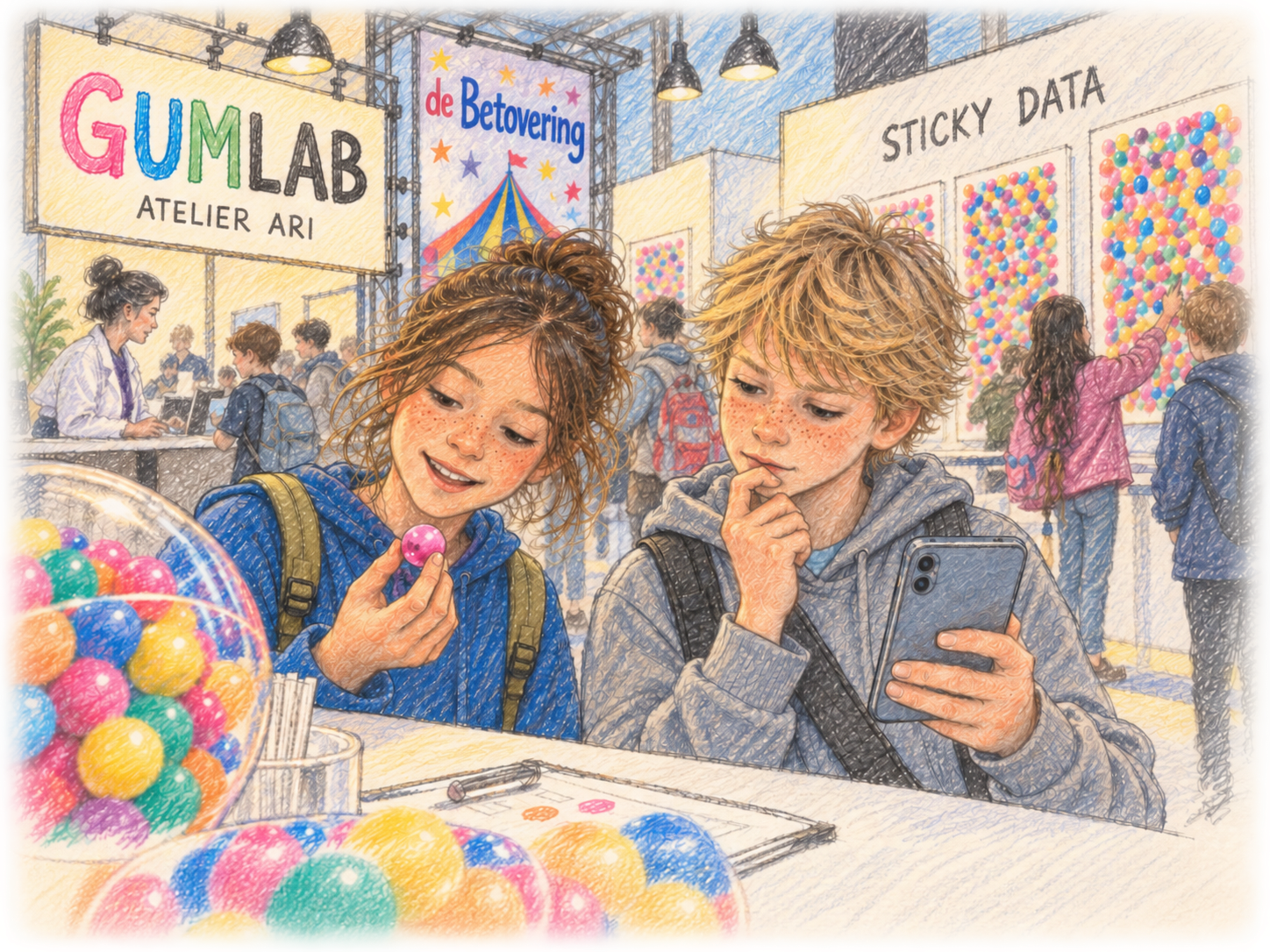
The Hague, 17 October 2026 – A shiny gumball, a few personal details and an unusual work of art: visitors to Theater aan het Spui on Saturday can strike a deal that sounds almost too good to refuse. At GUMLAB, created by the artists of Atelier ARI, information about yourself buys you a piece of chewing gum. Free of charge. At least, that's how it first appears.
The installation is part of De Betovering, the international children's arts festival bringing theatre, music, dance and visual art to around 65 locations across The Hague from 17 to 25 October. More than 400 activities are planned. Children can watch performances, try making art themselves and discover the city from unexpected angles.
But at the festival centre, an experiment awaits in which the visitor becomes part of the artwork.
A laboratory full of chewing gum
Artists Joyce de Grauw and Paul van den Berg created GUMLAB. Their studio, Atelier ARI, is based in Rotterdam. Since 2014 they have made interactive installations, sculptures and unusual architectural projects. What interests them most is what happens when people stop being spectators and help shape the art itself.
At GUMLAB, everything begins at a cheerfully decorated reception desk. Visitors share a few details about themselves and receive a gumball in return.
Next comes a room that looks rather like a medical laboratory. Participants chew until the gum has lost its flavour.
Then comes the twist: they hand the chewed gum back. It contains saliva and therefore traces of their DNA. Together with the details supplied earlier, it becomes material for a growing artwork.
The artists call their collective creation Sticky Data. It is designed as three large panels. One is already complete; visitors in The Hague can help make the other two.
What does ‘free’ really mean?
GUMLAB first appeared at an event in Oosterbeek in 2025. Even then, the artists noticed how differently people responded to the offer.
Some accepted the gum without a second thought. Others grew suspicious. Why did the artists want personal information? And what would happen to the traces left behind in the chewed gum?
Those reactions are part of the artistic idea.
Joyce de Grauw and Paul van den Berg are interested in the little bargains people make every day online. A free game asks you to register. An app requests access to your contacts or location. A social network provides entertainment while collecting information about its users.
With each of these offers, people choose what to disclose. The immediate reward can seem more appealing than consequences that might emerge much later.
GUMLAB makes this usually invisible exchange something you can hold. At first, participants have a piece of chewing gum in their hands. Later, they can see it becoming part of a work of art.
The project does not suggest that a used piece of gum automatically undergoes genetic testing. Instead, the biological traces it contains stand for the information we leave behind.
A city of new perspectives
GUMLAB fits this year's festival theme, Doorkijken: looking more closely, and looking beyond what is immediately visible.
At Theater aan het Spui, children can also make tiny finger puppets with artist Lotte Verweij and explore miniature worlds of their own creation. In the short theatre production FLY, everyday objects become the ingredients of an imaginative journey through space.
Beyond the festival centre, performances and workshops take place in libraries, museums, theatres and neighbourhood venues. The festival wants children not simply to look at art, but to ask questions, experiment and make things themselves.
At GUMLAB, they can even help create an artwork that could not exist without its visitors.
And they may leave with a rather odd thought: chewing gum loses its flavour after a few minutes. The information we willingly hand over can last a great deal longer.