A Gateway Europe Is Building Together
Twenty-three schools from twelve countries have been working together throughout the school year. At the Around Europe Festival in Pombal, that work becomes visible – from the European Arch they are building together to new partnerships for future projects.
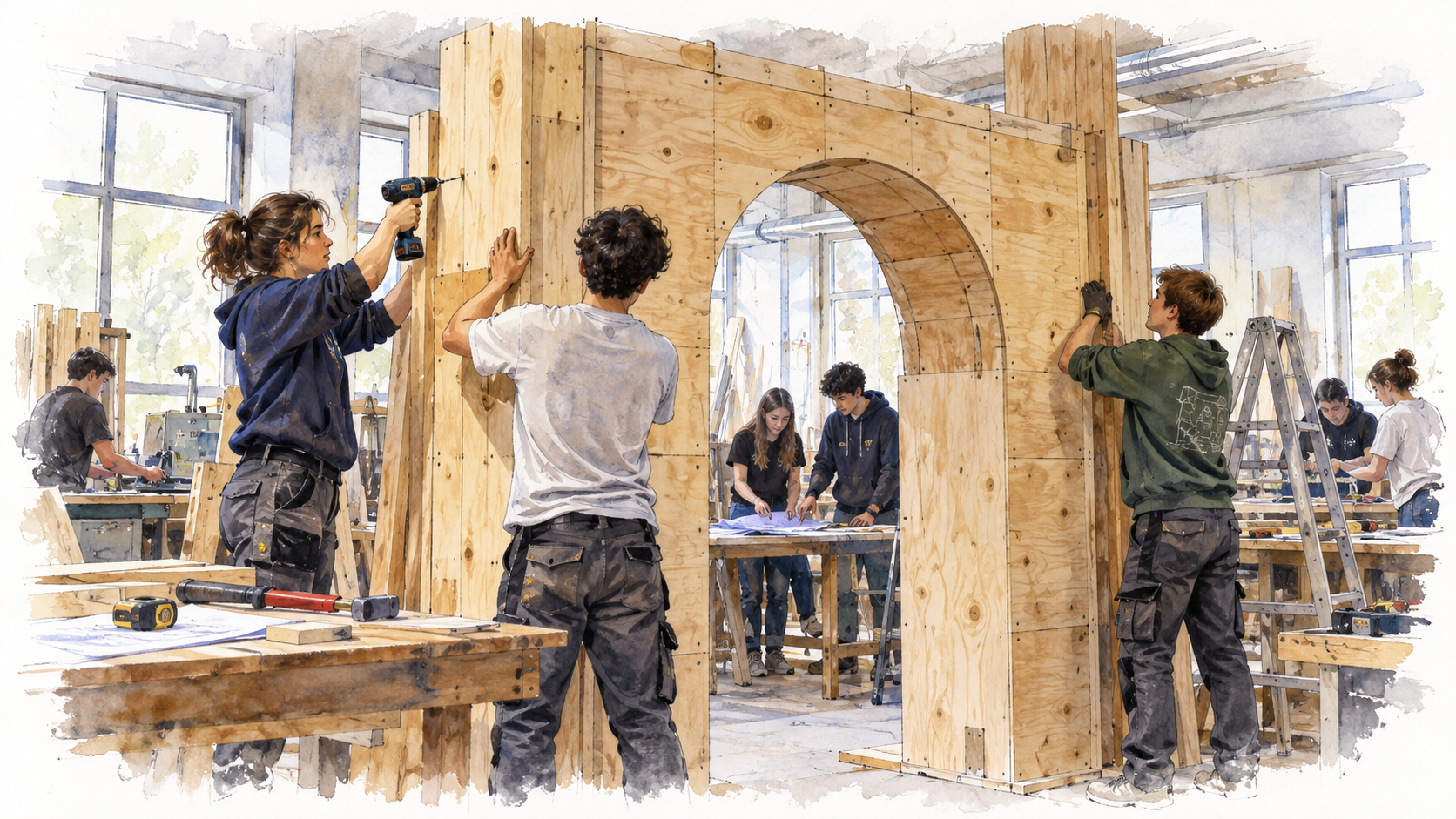
In a workshop, a wooden wall is rising. It is taller than the young people working on it. Large panels are cut, aligned and joined together. In the centre, a rounded arch is taking shape – a way through the wall.
Anyone familiar with the Around Europe Festival logo may recognise the shape. An arched gateway stands at its centre too. Now the symbol is becoming a real structure: the European Arch.
From 23 to 25 September, around 250 young people from 23 schools will meet in Pombal, Portugal. They come from twelve countries: Portugal, France, Germany, Spain, Ukraine, Greece, Türkiye, Czechia, Lithuania, Italy, Finland and Croatia. For three days, they will show what they have been working on together.
The gateway fits the festival motto: “Walls divide. Bridges unite.” Curiously, it is a large wooden wall that carries this message. But the wall does not remain closed. A passage is opening in its centre.
A festival that begins long before the festival
The schools did not start working together in Pombal. Throughout the school year, students and teachers have been collaborating across borders – online and during European encounters. In Pombal, the results of that work come together.
This is not just about art or foreign languages. The young people bring very different skills. Some are training in construction and design; others work with digital media, communication, catering or cultural mediation. The festival adds workshops, exhibitions, performances and hands-on projects. Sport, robotics and other STEM subjects are part of the programme too.
The young people are not simply guests at an event prepared for them by adults. They contribute ideas, help shape the programme and lead workshops themselves.
What does “mobility” actually mean?
Anyone exploring Erasmus+ soon encounters a rather technical word: mobility. It does not mean that someone has to be particularly good at moving around. An Erasmus+ mobility is a journey undertaken as part of a shared educational project. Students or teachers might, for example, spend several days at a partner school in another European country and continue working together there.
Such encounters are also part of the story behind the festival in Pombal. During the school year, the participating schools have not only worked together remotely; they have also developed their joint work further during European mobilities.
That changes the way the three festival days look. Pombal is not where the collaboration begins. The festival makes visible what has been growing across borders for many months.
And something can happen along the way that no project plan can fully predict: people do not merely learn about other countries. They actually work with one another.
When everyone means the same screw
And anyone working together also has to find ways to understand one another.
What language do you use in a European workshop for “hold this”, “a little higher” or “does this fit?” English can provide a common language. But when young people from twelve countries are working together, plenty of other words are likely to find their way into workshops, video calls, activities and conversations during breaks.
You can demonstrate something, point, look up a word or ask someone else. Sometimes the word that sticks is precisely the one you did not know five minutes earlier – because at that moment you genuinely needed it.
Sometimes language exchange begins exactly where nobody has prepared a vocabulary list: because people want to make something together.
The same is true beyond the European Arch. Designing a poster, preparing a presentation, programming, cooking, making music or organising an event all require different skills. Not everyone has to be good at the same thing. That is one of the strengths of projects like these.
Three days when the work becomes visible
The festival itself begins on 23 September with European workshops, a parade and an artistic evening. The second day brings further workshops and an evening with a special focus on Ukraine. The final day includes a European Youth Forum and opportunities for schools to make new connections.
Those three days in Pombal therefore become more than an ordinary school event. What was previously spread across screens, journeys, workshops and classrooms suddenly comes together in one place.
The European Arch, too, will no longer be a collection of separate pieces of timber. Young people from different parts of Europe are building a large passage together – one that people will eventually be able to walk through.
It is a remarkably tangible symbol of European cooperation.
Beyond the 23 schools
The festival also addresses larger questions: peace, exclusion, disinformation, sustainability and solidarity. One part of the programme is specifically dedicated to Ukraine.
On the third day, the focus turns to what comes next. The programme includes a European Youth Forum, “European Meetings & Partnerships” and an Erasmus+ Matching Day. Those encounters can lead to new contacts and, potentially, new joint projects.
That also makes Pombal interesting for teachers whose schools are not taking part this time.
European school projects do not have to arrive as fully formed ideas from a desk somewhere in Brussels. Schools can develop their own themes, look for partners and decide together what their students can contribute. Erasmus+ provides ways of supporting this kind of cooperation.
Nor does a school necessarily need a special “Europe club”. A joint project can begin with craft skills, music or theatre, robotics, cooking, history, environmental questions, media or languages. What matters is that young people from different schools do something together.
The workshop images from Pombal can therefore become more than a record of a festival. A teacher seeing them may begin thinking about a project for their own school and start looking for partners. The thought “Our students could do that too” can become the beginning of a new collaboration.
Then the European Arch really will have opened another way through.