A book fair without an exhibition hall: Porto reads in the open air
In the Jardins do Palácio de Cristal, books sit among the trees. Porto’s book fair mixes stalls and readings with workshops, conversations and music, turning an entire park into an open cultural space.
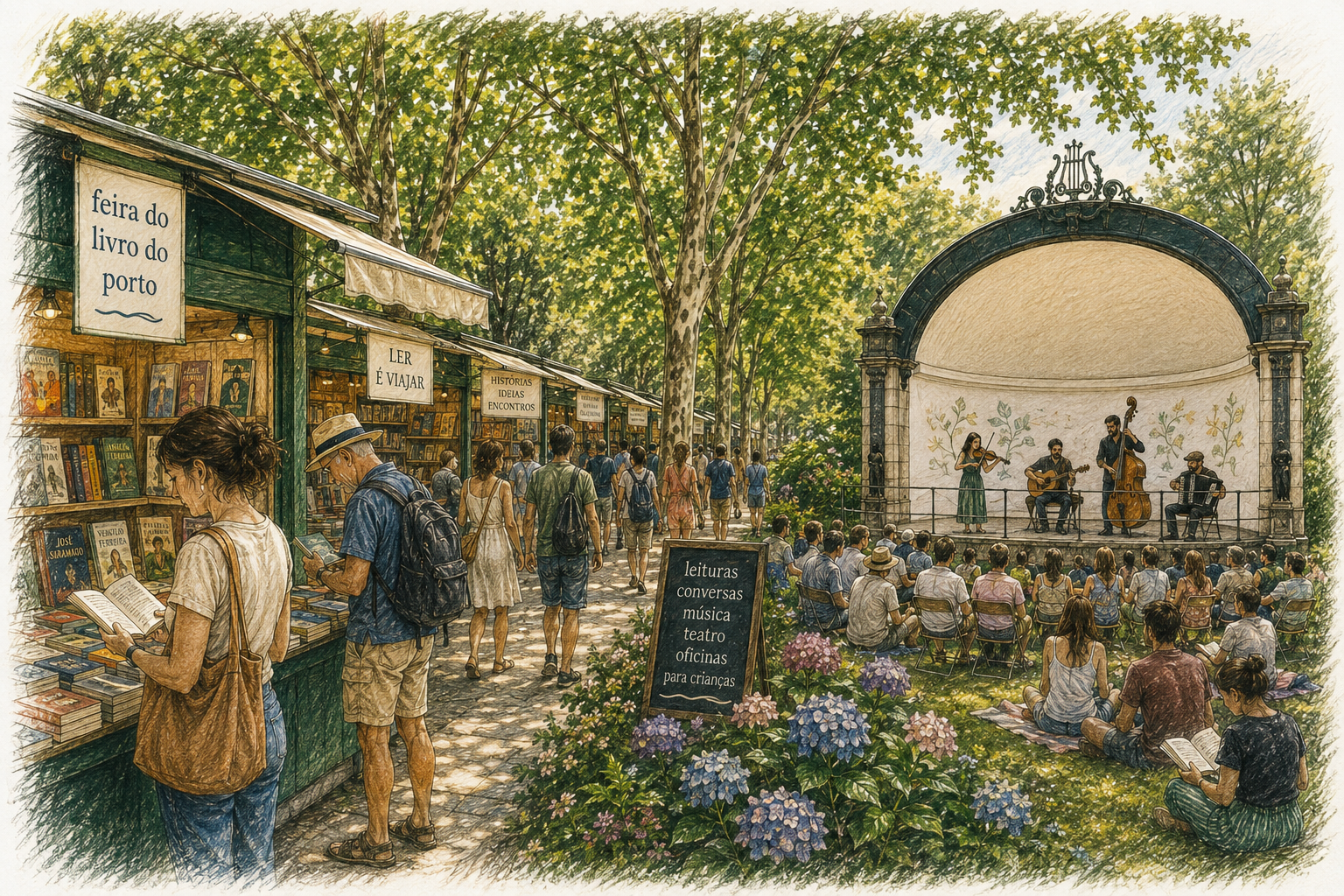
If the words “book fair” make you think of huge halls, long aisles and stands under fluorescent lights, Porto has something quite different in store.
Here, the books are among the trees.
Until 6 September, the Jardins do Palácio de Cristal become a major meeting place for readers. More than 140 stands run by publishers, bookshops and antiquarian booksellers are spread through the gardens. But anyone who came only to look for books would miss a large part of the Feira do Livro do Porto.
The name of the place is slightly misleading, by the way. There is no Crystal Palace here today. The 19th-century building, inspired by London’s Crystal Palace and conceived as a symbol of progress, was demolished in 1951. The Pavilhão Rosa Mota now stands on the site. What remained are the gardens, with their old trees, paths and viewpoints.
And this is where literature is not only read.
The programme ranges from talks, readings and book presentations to workshops, theatre, cinema, exhibitions and concerts. There are dedicated activities for children and young people as well. In the early evening, visitors are repeatedly drawn to the Concha Acústica, the open-air stage in the gardens. At that point the book fair also becomes a concert venue: literature and music are suddenly only a few steps apart.
A single visit can therefore take very different forms. You can browse books, listen to a story, make something yourself, discuss ideas – and later sit down for a concert in the park.
But is all of this still a book fair?
Porto’s answer is a fairly clear yes.
Stories do not have to stay on a printed page. A poem can be spoken or sung. A text can become theatre. An idea from a book can start a conversation. And sometimes a story may only begin when two people meet at a book stall.
The Feira do Livro therefore treats literature less as something waiting on a shelf and more as a starting point for encounters with other arts and other people.
A poet and her city
The Portuguese poet Inês Lourenço has a special place in the 2026 edition.
Born in Porto in 1942, she has remained closely connected to the city in her writing. Her works include “Cicatriz 100%”, “Um Quarto com Cidades ao Fundo” and “Dois Cimbalinos Escaldados”. The last title already leads straight into Porto’s local vocabulary: “cimbalino” is the word commonly used in the city for an espresso.
This year the fair places particular emphasis on Lourenço’s work. Nine events form part of the tribute, including an exhibition, a concert and a staged reading of one of her poems. Lourenço herself also takes part in the programme.
That fits this particular book fair remarkably well.
Her poems do not simply remain between two covers either. They are read, exhibited, performed and connected with music. Literature leaves the shelf and moves through the city in which it was created.
And perhaps that is the most appealing idea behind the Feira do Livro do Porto:
A city does not need an exhibition hall to celebrate literature. Sometimes books, people and a park full of trees are enough.