A Tiny Bead on a Great Journey
Venetian glass beads were jewellery, trade goods and part of global trading networks. PERLE 6.0 in Venice traces their routes to Spain and Portugal – opening up a much larger story about value, culture and the darker side of global trade.
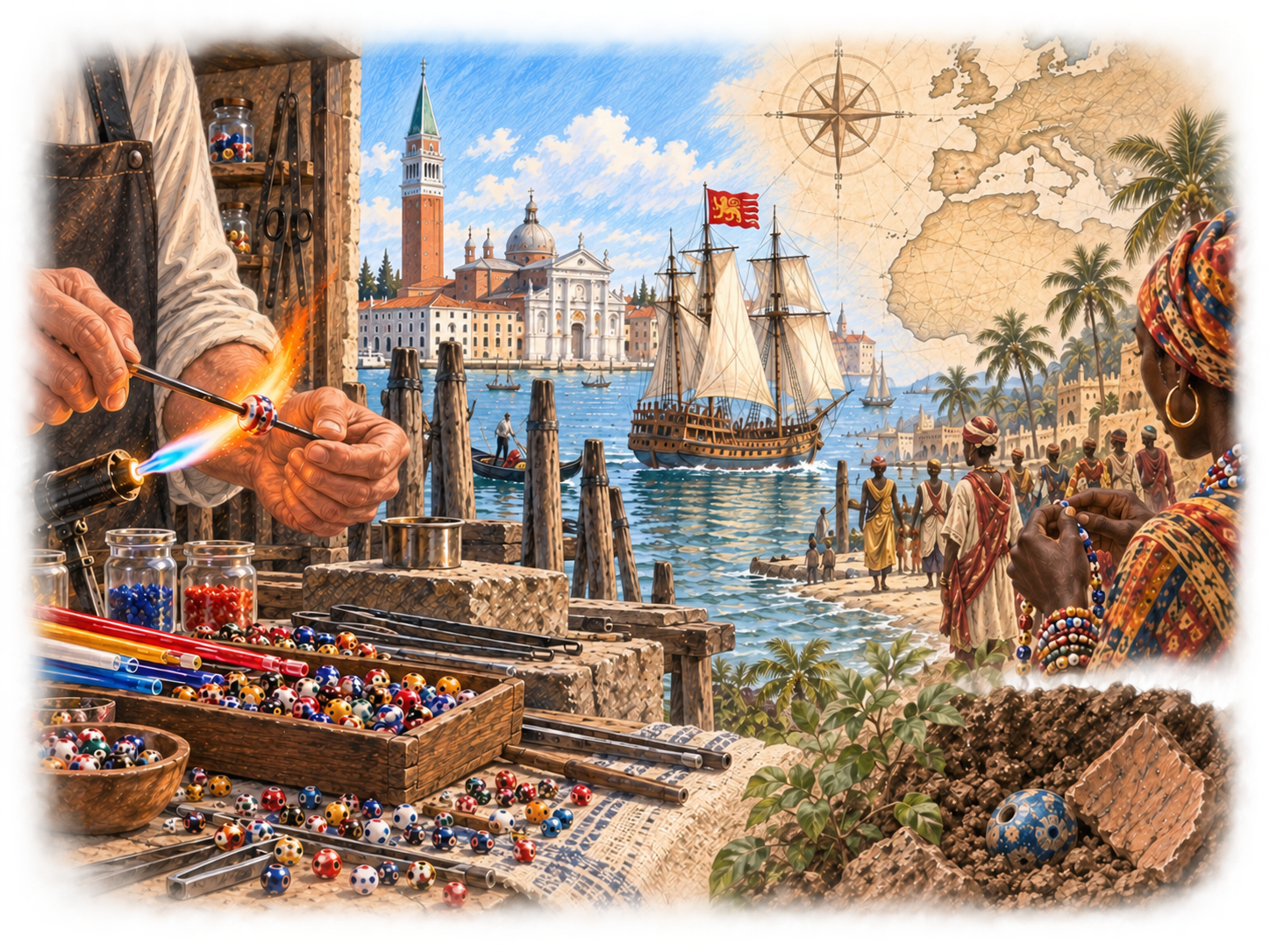
It may be no bigger than a pea: a little piece of glass with a hole through the middle, glowing blue, red or yellow. In Venice and on Murano, craftspeople have made beads like these for centuries. Some stayed in Europe. Others travelled farther than their makers could probably ever have imagined.
On 14 and 15 September, the conference “PERLE 6.0” at Venice’s Natural History Museum is exploring the trade routes of Venetian glass beads to Spain and Portugal. At first, that may sound like a very narrow subject. In fact, these tiny objects lead straight into a much bigger story: how people decide what things are worth, and how that value can change when an object passes from one culture to another.
Why take glass beads on a ship?
They were almost ideal cargo. Glass beads are small, light, durable and easy to transport in large quantities. Venetian glassmakers also mastered techniques that allowed them to produce an extraordinary variety of colours, shapes and patterns.
For centuries, Venice was one of the great centres of this craft. From there, beads travelled through trading networks across Europe. Spain and Portugal were not necessarily the end of the journey. The organisers of PERLE 6.0 themselves point out that Venetian glass beads became a strategically important commodity in the triangular trade linking Europe, Africa and the Americas. In many places, that was where a bead’s second life began.
Cheap glass for valuable goods?
Seen from today’s perspective, this history can feel uncomfortable. European merchants exchanged glass beads for goods that might have been worth far more to them. Beads were also given and traded during encounters with Indigenous societies in the Americas. Wasn’t that simply a bad bargain?
There is a problem with the question: who gets to decide what something is worth? To a European merchant, a single bead might have cost very little. Somewhere that particular kinds of coloured glass were not produced, the same bead could be rare and desirable. And the material itself was only part of the story.
Beads were sewn onto clothing, made into jewellery and incorporated into existing patterns and traditions. Colours and arrangements could signal belonging, status or other cultural meanings. A European trade object could therefore acquire a meaning of its own within another society.
Nor would it be accurate to imagine that Africans first encountered glass beads through European merchants. Different parts of Africa had their own, sometimes ancient, traditions of beadmaking, beadworking and trade. European beads entered societies that made their own choices about how to use them and what value to give them.
When trade becomes something darker
The journeys of these beads also have a far darker side. From the fifteenth century onwards, European glass beads were traded in West Africa for gold, ivory and other goods. Historical collections and research show something else as well: glass beads were among the goods used in the purchase of enslaved people. Venetian beads formed part of those trading networks. That changes the question of value once again.
A bead could be jewellery. It could express belonging or become part of an elaborate garment. It could be a trade good. And it could become part of a system in which human beings themselves were treated as commodities. A beautiful bead does not always have a beautiful history.
Today, glass beads can therefore tell us many different stories: about remarkable craftsmanship, fashion and beauty, trade, and the ways people incorporate objects from other cultures into traditions of their own. But they also tell us about the global trading networks of the early modern period, colonialism and deeply unequal relations of power.
A cannon tells a fairly obvious story about power. A ship tells a story about a journey. A bead only begins to tell its story when we ask who made it, carried it, traded it, wore it and eventually lost it. And sometimes there is one more question to ask: What was paid for with it?
And where is it today?
Archaeologists now find European glass beads thousands of kilometres from the places where they were made. Their material, colour and production technique can offer clues to their origins. Their age and the place where they are found can then help researchers reconstruct part of their journey. Suddenly, a tiny piece of glass becomes a trail.
Those are the kinds of trade routes explored by PERLE 6.0 during Venice Glass Week. And in the end, this very small bead leaves us with a surprisingly large question: If two people give the same object completely different values, which of them is right?