Around the world in one circle: Nice invites everyone to a farandole for peace
Folk-dance groups from several continents join hands in Nice. On 16 August, their farandole leads into the garden of Villa Masséna — a gesture of peace beside the names and portraits of the 86 victims of the 2016 attack.
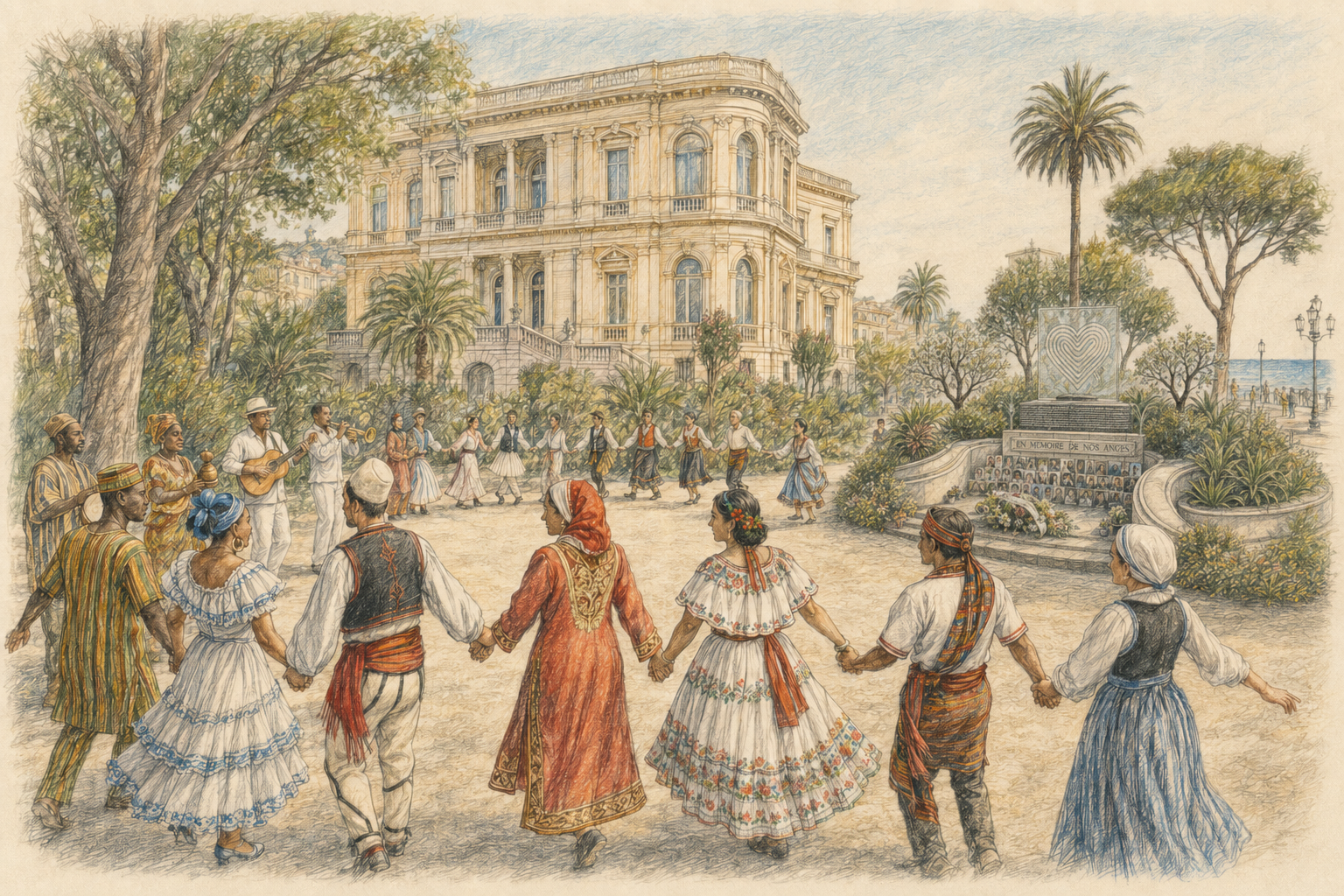
A farandole does not begin with a closed circle. People stand side by side, take one another’s hands and follow an open chain. Newcomers can join it, while the person at one end leads the movement onwards.
On Sunday, 16 August, this old Provençal dance takes on a special meaning in Nice. At 5 p.m., the groups of the international folklore festival La Farandole gather in the Jardin de la Légion d’Honneur beside Villa Masséna for a peace ceremony. Dancers and musicians from different parts of the world are not performing merely for one another. They are entering a place where Nice remembers its dead.
A garden with 86 names
On the evening of 14 July 2016, an attacker drove a lorry along the crowded Promenade des Anglais. Eighty-six people were killed and hundreds injured. Today, the garden of Villa Masséna contains a protected place of remembrance. Portraits of the victims stand in front of a low fountain. Above them, a heart carries their 86 names; the stone bears the words “En mémoire de nos anges” — in memory of our angels.
The pictures do not represent an anonymous number. They show people of different ages, relatives, friends and visitors to the city. Flowers, candles and personal tokens change, but the names and portraits remain. Speaking of peace beside them therefore demands more than a friendly ceremonial address.
The ceremony does not claim that dance can dissolve grief. Its gesture is simpler: people from different countries stand together, look at one another and move as one without covering over remembrance.
A dance that remains open
The farandole is one of Provence’s best-known communal dances. One person guides the chain in curves, winding lines and spirals across the square. Unlike a closed round dance, its form remains open. That makes it an apt image of encounter: no one needs to occupy the centre, and the line can continue to grow.
The festival has borne the dance’s name since it was founded in 1935. After a long interruption, it was revived roughly two decades after its previous edition. Today it belongs to the international network of folklore festivals associated with CIOFF, which has consultative relations with UNESCO.
In 2026, participating ensembles come from Benin, Cuba, North Macedonia, Mexico and Timor-Leste, among other places. They bring different instruments, rhythms, costumes and dance traditions. A large final gala follows that evening at the Théâtre de Verdure. Yet the ceremony in the garden is the quieter and perhaps more important part of the day.
More than colourful costumes
Folklore festivals carry a risk. A culture can be reduced to colourful clothing, a stage choreography and a few minutes of music. Differences then appear entertaining and harmless, while conflicts, inequalities and the lives behind the dances disappear.
La Farandole does not automatically escape this problem. An international dance chain cannot end a war or remove hatred. Nor should a peace ceremony pretend that every experience is interchangeable or that goodwill alone is sufficient.
Dancing together can nevertheless reveal something easily lost in political declarations: peace is not only a condition between governments. It also begins when people leave room for one another, attend to each other’s rhythm and do not seek to control the shared movement alone.
The next step
Two forms of remembrance therefore meet in the garden of Villa Masséna. The memorial preserves the names and faces of those killed. The farandole remains in motion. They do not contradict one another. Memory safeguards what must not be lost; the dance asks how people can continue living together afterwards.
In our eyes, this is the most honest message of peace possible in this place: the 86 names remain. Grief remains. The conflicts of the present do not disappear either. And yet people from different parts of the world gather beside them — not to forget what happened, but to take the next step together.