Hands, Face, Gaze and Space
Twenty minutes, two performers and no page to turn: at the Gothenburg Book Fair, Amina and Jamila Ouahid show how literature can emerge from hands, faces, gaze, rhythm and space. A short stage programme suddenly opens a much larger question: how many different things can storytelling be?
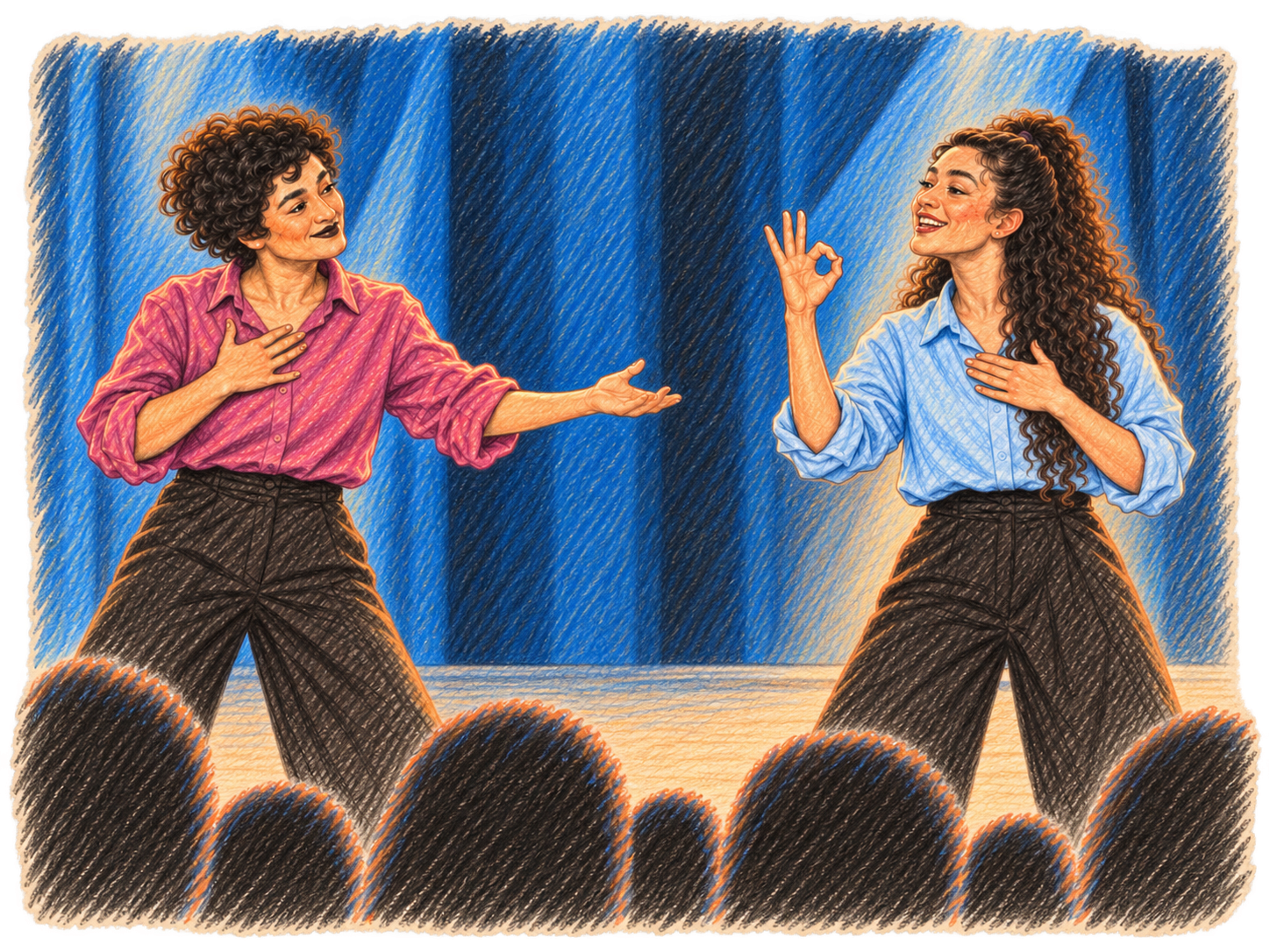
At a book fair, you expect books. Yet on this Sunday in Gothenburg there is also reading, performance, drawing and discussion about the changing shapes of stories. At 11:30 a.m., Amina and Jamila Ouahid step onto Dramascenen. They have twenty minutes, from 11:30 to 11:50.
That is barely enough time for a coffee. It may, however, be enough to unsettle a fairly basic idea of what literature is.
A stage with no car
A woman is driving. At least, that is what we see. There is no car onstage, no steering wheel and no road. Still, posture, hands, facial expression and gaze can be enough to make a journey appear.
Amina and Jamila Ouahid work, among other forms, with Visual Vernacular, or VV. In their earlier piece Unexpected Moment, one sister becomes the driver while the other takes on the landscape, objects and other parts of the scene. The roughly ninety-second story uses shifts of perspective, pace, repetition and physical expression so cinematically that an academic analysis explicitly identifies devices such as zoom and close-up.
The driver realises she is late, speeds up and crashes. For us, though, the way the story is built is at least as interesting as what happens: one sister can be the character while the other becomes part of the surrounding world. A movement can alter distance; a change in posture can alter perspective.
No car. No camera. Yet we see a journey and something that feels remarkably like the language of film.
Who is actually telling the story?
Visual Vernacular can sometimes recall mime. There too, performers can open doors that do not exist, give weight to invisible objects and create whole rooms on an empty stage.
At other moments VV can remind us of improvisational theatre. People respond to one another, roles shift and a situation can change completely within seconds. But it is not simply improv without spoken words.
In improvisational theatre, much of the excitement often lies in seeing how a story develops from spontaneous impulses. Visual Vernacular, by contrast, can be carefully composed and rehearsed; the artistic question may lie more strongly in how an action, a viewpoint or a rhythm is made visible.
A body can show a person and, a moment later, become something else. A gaze can establish where something exists in space. A change of tempo can create acceleration, repetition can add weight, and a brief pause can become as distinct as a full stop at the end of a sentence.
What film achieves through camera, editing and montage can here emerge from body and space.
Two people and the space between them
Amina and Jamila add another possibility: they tell together. That makes the space between them part of the material.
They can look at one another or past one another. One can begin a movement and the other can pick it up, answer it or oppose it. Nearness and distance can alter a relationship without a set having to be built.
Suddenly, a story is not made of hands alone. Face, posture, direction of gaze, speed of movement and the interaction between two performers all matter. Even the empty space left between them can carry meaning.
That is precisely the subject of the programme at the Gothenburg Book Fair on 27 September 2026. “Teckenspråkskonst – Litteratur i rörelse” presents sign language art as both a literary and artistic practice. Through staged examples and conversation, Amina and Jamila Ouahid show how stories, poetry and cultural memory can be carried in visual, physical and spatial form.
Where is the poem written?
With a printed poem, the answer seems simple at first. You can read a line, go back and read it again. You can underline a word, close the book and open it tomorrow at the same place.
But on what page do you find a poem whose rhythm is made of movement?
On none of them.
Swedish Sign Language is a language in its own right, but it has no generally used written form that functions like ordinary book script. Sign language art is therefore not simply Swedish text translated sign by sign into the hands.
Hands can carry linguistic meaning, but facial expression and posture are part of the form too. Gaze can establish spatial relationships, repetition can make rhythm, and movement can speed up, slow down or stop. Visual Vernacular adds particularly strong visual and cinematic techniques.
A performance can be filmed. It can be described, analysed or translated. Yet part of the work remains bound to movement, time and space.
Perhaps that is the real question raised by this Sunday at the book fair: not where literature ends, but how many forms storytelling can take.
A book fair beyond the book
The Gothenburg Book Fair is, of course, full of books. People read, discuss, browse, sign copies and look for stories they want to take home. At the same time, Dramascenen makes room for something that cannot simply be placed between two covers.
Amina and Jamila have twenty minutes. You do not have to understand every individual sign to notice something fundamental: a gaze acquires direction, a movement acquires tempo, two bodies create relationships, and an empty stage begins to mean something.
Then the twenty minutes are over. Conversations and readings continue on the other stages, people move through the halls, and Amina and Jamila leave the stage.
The space is empty again. The story has been told.