A work his audience has never heard: Hayko’s “Ararat” is performed for the first time
On what would have been Hayko’s 53rd birthday, a previously unreleased composition by the Armenian singer and composer receives its world premiere. “Ararat” bears a name of enormous significance to Armenia – but what Hayko intended to express through the work is still unknown.
Geographically, Armenia lies in the South Caucasus and is generally classified as part of Western Asia. At the same time, the country is closely connected with European political and cultural structures – among other things as a member of the Council of Europe and through its long-standing participation in the Eurovision Song Contest. Armenia is therefore certainly of interest to “News from Europe”.
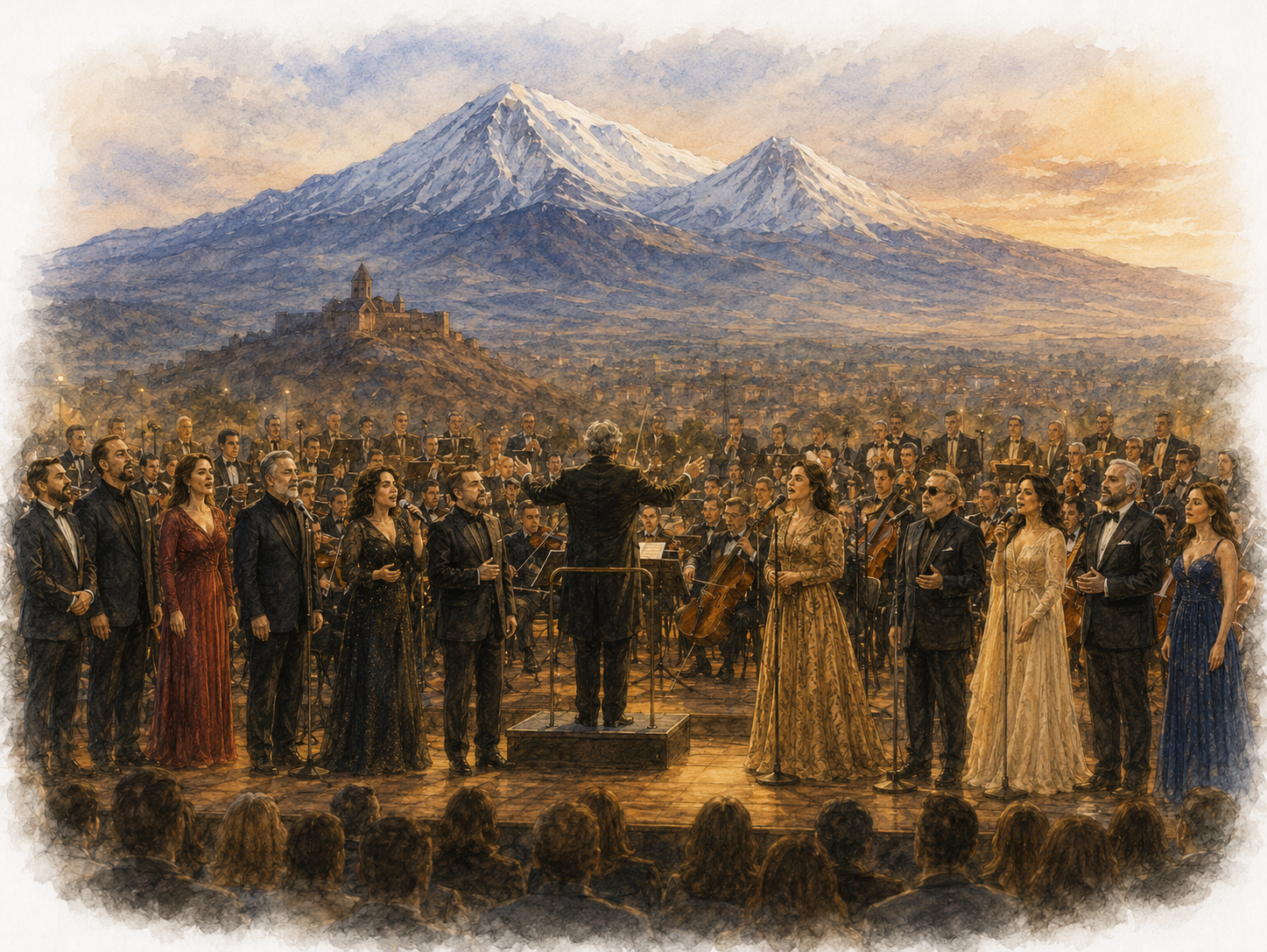
Today, 25 August, attention turns to a musical event: almost five years after Hayko’s death, his previously unreleased composition “Ararat” receives its world premiere. It happens on the very day the Armenian singer and composer would have turned 53. The “Symphonic Hayko” concert begins at 7:30 p.m. at the Adana Complex near Mkhchyan in Ararat Province.
A singer who made old songs audible again
Hayko’s real name was Hayk Hakobyan. He was born in Yerevan on 25 August 1973, received extensive musical training and studied at the Komitas State Conservatory. He became best known as a singer of romantic ballads, but his work extended far beyond that.
Part of his success came from returning to older Armenian songs and romances and giving them new arrangements. He did not try to preserve historical music in an untouched form. He retained its character while bringing it into a contemporary sound. His “Romance” recordings reached listeners both in Armenia and across the Armenian diaspora.
Hayko also became well known as a composer. His music appeared in several Armenian films, and he was named Composer of the Year in 2007, 2010 and 2011. In 2006 he had already received the state title Honored Artist of Armenia.
Europe came to know him particularly in 2007. At the Eurovision Song Contest in Helsinki, Hayko represented Armenia with his self-composed ballad “Anytime You Need” and finished eighth. An artist who was already well established in Armenia thus became visible to a large international audience.
Hayko’s importance to Europe should not be exaggerated. He was not a pan-European superstar. Something else is more interesting: his career shows how Armenian music can become part of a European musical public through competitions, concerts and the diaspora.
When his music filled Yerevan
Hayko died from COVID-19 on 29 September 2021 at the age of 48. He had previously been treated in a hospital in Yerevan. His early death prompted widespread mourning in Armenia.
The following day, his songs and film music were played in the Yerevan Metro. His music was also heard in Republic Square. Friends, colleagues and numerous fans later gathered to say farewell at the Aram Khachaturian Concert Hall.
By then, Hayko’s music had already become part of the memory of an artist whom many people associated with an entire era of Armenian pop music.
Yet it appears that his story had not been completely told.
An unknown work with a familiar name
At today’s concert, the Armenian State Symphony Orchestra under conductor Sergey Smbatyan will bring Hayko’s music to the stage together with numerous Armenian singers. The announced guests include Sona Rubenyan, Sirusho, Erik Karapetyan, Liparit Avetisyan and Gor Sujyan. Altogether, the programme names around fifteen well-known guest artists.
The most unusual item in the programme, however, is a work Hayko’s audience has never heard before.
Its title is “Ararat”.
The organisers explicitly announce the world premiere of a previously unreleased composition by Hayko. The information published so far reveals little more. There is currently no public explanation of when the work was created, what story lies behind it or what Hayko himself intended to express through the title.
That is precisely why the name attracts attention.
Mount Ararat lies today in eastern Türkiye. For Armenia, however, the mountain carries extraordinary cultural and historical significance. It is so deeply connected with Armenian identity that it even appears on the country’s coat of arms, together with Noah’s Ark.
We do not yet know what Hayko made of that symbol musically.
And perhaps that is something we should not try to explain before hearing the premiere.
Today “Ararat” becomes audible for the first time
There is nothing unusual about continuing to perform music by composers who have died. “Ararat” is different: this is not a new interpretation of a familiar work. A previously unreleased part of Hayko’s creative output is appearing before his audience for the very first time today.
That gives “Symphonic Hayko” a second meaning. The evening does not only remember a well-known Armenian artist. It also expands the body of work that can be remembered.
Hayko himself had taken older Armenian music, rearranged it and passed it on to another generation. Now something similar is happening to his own music: singers and a symphony orchestra are carrying it forward.
And at the centre of it all is a piece about which, so far, we know little more than its name.
Tonight, the audience will discover for the first time what Hayko’s “Ararat” sounds like. Perhaps afterwards we will also learn more about when and why it was created and what its title meant to its composer.
We will follow up.