When abstraction did not yet have a name: Paris rediscovers Hilma af Klint
The Grand Palais in Paris is presenting the first major French exhibition devoted to Swedish artist Hilma af Klint. Her abstract paintings began as early as 1906 – years before art history came to associate the beginnings of abstraction with names such as Kandinsky or Malevich.
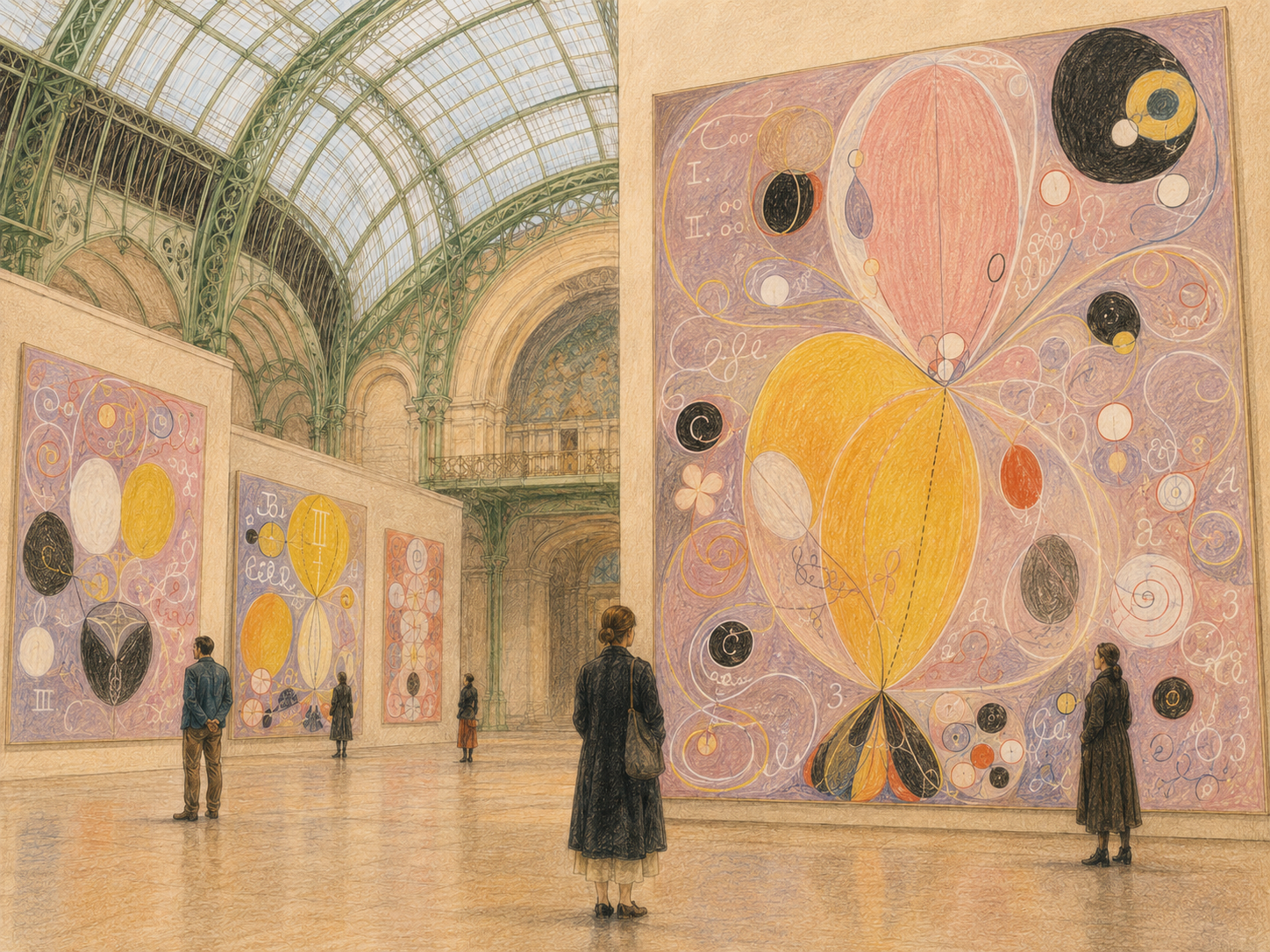
A Swedish artist at the Grand Palais
Paris offers countless places to admire art. Today, however, we are not talking about the Louvre, the Musée de l’Orangerie or the Musée d’Orsay. At the Grand Palais, attention is currently focused on a Swedish artist who for a long time remained outside the grand narrative of European modernism: Hilma af Klint.
Together, the Grand Palais and Centre Pompidou are presenting the first major monographic exhibition devoted to her in France. The dates alone are enough to make one curious: Hilma af Klint began producing large-scale abstract paintings in 1906, at a time when later art history would associate the beginnings of abstraction primarily with names such as Wassily Kandinsky or Kazimir Malevich.
Two artistic worlds
Hilma af Klint was born in Sweden in 1862 and received a classical artistic education at the Royal Academy of Fine Arts in Stockholm. She was perfectly capable of painting in the manner expected by her time. Figurative works, landscapes and botanical studies formed part of her practice.
Alongside them, however, something entirely different emerged.
From 1906 onwards, she combined geometric forms, spirals and circles with bold fields of colour and organic motifs. Many of these works still appear strikingly modern. Her major project “Paintings for the Temple” was created between 1906 and 1915 and consists of 193 works. It includes “The Ten Largest”, monumental paintings more than three metres high.
Important parts of her abstract work therefore appeared several years before the period around 1910 to 1913 that art history long associated especially with Kandinsky and other pioneers of abstraction.
Art, nature and an invisible world
These paintings did not emerge from nowhere. Around 1900, many artists and intellectuals were fascinated by new scientific discoveries, but also by spiritualism, Theosophy and the idea that connections might exist beyond the visible world.
Hilma af Klint belonged, together with four other women, to a group known as “De Fem” – “The Five”. They met regularly, experimented with automatic writing and drawing and attempted to make contact with a spiritual realm. For af Klint, art, observation of nature and spirituality were closely connected.
Perhaps that is why her paintings remain so difficult to place in a single category. They can appear rigorously geometric and organic at the same time, scientific and mystical, carefully planned and surprisingly free.
An artist waits for the future
Even more unusual is what happened to these paintings afterwards.
During her lifetime, Hilma af Klint rarely showed much of her abstract work publicly. She believed that her time was not yet ready for it and stipulated that at least twenty years should pass after her death before the works were made available to a wider audience. She died in 1944.
Her international rediscovery began only decades later. In 1986, her abstract works were introduced to a broad audience in the exhibition “The Spiritual in Art” in Los Angeles. Today, Hilma af Klint is regarded as an important figure in early abstraction.
This also changes a familiar story of art history. The point is not to remove Kandinsky, Malevich or Mondrian from their place. But their names alone are clearly not enough to tell the complete story of the emergence of abstract art in Europe.
Art history remains in motion
Art history is not simply a fixed list of great names that was completed long ago. Archives are opened, works are rediscovered and earlier judgements are questioned. In this way, our view of an entire period can change.
Hilma af Klint did not paint her extraordinary works in 2026. Many of them were created more than a century ago. What is new is the place we are now prepared to give them.
In our eyes, her story therefore also says something about Europe itself: a shared cultural heritage consists not only of what we already know. It also grows when we look more closely, rediscover forgotten voices and are willing to retell familiar stories.
The exhibition “Hilma af Klint” remains on view at the Grand Palais in Paris until 30 August 2026. Together, the Grand Palais and Centre Pompidou are presenting works including the “Paintings for the Temple” cycle in France for the first time.