Are you still hearing birds – or individual voices?
A solitary walk in the woods, a blackbird called Arne and Germany’s first bird-call imitation competition: in Landshut on Saturday, a quirky contest turns out to be all about one skill above all – listening closely.
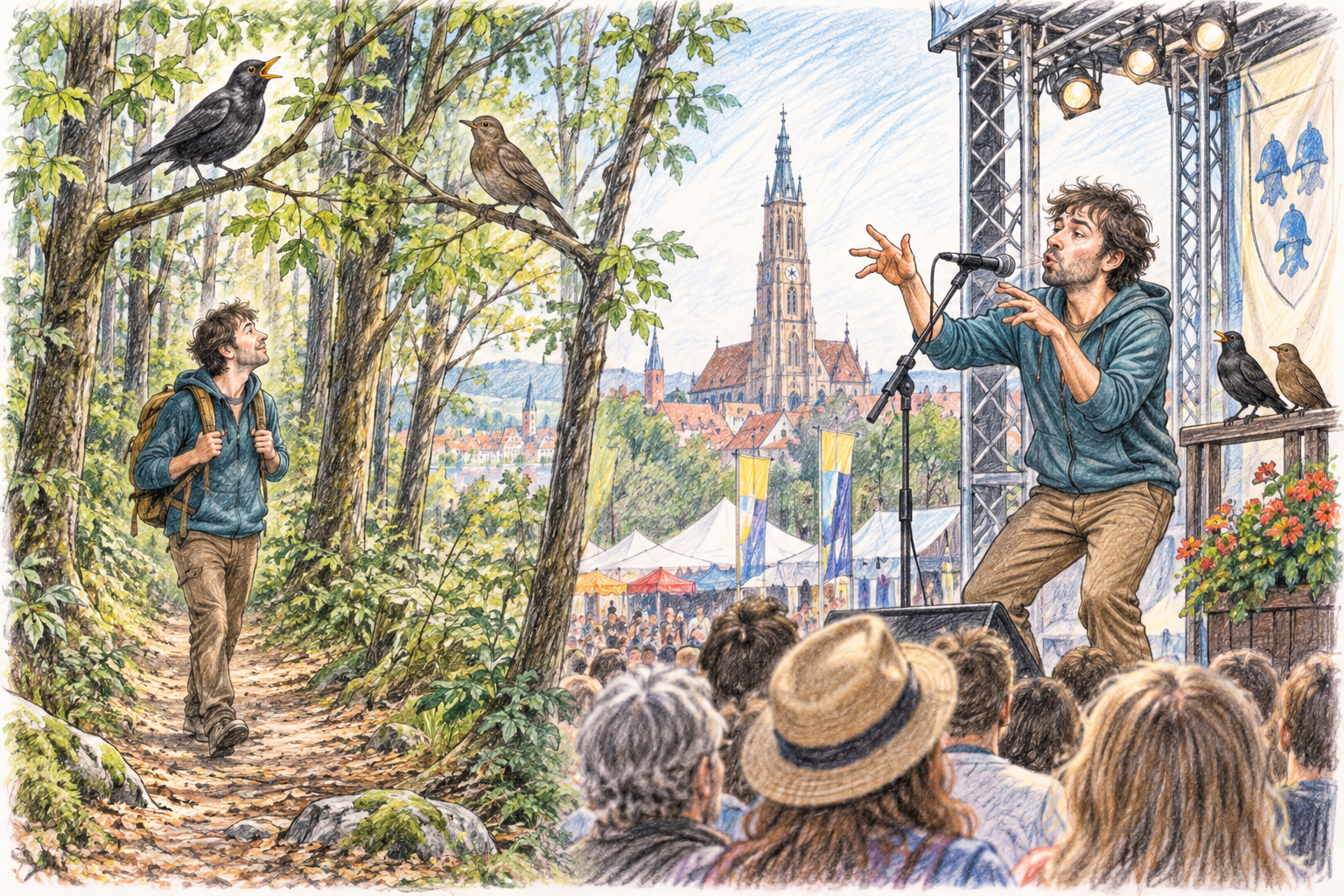
You are walking alone through the woods. It is quiet – or at least that is how it sounds at first. The trees say nothing, yet somehow they change something in you. After a few minutes, you slow down. You hear your own footsteps on the ground, leaves rustling, a branch moving somewhere nearby.
The forest speaks to you without saying a word. The birds are more direct. One whistles from the left, another answers farther away. Above you, someone is scolding furiously, though you cannot see who it is. Somewhere else, another bird seems convinced that two notes are quite enough to let the whole forest know it is there.
You do not understand a single word. But you quickly realise: they are talking to one another.
And don't you eventually feel the urge to answer? You whistle back. Just one note. Any note. Then you wait.
Does anything answer?
You probably did not make a particularly convincing bird. In Landshut this Saturday, that could be a problem.
Germany’s first championship in chirping
From 2.30 p.m. on the Jungheinrich stage at Landshut’s “Spektakel”, people are invited to try exactly that: imitating birds. The city is presenting the event as Germany’s first bird-call imitation competition.
Children up to the age of twelve compete alongside teenagers and adults. The judges are looking for bird calls that are as authentic and creative as possible, and even a costume can earn extra points. The jury includes wildlife expert Woid Woife, “Vogelphilipp” and Johannes Selmansberger from the German nature conservation organisation Bund Naturschutz.
At first, it sounds like a wonderfully harmless eccentricity – until you try it yourself. Because which bird are you actually trying to imitate?
Arne wants to impress Anissa
Take a blackbird. Let us call him Arne.
Arne is sitting high in a tree and singing. And let us suppose that Anissa is perched a few trees away. In that case, Arne's performance may have quite a lot to do with her.
Male blackbirds often deliver their melodic song from an elevated perch. It helps them mark their territory against rival males while also advertising themselves to females. Skilled singers have a large repertoire of different song phrases which they combine in ever-changing ways.
So Anissa is not simply being treated to one standard “blackbird song”. And Arne has plenty of other sounds at his disposal. A bird can sing, keep in contact, give a warning or react to danger. Once you learn to distinguish bird voices more precisely, you no longer hear only which species is hidden somewhere in the undergrowth. The sound can also offer clues about what is happening.
Suddenly, saying “I can imitate a blackbird” is no longer enough.
Which blackbird? Arne giving his big performance for Anissa? Arne arguing with the neighbour? Or Arne discovering that something in the bushes is seriously wrong?
Listening comes before imitation
That turns a little game into a surprisingly demanding skill. To imitate a bird convincingly, you first have to learn how to listen: pitch, rhythm, pauses, timbre.
Some voices are relatively easy to recognise. The chiffchaff practically gives us its name in its call. The green woodpecker can sound rather like someone laughing loudly. Other species make things far more difficult. And the starling takes the game one step further: it imitates other birds itself.
So a person on the stage in Landshut may end up imitating a bird that is itself imitating other birds. At that point, you are allowed to lose track for a moment.
But that is exactly where the interesting part begins. Before anyone can chirp, whistle, trill or scold well enough to impress a jury, they must have done something we do surprisingly rarely in everyday life.
They must have listened for long enough.
“Birdsong” turns into neighbours
Nature organisations try to teach precisely this kind of listening. On bird-song walks and in activities for children, people learn to notice calls deliberately, hear the differences and sometimes try to imitate them themselves.
Because a forest changes as soon as you begin to recognise the first voices. There is no longer simply “a bird” somewhere. A green woodpecker is calling. A blackbird is singing. A tiny wren is making an astonishing amount of noise. Eventually, you may even notice that the same bird does not always say the same thing.
Then you keep walking. The trees are just as quiet as before. The birds are singing, calling and scolding exactly as they were before.
Only you are listening differently.
And when Arne launches into his big number for Anissa from high above you, you can of course just keep walking.
Or you can answer.
But if you do, at least make a bit of an effort. In Landshut on Saturday, there is a jury listening.