In Osaka, people say “Maido!”
What do a greeting from Osaka, three small Croatian words and a walk from Porto to Santiago have in common? At Zagreb’s Festival jezika, a workshop on the Kansai dialect opens up a much bigger question: where do dialects end and languages begin?
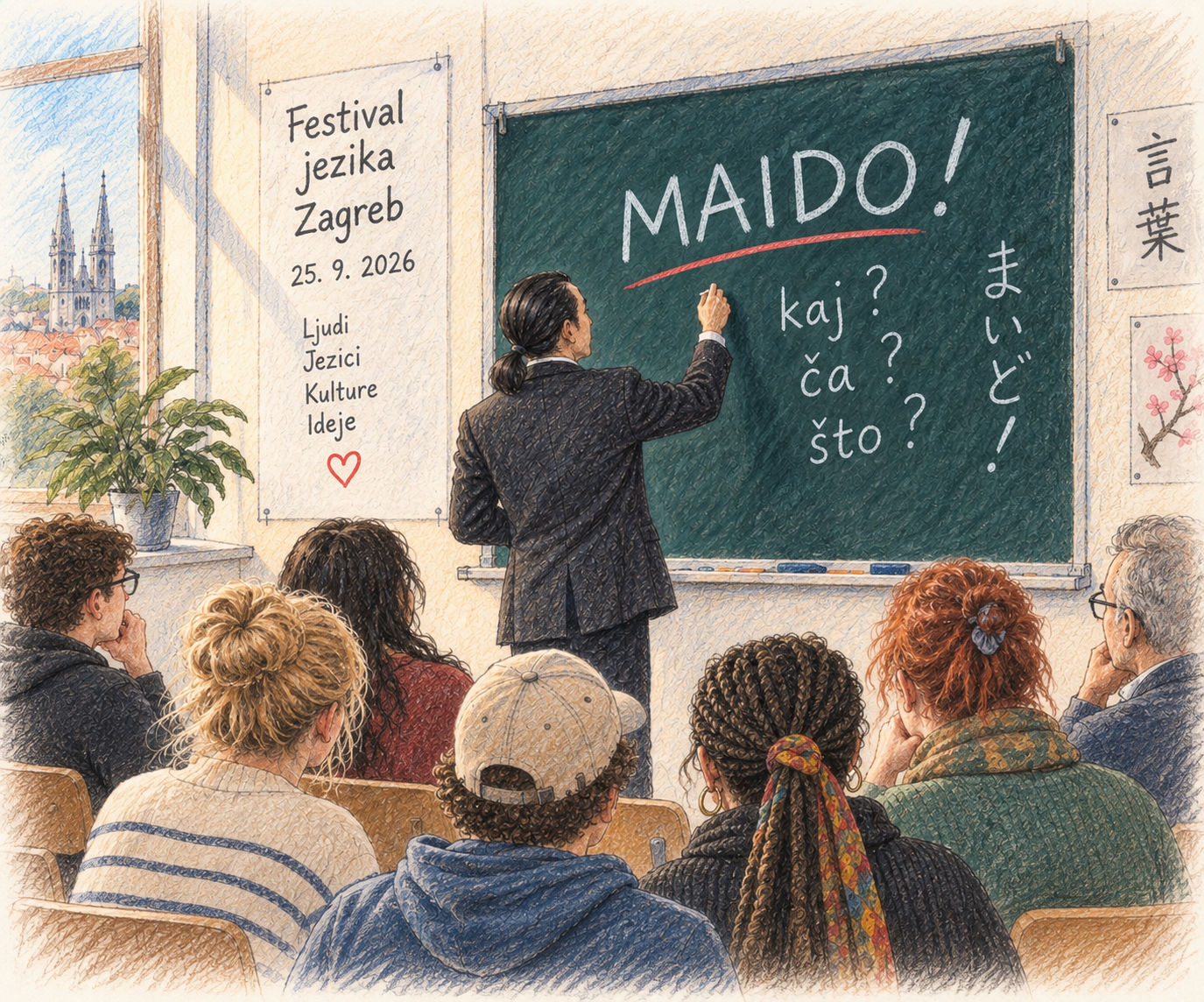
In Osaka, people say “Maido!”. At least, it is a greeting you may hear where a Japanese textbook might be more likely to offer “Konnichiwa”. And anyone sitting in a classroom at Zagreb’s Prva gimnazija on Friday, 25 September, can find out why.
At Festival jezika, a one-hour workshop is devoted to the Kansai dialect and standard Japanese. It is led by Akihito Uebayashi from the University of Zagreb and Saeko Yamauchi from the University of Pula. No knowledge of Japanese is required. That is actually an excellent starting point. To understand what this is about, you do not need to speak Japanese. You only need to have listened to people speak.
Three small words
In Zagreb, too, a language does not always sound the way it does in a textbook. Travelling through Croatia means encountering a remarkably varied dialect landscape. Traditionally, three major groups are distinguished: Kajkavian, Chakavian and Shtokavian. Their names are linked to three small words that can all mean the same thing: kaj, ča and što – “what?”
At first, that sounds wonderfully tidy. Around Zagreb you hear kaj, along parts of the Adriatic coast ča, while standard Croatian is based largely on Shtokavian varieties. There is our language map. Except that real life refuses to fit it quite so neatly.
For centuries, dialects have influenced one another. People have moved, borders have shifted and words have travelled with them. Even ča is not always enough to identify a Chakavian variety: there are Chakavian communities where što or šta is used today. A language is not a map on which three regions can simply be coloured in separately.
With Winnetou through the language landscape
This becomes particularly clear on the Adriatic. Anyone travelling from Zadar towards Paklenica may know the area for a completely different reason. Scenes from the famous Winnetou films were shot among its rocks and gorges. But this is a landscape you can listen to as well as look at.
Across the wider Zadar region, Chakavian and Shtokavian varieties meet. Places such as Privlaka, Bibinje and Sukošan are regarded, at least partly, as belonging to the Chakavian area. Over comparatively short distances, the apparently simple rule that “people on the coast say ča” turns into something much more intricate.
Perhaps that is a better way to imagine dialects: not as blocks of territory, but as landscapes. They have centres and edges, transitions and islands – and people who carry their language with them.
From Zagreb to Porto
Inside the Zagreb school, the journey goes much further that afternoon. Visitors can, for example, take their first steps in Portuguese. And that brings us back to the question that has followed us since “Maido!”: where does one variety of a language end, and where does another language begin?
Walking offers a particularly good way to think about it. Anyone walking from Porto to Santiago de Compostela will eventually cross the border between Portugal and Spain. On a map, the moment is clear. To the ear, things become more complicated.
Across the border, the walker encounters Galician. Much of it sounds surprisingly familiar. Some things recall the Portuguese heard since Porto; others sound closer to Spanish. But Galician is neither one nor the other, nor is it a mixture of the two.
Galician and Portuguese share a historical origin. In the Middle Ages, the forms spoken across what is now Galicia and northern Portugal formed a Galician-Portuguese continuum. As Portugal and Galicia became politically separated, the later standard languages increasingly developed along their own paths.
A border sign can tell you quite precisely where Portugal ends and Spain begins. Languages have no such sign. In the Galician-Portuguese border region, transitions, similarities and the effects of centuries of contact can still be perceived. The political border is a line; the language landscape is more complicated.
One language or two?
We can now place our three journeys side by side. In Osaka, we encounter the Kansai dialect and standard Japanese: different forms of Japanese. In Croatia, we meet Kajkavian, Chakavian and Shtokavian – a dialect landscape that cannot be neatly divided into three differently coloured areas either. And on the route from Porto to Santiago, we encounter Portuguese and Galician, two distinct languages that remain very close because of their shared history.
Suddenly, a greeting from Osaka leads to a much bigger question: when are two people speaking different varieties of the same language, and when are they speaking two different languages?
Simply asking whether they understand one another is not enough. A dialect can be difficult for outsiders to understand and still be regarded as part of the same language. Two closely related languages, meanwhile, can be similar enough for their speakers to understand a great deal of each other.
Literature and education matter too, as do dictionaries and media, history and political borders – and, not least, the people themselves and the way they understand and name their language. A standard language is therefore not simply the “correct” form from which dialects deviate to a greater or lesser degree. It is a variety established and developed for certain shared purposes. Alongside it, people continue to speak in the ways used by their families, towns and regions.
Sometimes a single word can reveal an entire language landscape: Kaj? Ča? Što? Or simply: Maido!
A school full of languages
And that brings us back to where our journey began: Zagreb. Festival jezika takes place at Prva gimnazija on 25 September and is now in its fourth edition. Embassies, cultural institutes, universities, schools, translators and other language specialists contribute to a programme filled with workshops, short language courses, quizzes and conversations.
It is by no means only about Japanese and Portuguese. Visitors can encounter false friends in Bulgarian and Slovak, try Hungarian board games, explore Croatian-French musical connections or discover other languages and cultures.
And somewhere in this very multilingual school, between 5 and 6 p.m., a group will be exploring why Japanese in Osaka can sound different from the Japanese found in a textbook. Perhaps someone will go home afterwards with just one new word: Maido!
That would be no small thing. Sometimes one word is enough to discover that languages are not fixed systems. They change when people speak them, travel with them, meet other languages, cross borders and still preserve something of the places where they are spoken.
It is a long way from Osaka to Zagreb, from Zagreb to Zadar and from Porto to Santiago. For a word, apparently, not so far.