Can you hear a black hole?
Rick Wakeman, once the keyboardist of Yes, premieres music inspired by black holes in Tenerife. Stephen Hawking’s unmistakable voice is part of the performance.
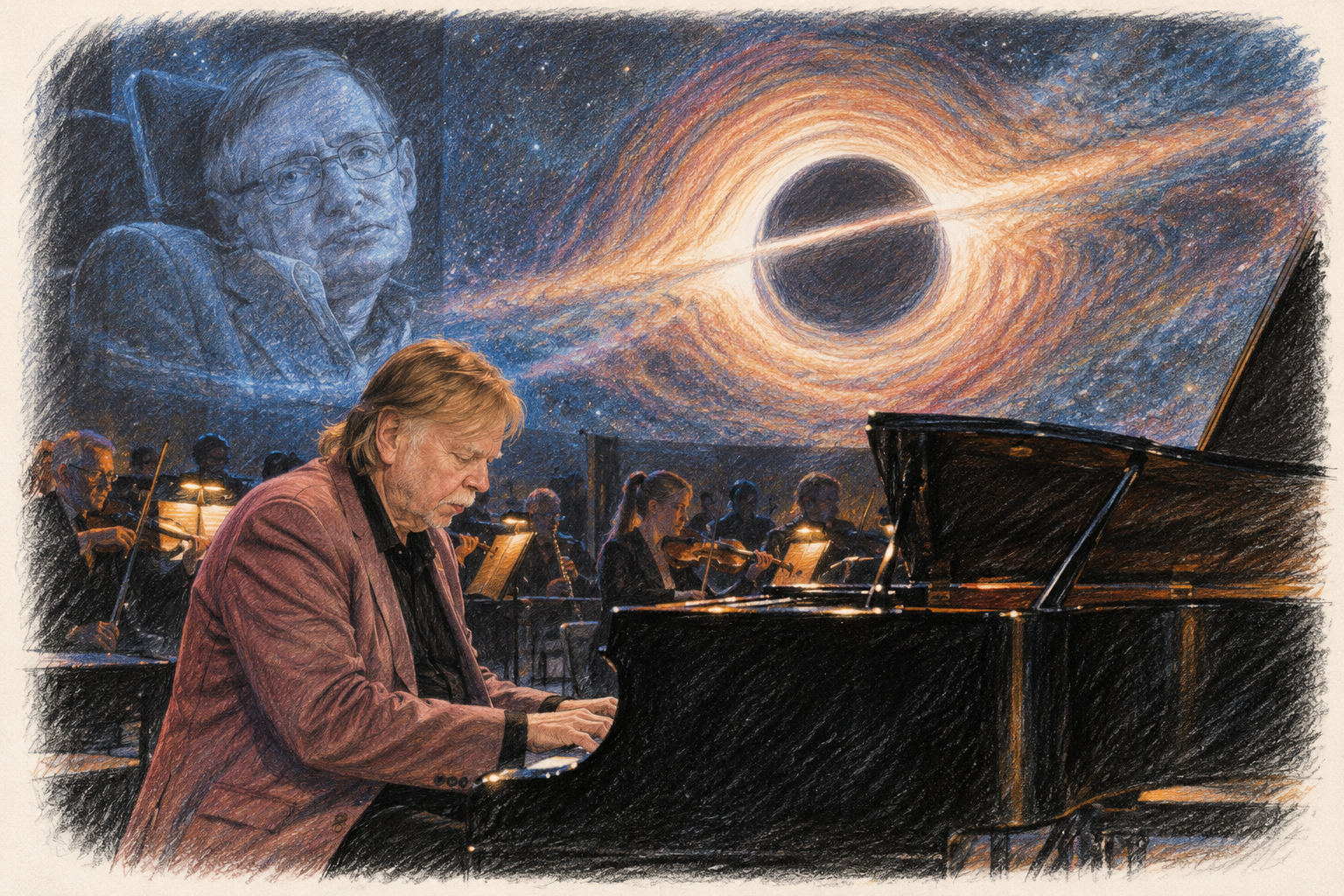
Tenerife, 18 October 2026 – A piano, a small orchestra and the unmistakable computer-generated voice of a famous physicist: on Sunday evening, the Pirámide de Arona in southern Tenerife will host an unusual musical journey. British keyboardist and composer Rick Wakeman is giving the world premiere of Echoes from Black Holes at STARMUS, an international festival of science and music. The piece explores black holes and the mysteries of the universe, and is billed as a one-off live performance.
Wakeman will be accompanied by a chamber ensemble featuring strings, flute and oboe. Specially created visual projections are part of the production. The music is expected to last around an hour, without an interval. Alongside the instruments, another voice will be heard: that of physicist Stephen Hawking, who died in 2018.
Wakeman composed the work especially for STARMUS. In August he wrote on his website about working in the studio and collaborating with conductor and orchestrator Stuart Morley. The score combines purely instrumental passages with recordings of Hawking speaking. Wakeman has not revealed exactly which of the scientist’s ideas will feature.
A musician who loves extraordinary journeys
Born in London in 1949, Rick Wakeman is one of progressive rock’s best-known keyboard players. His career is closely bound up with the British band Yes, whose musicians pushed rock beyond conventional song structures in the early 1970s.
Wakeman joined Yes in 1971. With his Hammond organ, Mellotron and an array of keyboards, he helped shape the band’s distinctive sound. On albums such as Fragile (1971) and Close to the Edge (1972), intricate rhythms, dazzling instrumental passages and compositions with several contrasting sections came together in music that ventured far beyond the usual rock single.
Tracks such as Roundabout, Heart of the Sunrise and the more than eighteen-minute Close to the Edge demonstrated what could happen when musicians refused to be confined by familiar forms. Wakeman’s keyboards were central to the sound. The music could be powerful and dramatic one moment, quiet and almost weightless the next. Those records became landmarks in the history of progressive rock.
His solo career shows the same appetite for ambitious ideas. In 1973 he released The Six Wives of Henry VIII, an instrumental album inspired by the six wives of the English king. A year later came Journey to the Centre of the Earth, a musical adaptation of Jules Verne’s novel.
For that work he combined rock instruments with a full symphony orchestra, choir and spoken narration. It was recorded at London’s Royal Festival Hall in 1974. In 1975 he turned to the legends of King Arthur, and other works followed, exploring literature, history and fantasy.
Wakeman has never been easy to confine to one genre. Rock, orchestral music, electronic instruments and storytelling repeatedly meet in his work. His latest journey leads not beneath the Earth’s surface but far into the universe.
A voice from science
Rick Wakeman and Stephen Hawking have a connection to STARMUS that predates this new composition. Both took part in the festival in Tenerife in 2014. Wakeman performed with his band and Queen guitarist Brian May, while Hawking spoke about the origins of the universe and black holes. Both also appeared on the festival programme in 2016. Music and astrophysics were meeting there long before this particular work was conceived.
Hawking was not only one of the most recognisable theoretical physicists of his generation but also an outstanding communicator of scientific ideas. His research explored black holes and the problem of reconciling gravity with quantum physics.
One of his most important insights was that, according to quantum theory, black holes need not be completely black. They can emit an extraordinarily faint form of radiation, now known as Hawking radiation.
Because of a serious illness, Hawking was unable to speak naturally for many years. His computer-generated voice became famous around the world. It was an essential part of his public identity, allowing him to give lectures, present books and communicate with others.
Hawking held a special place at STARMUS. In 2016, a medal for science communication bearing his name was awarded for the first time in Tenerife. Ten years later, the festival has returned to the islands. With Hawking’s voice woven into Wakeman’s music, scientific thought and musical imagination meet again.
Turning the invisible into music
But what does a black hole actually sound like?
Not like an ordinary sound we might hear with our ears. Sound waves need a medium through which to travel. The near-vacuum of space means we cannot simply listen to a black hole from afar.
Nor can we directly see the black hole itself. Its gravity is so strong that no light can escape from within its event horizon. Instead, scientists study how matter behaves around it and how its gravity affects nearby objects.
So the piece performed in Tenerife is not a recording made inside a black hole. It is Wakeman’s artistic response to the challenge of expressing such mysterious objects in music.
Exactly what sounds he has chosen will remain a surprise until the premiere. Perhaps there will be long, sustained textures, isolated piano notes or sweeping orchestral passages. His earlier work certainly shows how many different musical colours he can draw upon. What we do know is that the new composition is conceived as one continuous performance rather than a series of separate concert numbers.
Beneath the skies of the Canary Islands
Few settings could be more appropriate. The Canary Islands are among Europe’s most important centres for astronomical observation. On Tenerife and La Palma, altitude, favourable atmospheric conditions and protection from artificial light help scientists study the night sky.
STARMUS was co-founded in 2011 by astrophysicist Garik Israelian and Queen guitarist Brian May, who also holds a doctorate in astrophysics. Ever since, the festival has brought researchers and artists together so that science can be experienced through more than lectures and technical discussions.
The eighth edition is called The Search for Truth. From 17 to 22 October, scientists, astronauts and musicians are gathering on Tenerife and La Palma. While talks and debates pursue scientific explanations, a concert can offer another kind of encounter, through images, emotion and sound.
Throughout his career, Rick Wakeman has written music about queens, kings, imagined worlds and a journey to the centre of the Earth. Now he turns to a phenomenon from which even light cannot escape. On Sunday, inside a modern concert hall in Tenerife, his musical vision will take shape. Between piano, orchestra and Stephen Hawking’s words, something may emerge that neither a scientific lecture nor a concert could convey quite so well on its own: a meeting with the universe without ever leaving Earth.