Kratt – an old legend reimagined
An old figure from Estonian folklore becomes a ballet, is reimagined by more than 400 young dancers – and even lends its name to artificial intelligence. What remains the same through all those transformations?
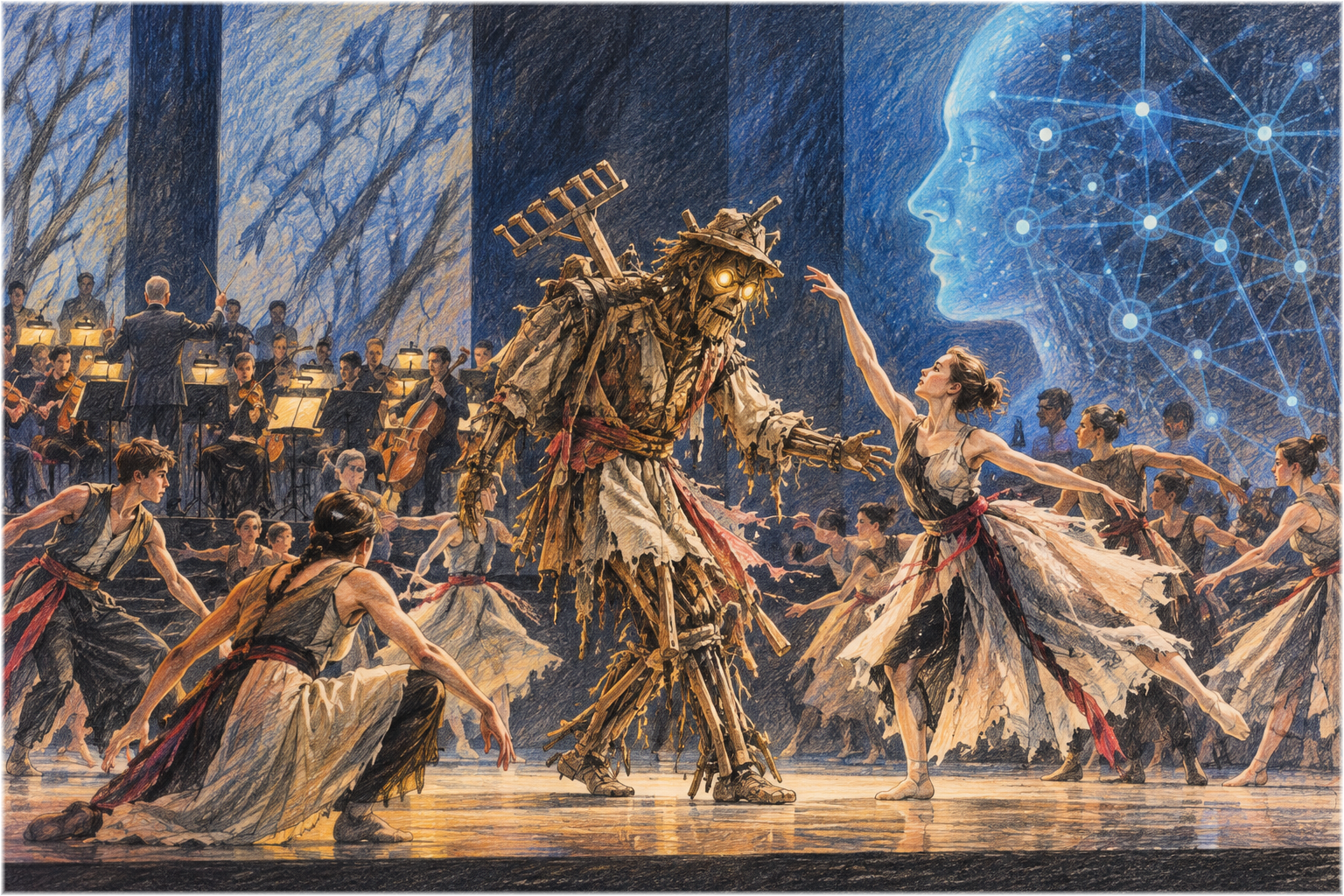
Two days ago in Tallinn, our story was about Eduard Tubin himself and whether music can reveal something about the person who wrote it. On Sunday, the TubIN Festival moves to Tartu. Tubin is on the programme again, but this time the focus is not the composer as a self-portrait. It is a figure that haunted Estonian stories long before him and now survives in an entirely different world: the Kratt.
What exactly is a Kratt?
If a legendary creature from northern Europe immediately makes you think of an Irish leprechaun, you are not completely wrong – but the comparison only gets you so far.
In Estonian folklore, a Kratt is a man-made helper and treasure-bringer. A person builds it and expects it to bring wealth to its owner. Old stories can be surprisingly specific about the materials: whatever happens to be available. In one tale, a spindle, a large needle, old sleeves, pieces of coal and parts of a harrow are assembled into the creature. Once brought to life, the Kratt immediately demands work.
The convenient part of the story does not last long. A Kratt does not create wealth; it brings it from somewhere else. In many versions, its owner must also pay a very high price for this supernatural servant: his soul. The stories could therefore carry a social warning as well. Someone who became rich without any visible work could quickly attract suspicion, and wealth gained at other people’s expense acquired a vivid shape in the figure of the Kratt.
Above all, then, a Kratt is a highly efficient helper with an assignment.
Why did Tubin choose this creature?
Eduard Tubin’s interest in the Kratt was more than casual. In 1938 he contacted Oskar Loorits, head of the Estonian Folklore Archives, and asked for stories about the figure. Archive lending records show that he repeatedly borrowed material about it. At the same time, Tubin collected folk melodies on the islands of Muhu and Hiiumaa. When the Estonia Theatre called for a new stage work, he eventually developed “Kratt” together with Erika Tubin, who wrote the libretto from folk tales.
Tubin explicitly did not want to write an ordinary classical ballet. He drew on around 30 Estonian folk melodies and reshaped them in his own musical language. “Kratt” became the first Estonian ballet. It premiered at the Vanemuine Theatre in Tartu in 1943, conducted by Tubin himself.
Something happened there that matters to our story today: Tubin did not simply place an old tale in a museum. He took it apart and made something new from it.
Now more than 400 young people are doing it again
That process continues on Sunday. Kratt Day at the Vanemuine Concert Hall begins at 3 pm with a creative laboratory. Workshops in crafts, dance and Estonian folk music allow visitors to encounter the tradition for themselves. At 5 pm, more than 400 young dancers from the Shaté and dotE schools present their own vision of the Kratt to Tubin’s music. They are accompanied by the Vanemuine Symphony Orchestra under Mihhail Gerts. Erika Tubin, the composer’s great-granddaughter and a student at the State Ballet School in Berlin, also takes part.
The words “their own” matter. The young dancers are not simply recreating a choreography from 1943. They are given a figure, a story and Tubin’s music – and have to decide what the Kratt means to them.
That is one of the ways folklore stays alive. Stories do not survive because every generation repeats them as faithfully as possible. They survive because people know them, pass them on and connect them with the questions of their own time.
And in the case of the Kratt, that has happened in a particularly surprising way.
A Kratt made of software
Search for “Kratt” in Estonia today and you will not end up only with folklore and ballet.
On Estonia’s official website about artificial intelligence, Kratt is explicitly used as a name for AI applications. A modern Kratt is described as a system based on AI technologies that can independently perform tasks that would otherwise be carried out by people.
The choice of name is deliberate. The Estonian site explains that the familiar folklore figure is used as a metaphor to make a technically complicated subject easier to understand. If there is a problem to solve, the basic idea goes, the Kratt performs the task. But the modern definition adds an immediate condition: such systems should be fair and useful, and they must be supervised so that they do not cause harm.
A centuries-old legendary creature has therefore acquired a new role. Artificial intelligence is, of course, not a demonic being that prowls through the neighbourhood at night carrying away sacks of someone else’s grain. But the metaphor directs our attention to something that has remained remarkably current:
The Kratt is given an assignment.
It does not judge whether its owner should have given that assignment in the first place. It carries it out.
Who is responsible?
That is what makes the Kratt metaphor different from images of AI as an exceptionally clever, almost superhuman thinker. With a Kratt, admiration for the helper’s abilities is not the first thing we see. Our attention moves back to the human being who built it and gave it a task.
What is the system supposed to achieve? What limits are placed on it? What happens if the desired result is achieved, but the path to that result causes harm?
Those questions are part of developing and using artificial intelligence today. Estonia’s AI guidance therefore stresses human oversight, fairness, safety and technology that serves people’s interests.
The old Kratt cannot provide a technical answer. But it poses a remarkably useful question.
Who does the Kratt belong to on Sunday?
On Sunday, at least, it does not belong to Eduard Tubin alone. More than 400 young people in Tartu will bring their own interpretation to the stage. Before the performance, it would be wrong to tell them what they are going to see in the figure. That is precisely where the tension lies: they inherit a story that existed long before them and give it a new form for one evening.
The journey is an unusually long one: from Estonian folk tales to Tubin’s 1943 ballet, then to young dancers in 2026 – and, along the way, to the AI systems of a modern digital state.
The legendary figure has changed shape several times. The question of people, helpers and responsibility has remained.
So the most important question is not how clever a Kratt is. It is how clever the assignment is that we give it.