A Giant One Day, a Dwarf the Next
In Paris, an actor and an Irish violinist celebrate 300 years of Gulliver’s Travels. Beneath the adventure lies a surprisingly timely story about power, changing perspectives and what makes a person truly great.
Paris, 14 October 2026 – A traveller who is a giant in one land and tiny in another; a French actor and an Irish violinist: on Wednesday evening, the Bibliothèque historique de la Ville de Paris celebrates a book that has carried readers to extraordinary places for 300 years. Jonathan Swift’s Gulliver’s Travels is the subject of a musical reading. Théophile Choquet will give voice to the text, accompanied on violin by Rachael Ní Leannáin.
The historic library occupies the Hôtel Lamoignon, a late-sixteenth-century mansion in the Marais district of Paris. Surrounded by books and traces of earlier centuries, Gulliver will find a new voice for the evening. The library will also display selected original documents from its collections. The event is being organised with the Centre Culturel Irlandais. Ireland’s presidency of the Council of the European Union in the second half of 2026 lends the literary anniversary another European dimension.
Two artists, two paths into literature
Théophile Choquet is an actor and director. He trained in Metz and Strasbourg and studied theatre at the Sorbonne Nouvelle in Paris. His work has taken him to Brazil, Argentina and Denmark, among other places. He is particularly interested in bringing literature, poetry and theatre together. That does not always require a traditional stage: he has performed and read in churches, libraries, historic buildings and even on boats. He already knows Gulliver well. Back in 2019, he gave a candlelit reading devoted to Swift’s traveller at the Centre Culturel Irlandais in Paris.
His musical partner, Rachael Ní Leannáin, comes from County Monaghan in Ireland. She has played traditional Irish music since the age of seven. She has performed as a soloist, in groups and in orchestras, appeared at festivals and won awards in national competitions. During her time in Paris, she played at events held by the Irish embassy, the Centre Culturel Irlandais and the Marché de la Poésie. On Wednesday, her musical roots will meet one of her country’s best-known stories.
The anniversary extends beyond a single evening. At the Centre Culturel Irlandais, the exhibition Gulliver 300, created with Marsh’s Library in Dublin, brings together early editions, illustrations and historical documents. A bilingual virtual exhibition is also part of the project. Visitors can trace how a novel published in 1726 became a work that still inspires new artistic interpretations.
A traveller holds a mirror up to Europe
Jonathan Swift was born in Dublin in 1667. He was a writer, an Anglican clergyman and a keen observer of the politics of his age. When Gulliver’s Travels appeared in London in 1726, George I was king of Great Britain and Robert Walpole was among the country’s most powerful politicians. Rank, personal connections and royal favour often shaped careers at European courts. In France, Louis XIV, who had made Versailles the glittering centre of his rule, had already been dead for eleven years.
Swift disguised his criticism as a travel account. First published anonymously, the book presented itself as the adventures of Lemuel Gulliver, a ship’s surgeon who later becomes a captain. It was soon a success. Yet beneath its remarkable voyages lay a satire of politics, social vanity and human arrogance.
In Lilliput, Gulliver meets people scarcely bigger than his hand. Although he towers over them, the tiny inhabitants manage to tie him down and enlist him in their schemes. Their rulers engage in bitter struggles for power. Candidates for high office may win favour by performing skilfully on a tightrope before the emperor. Even the question of which end of an egg to crack becomes the cause of fierce disputes.
It sounds absurd. Yet Swift was describing behaviour that his contemporaries would probably have recognised. Good judgement and ability do not always determine who gains influence. Sometimes it is enough to be especially adept at pleasing those in power.
When the giant suddenly becomes small
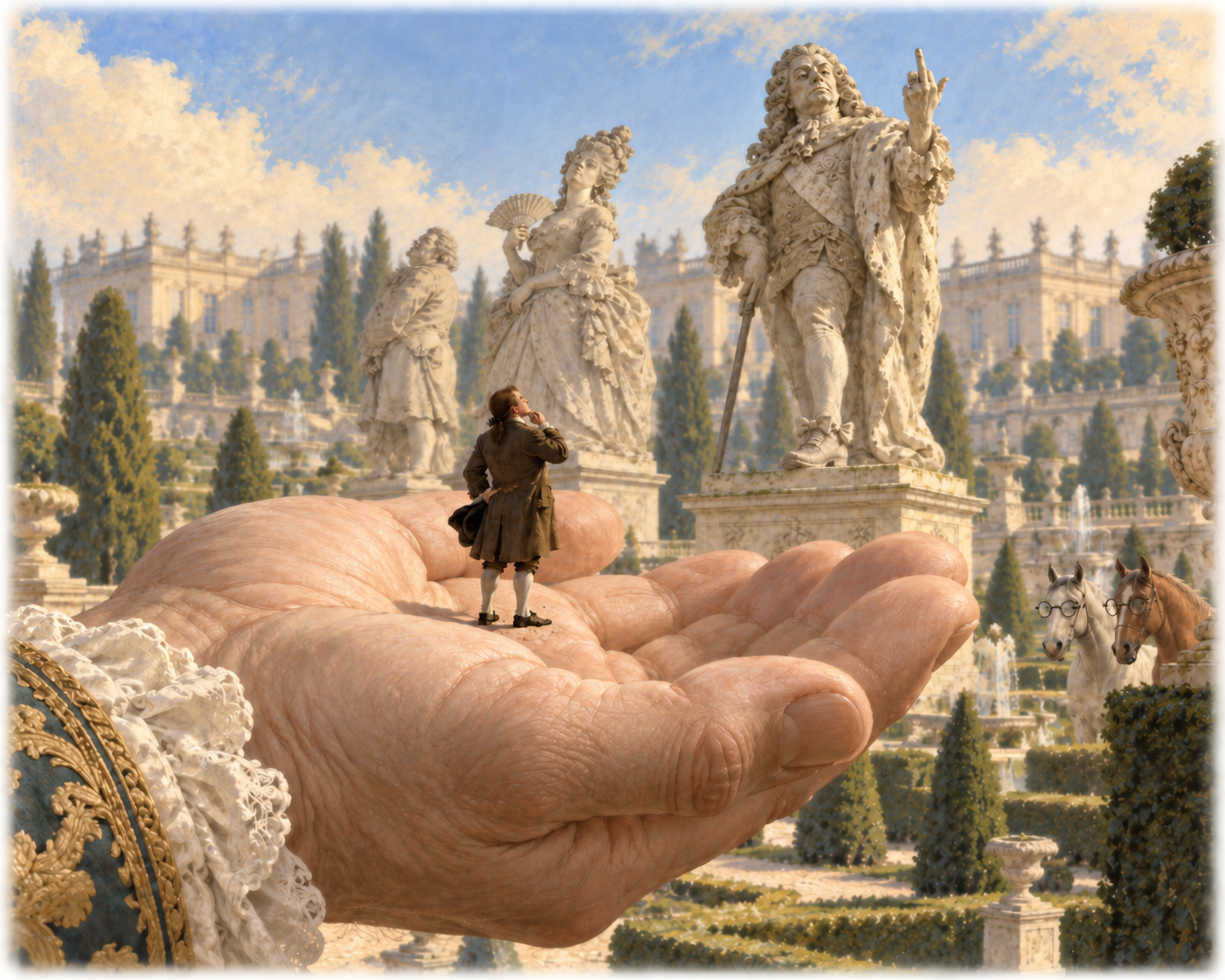
On his next voyage, Gulliver reaches Brobdingnag, the land of giants. Now the balance has shifted. He is tiny, stared at, carried about and dependent on other people’s protection. Neither his experience nor his background makes him any bigger. What seemed enormous in Lilliput is insignificant here.
Yet Gulliver is still the same person. Only his surroundings have changed.
That shift of perspective is part of what keeps the story alive. In everyday life, too, influence and vulnerability often depend on the group or situation we find ourselves in. Someone who feels powerless among one set of people may soon be in a group that gets to make the decisions. But having power does not mean having to abuse it. Nor does holding back make someone weak.
Swift offers no simple answer. He exaggerates human weaknesses, brings contradictions into view and trusts readers to notice them. His satire can be funny without being harmless.
Nor does Gulliver’s story end with small people and giants. Later journeys take him to a flying island, where the inhabitants become absorbed in mathematical and musical speculation, and eventually to a land of rational horses. There he also meets the Yahoos, human-like creatures ruled by greed, aggression and base impulses. Gulliver comes to admire the horses and increasingly despise his own kind.
When he finally returns home, he can barely bear to be near even his wife and children. He prefers to spend his time with the horses in the stable. The traveller who has learned so much about human failings seems to have forgotten how to live with other human beings.
Has Gulliver really grown wiser by the end? Is reason without compassion something to aspire to? Swift does not spell out the answers. He lets his traveller report his discoveries with absolute conviction, leaving readers plenty of reasons to doubt him.
The book has since been illustrated, adapted for the stage and filmed countless times. Generations of artists have emphasised different aspects: the fantastic adventure, the humour or the social criticism. Anyone who knows Gulliver only from Lilliput and the land of giants may still have a few unexpected encounters ahead.
On Wednesday evening in Paris, spoken words and an Irish violinist will add another interpretation. Three centuries after the book first appeared, Gulliver is setting off once more. And it is still remarkably hard to say who, in his world, is truly the greatest.