Night in the lecture hall: who does a university really belong to?
At the PAS Festival, Maastricht University opens lecture halls, courtyards and gardens to the whole city. Between research, music and theatre, a surprisingly simple question emerges: who does knowledge belong to?
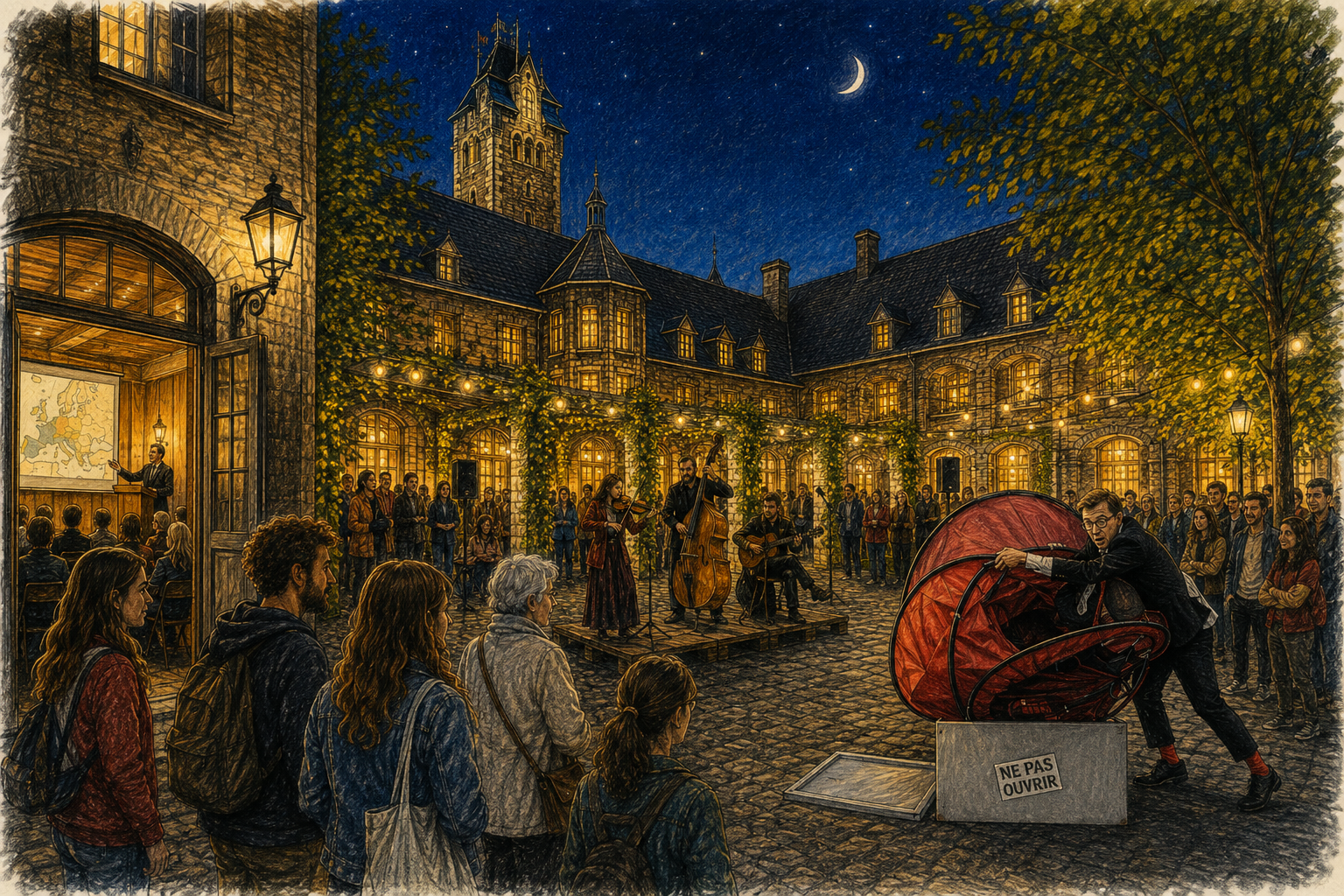
A man in a tight suit stands in a garden in the middle of Maastricht, trying to fold up a self-opening pop-up tent. It stubbornly refuses to cooperate. A few metres away, people are discussing who really influences political decisions in Brussels. Later, music fills a courtyard. And all of this is happening at a university.
On Friday, 4 September, the Pleasure, Art & Science Festival – PAS for short – begins in Maastricht. For two evenings, the university opens its buildings, courtyards and gardens to students, but also to everyone else from Maastricht and the surrounding region. Admission is free and no registration is required.
And suddenly a very simple question arises:
Who does a university actually belong to?
More than lecture halls and exams
If you are still at school, you may imagine a university roughly like this: lecture halls, libraries, professors, very thick books – and students who eventually have to sit exams.
That is not wrong.
But it is only part of the story.
Universities are meant to create new knowledge. Researchers work on questions for which there are no simple answers yet. And if that knowledge remains entirely inside the university, something essential is missing: exchange with people outside it.
PAS takes that exchange quite literally.
On Friday and Saturday, visitors can make their own route through historic university buildings in Maastricht’s city centre. Each evening offers more than 80 events: talks, music, theatre, dance, performances and scientific demonstrations.
You do not need a student card.
You do not need to be studying at all.
You can simply walk in.
From lobbyists to a clown
Then the really interesting part begins: things appear side by side that hardly anyone would normally put on the same timetable.
At 19:30, researchers use a study of thousands of European lobbyists to explain who the people are who try to influence political decisions in Brussels.
At 21:15, the French Compagnie du Petit Monsieur appears in the garden of the Faculty of Law. In its wordless show 2 Seconds!, Ivan Chary’s character Paul Durand tries to fold up a self-opening pop-up tent. What the instructions claim should take seconds turns into an escalating battle between a human being and supposedly practical technology.
Later, politics returns. At 21:30, political scientist Yf Reykers asks: What would NATO be without the United States?
And in between?
You can listen to music.
For example Marike Jager, who once began as a student on an open stage in Maastricht and has since received several nominations for the Dutch Edison music awards. On Friday evening she performs in the Minderbroedersberg courtyard.
PAS does not even try to keep science and culture neatly separated.
Perhaps that is exactly the point.
A university turns fifty
In 2026, this open door is especially fitting.
Maastricht University is celebrating its 50th anniversary. At the same time, PAS is taking place for the tenth time. That makes Maastricht one of Europe’s younger universities – and it is celebrating part of its anniversary not behind closed doors, but in the middle of the city.
Even its own history becomes a subject of inquiry.
On Friday, historian Bart Zwegers tells the university’s story through 50 objects. Objects can do something dates alone often cannot: connect history with people, events and memories.
So a fifty-year-old university looks at itself while, outside in the courtyard, the next concert is already being prepared.
Science after sunset
The idea is not unique to Maastricht.
Other European cities also open research institutions to people who do not normally work or study there. Berlin, for example, has its Long Night of the Sciences.
Maastricht turns the idea into a particularly compact version.
Many venues are in the city centre. Visitors move not only from talk to talk, but from building to building, through courtyards and gardens. For a few hours, the university almost becomes part of the city’s nightlife.
And on Saturday the mixture continues: antibiotics, psychotherapy, Big Tech, geopolitics and fake news share the programme with clarinets, installations, theatre and music.
You could try to impose order on all of this.
Or simply accept that curiosity has no faculties.
So who does the university belong to?
Of course, the university buildings do not suddenly belong to everyone in Maastricht.
But knowledge works differently from a building.
When someone discovers something and shares it, the knowledge does not become smaller. On the contrary: others can ask questions, disagree, think further or suddenly become curious themselves.
So the most interesting thing about PAS may not be any single lecture or concert.
It is the open door.
Because this weekend, nobody has to become a student before entering a university.
And sometimes science begins exactly like this:
Someone walks in and asks a question.