No. That’s not how you say it.
A language has been spoken on Jersey for more than a thousand years – yet today only a small number of people still speak it as their mother tongue. At Friday’s Festival of Words, the question is whether Jèrriais will fall silent. A small interruption may reveal what it takes for a language to survive.
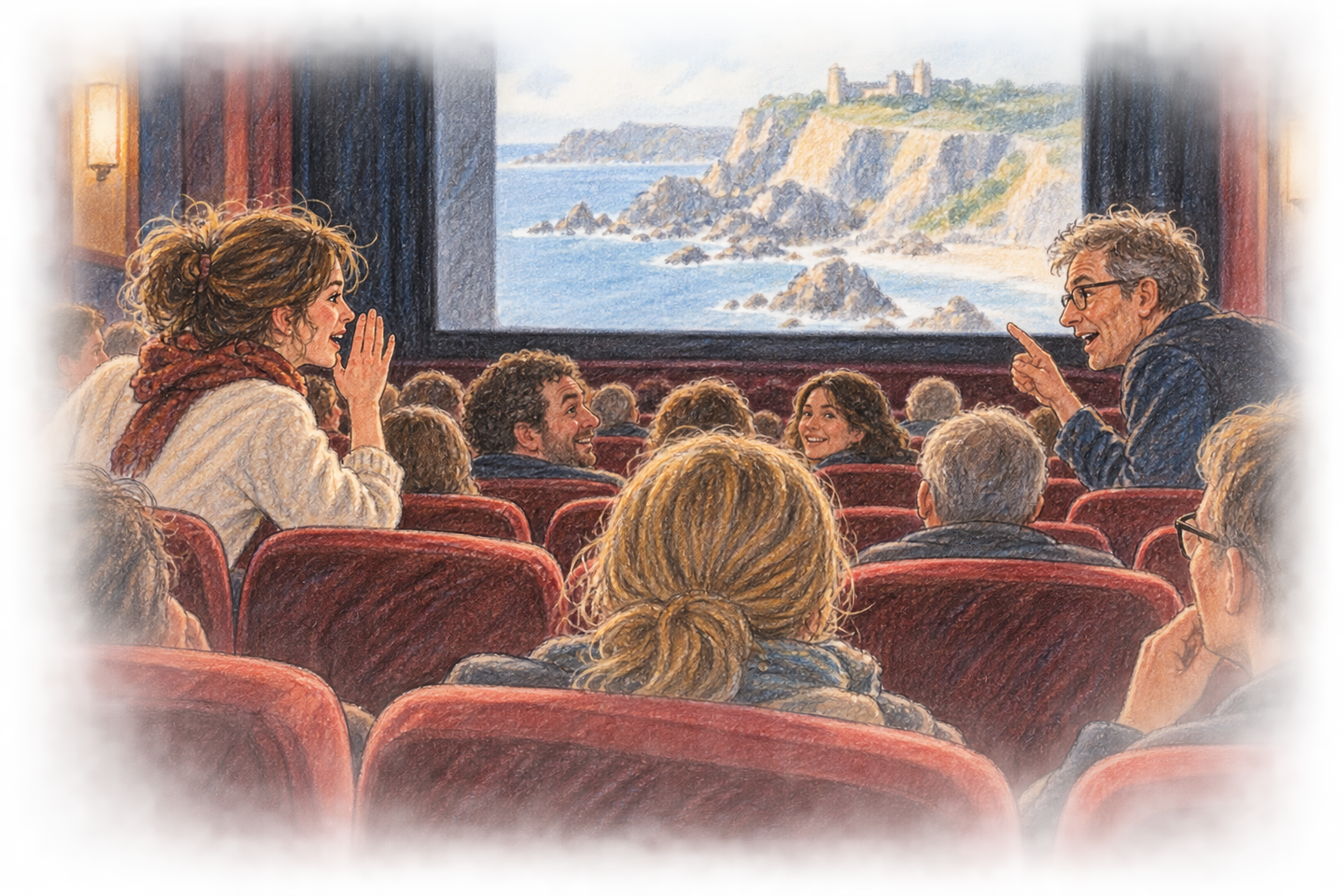
Someone in the cinema says something in Jèrriais.
A reply comes immediately from a few rows away. Also in Jèrriais. A correction. A word, a pronunciation, a phrase – something was apparently not quite right.
A few people laugh.
For a moment, this does not sound at all like a language “on the edge of silence”. It sounds remarkably alive: one person says something. Another is listening closely enough to disagree.
“No. That’s not how you say it.”
On Friday, the Jersey Festival of Words is screening the documentary À BÉTÔT? GOODBYE? – Jèrriais: A language on the edge of silence. Its subject is more serious than this little exchange. Jèrriais has belonged to Jersey for centuries, but the number of people who learned it as their mother tongue has become very small.
The film’s title therefore asks a rather large question with two small words of farewell: À bétôt? Goodbye?
Is it merely “See you soon”? Or is it a final goodbye?
You cannot put a language in a museum
Jèrriais has its roots in Norman. For generations, people on the island spoke, told stories, argued, joked and sang in this language. Poems and stories, expressions and nursery rhymes emerged in it. Parts of Jersey’s history have been handed down only in this language.
All of that could be collected. Dictionaries could be written, old texts digitised and audio recordings archived. Jèrriais would then be excellently documented.
But would that mean the language had been saved?
A sword in a museum remains a sword even if nobody fights with it any more. A language works differently. It does not exist only in its words. It lives in the moment when one person says something and another responds.
That is why Jersey is not merely trying to preserve Jèrriais. The language is being taught again. Children and adults can learn it, and there are books and digital learning resources. This festival weekend it will not only be the subject of a film: people will sing in Jèrriais, and a new book of children’s rhymes is also part of the programme.
A festival of words, of all things, thus demonstrates that a language needs more than words.
How do you preserve a voice?
Recordings of people who learned Jèrriais as their mother tongue are especially precious today.
A written word does not tell us everything.
How long is a sound? Where does the voice rise? Which syllable is stressed? How does a word sound when spoken by someone from another part of the island? And what happens when two older speakers do not pronounce the same word in quite the same way?
It would be rather presumptuous simply to decide that one of them must be wrong.
Such differences are part of a living language. They tell us something about places, families and generations. Audio and video recordings therefore preserve more than vocabulary. They preserve voices.
And this is exactly where modern technology becomes interesting.
What if the last native speakers were not the last teachers?
Artificial intelligence could search old recordings and connect spoken words with written texts. It could allow learners to compare their own pronunciation with historical recordings. Difficult recordings could become easier to explore, and different versions of the same word could be placed side by side.
A recording that once could be found only by a researcher in an archive could become learning material for a child.
That would be an enormous opportunity.
But it would also be remarkably easy to do precisely the wrong thing.
An AI system might calculate an average pronunciation from several speakers. It might treat rare variants as mistakes. It might decide which form is statistically most likely – and thereby erase precisely those small differences that people preserved for generations.
So in the future it should, hopefully, not be the AI that interrupts:
“No. That’s not how you say it.”
Its task would be different. It could help people hear how it was said. By different people. At different times. In different voices.
What becomes correct, new Jèrriais should be decided by the people who speak it.
A language needs to be sung, too
The pages of L’Office du Jèrriais contain more than grammar and vocabulary lists. There are nursery rhymes and songs. Familiar melodies acquire Jèrriais words, and Lé Jèrriais. Ma Langue. is even a song about the language itself.
That is more than a pleasant addition to a language course.
When we hear a spoken sentence in an unfamiliar language, later we may remember only that we did not understand it. A song can remain. We do not understand the words – yet we still hum the melody.
Next time, we recognise one word.
Later, perhaps two.
And eventually someone joins in.
A threatened language therefore lives not only in dictionaries. It lives in voices – and especially in songs.
Who will interrupt in twenty years?
That brings us back to the cinema.
Today, people can still sit there who have known Jèrriais since childhood. They hear an expression and notice immediately when something sounds unusual. That knowledge can be recorded, written down and stored digitally.
But the real goal cannot be for a computer to speak perfect Jèrriais in twenty or fifty years.
There is a better future.
A child says something in Jèrriais.
Another listens.
And interrupts:
“No. That’s not how you say it.”
Perhaps a third child objects: “Yes it is. My grandmother says it exactly like that.”
Then they argue. Someone laughs. One searches for a word. Another knows how their grandmother would say it. Eventually expressions arise for things that did not even exist in the lifetime of today’s last native speakers.
And the AI?
It may have helped keep old voices audible, find words again and support a new generation as it learned.
But now it can be quiet.
Because a language has not been saved when a machine masters it.
It lives when people speak it with one another again – and can even interrupt one another in it.