‘Nobody has any intention…’: Berlin marks 65 years since the Wall was built
13 August marks 65 years since construction of the Berlin Wall began. An installation changes with the viewer’s position, 140 biographies restore the victims’ stories, and two guitars turn division into music.
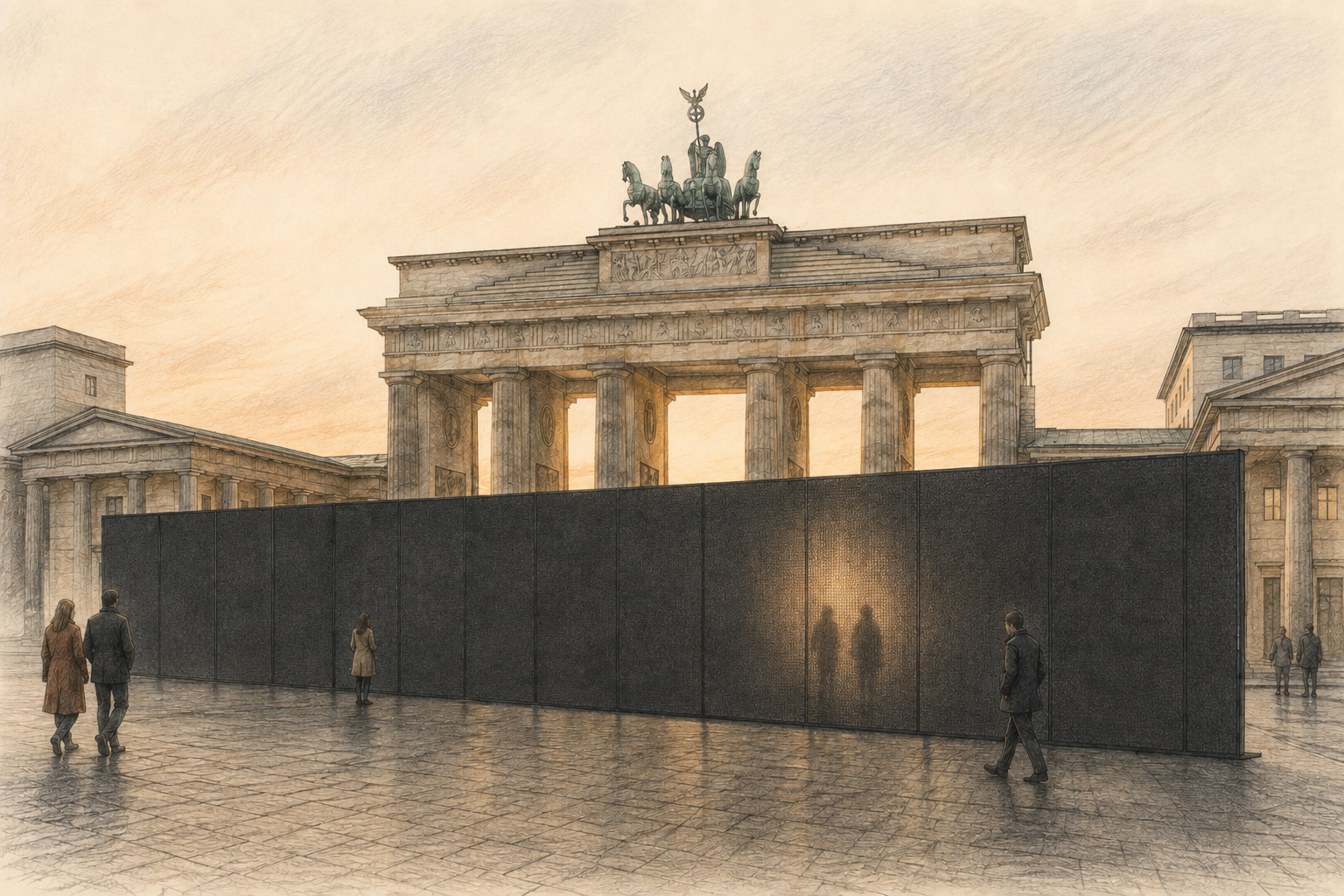
‘Nobody has any intention of building a wall,’ Walter Ulbricht declared on 15 June 1961. Just 59 days later, streets were torn up, rail links severed and the border between East and West Berlin sealed with barbed wire and armed guards. Concrete soon followed.
The Wall now ran visibly through streets and squares, and invisibly through families, friendships and lives. On 13 August 2026 Berlin commemorates its construction with a programme centred on the Berlin Wall Memorial in Bernauer Strasse and a temporary memorial site outside the Brandenburg Gate. Rather than simply rebuilding the historic Wall, it explores different views of a border and the visible and invisible walls that separate people.
A wall that changes with the viewer
From 13 to 16 August, “view”, an installation by the artist Hubertus Hamm measuring around 30 metres long and three metres high, stands where the Berlin Wall once sealed off the Brandenburg Gate. Its 24 connected lamellar elements are made from a partially permeable material. Depending on the viewer’s position, angle and the incidence of light, the wall appears almost closed or allows people and surroundings behind it to emerge as indistinct shapes. Anyone walking alongside it sees the same surface change repeatedly.
The installation plays with sightlines, orientation and shifts in perspective. People behind its dark surface almost disappear, only to become recognisable again a few steps later. In this way, the work recalls the physical presence of the former border fortifications without reconstructing them in concrete. At the same time, it reaches beyond the historical event: which walls stand visibly before our eyes today? Which are created by isolation, fear and prejudice? And which have we long carried in our minds?
The accompanying open-air exhibition ‘Views of the Wall: Berlin 1961–1990’ presents historical photographs of everyday life in the divided city and of those who observed, secretly photographed, documented or guarded the border.
140 people, 140 names
At 10 am the central commemoration begins in the Chapel of Reconciliation. Members of the Hildebrandt family tell their story of Bernauer Strasse. Pastor Helmut Hildebrandt conducted the final service in the old Church of Reconciliation in 1961. The church was trapped in the border strip and demolished by the GDR in 1985. His son Jörg could no longer continue studying at the Free University, and the family was forced from its home.
From 1 to 4.30 pm the victims’ biographies are read at the memorial under the title ‘140 People – 140 Names’; readings continue at the Brandenburg Gate from 6 pm. Actors, Foundation staff and other participants read in German and English. Every name represents an individual life and family.
Photographs from two sides
At 5.30 pm Christine Bartels and Mahmoud Dabdoub meet in a conversation moderated by Marion Brasch. Bartels secretly photographed the border strip from her East Berlin flat. In 1986 she viewed her own home from a platform in West Berlin and felt the reality of her enclosure with particular force. Dabdoub came from Lebanon to study photography in Leipzig. As an international student he could travel west and photographed the Wall from West Berlin. Their stories bring together two sides of the border and two distinct experiences of the GDR.
History in the language of two guitars
Stefan Loos and Bernd Steinmann have performed together as the Essen Guitar Duo for more than 35 years. Their repertoire ranges from Renaissance, Baroque and Classical music to flamenco. In 2019 they accompanied the official 30th-anniversary ceremony for the fall of the Wall. A year later Steinmann composed ‘13 August 1961 – The Construction of the Wall’. Pieces including ‘The Construction of the Wall’, ‘Berlin’ and ‘Waving Women’ translate closure, separation and gazes across an unreachable border into the language of two guitars.
On the anniversary they perform the work in three free half-hour concerts at 12.30, 3 and 5 pm. Their music replaces neither words nor eyewitness accounts. It opens another path to the same memories: where a biography tells what happened to one person, music can make audible what is difficult to say.
At 7.30 pm Jörg Hildebrandt and Renate Werwigk-Schneider speak about forced removal, conscientious objection, escape attempts and imprisonment. The day thus leads from a sweeping political claim to its concrete consequences.
The installation becomes transparent or impenetrable with every step. History itself does not change with the viewing angle; our understanding of it can. A visible wall can be torn down. Invisible walls made of fear, enemy images and prejudice do not automatically disappear with the concrete. Perhaps dismantling them begins when people cross to the other side, look at one another again and listen to the stories told there.
The programme is organised by Kulturprojekte Berlin and the Berlin Wall Foundation with the Berlin Commissioner for the Reappraisal of the SED Dictatorship, with federal and LOTTO Foundation Berlin funding. Most events are free.