Again!
What happens when something turns out completely differently from what your brain expected? At the Brave Young Minds mini-festival in Leiden, children get to find out – and discover why surprise can be the beginning of learning.
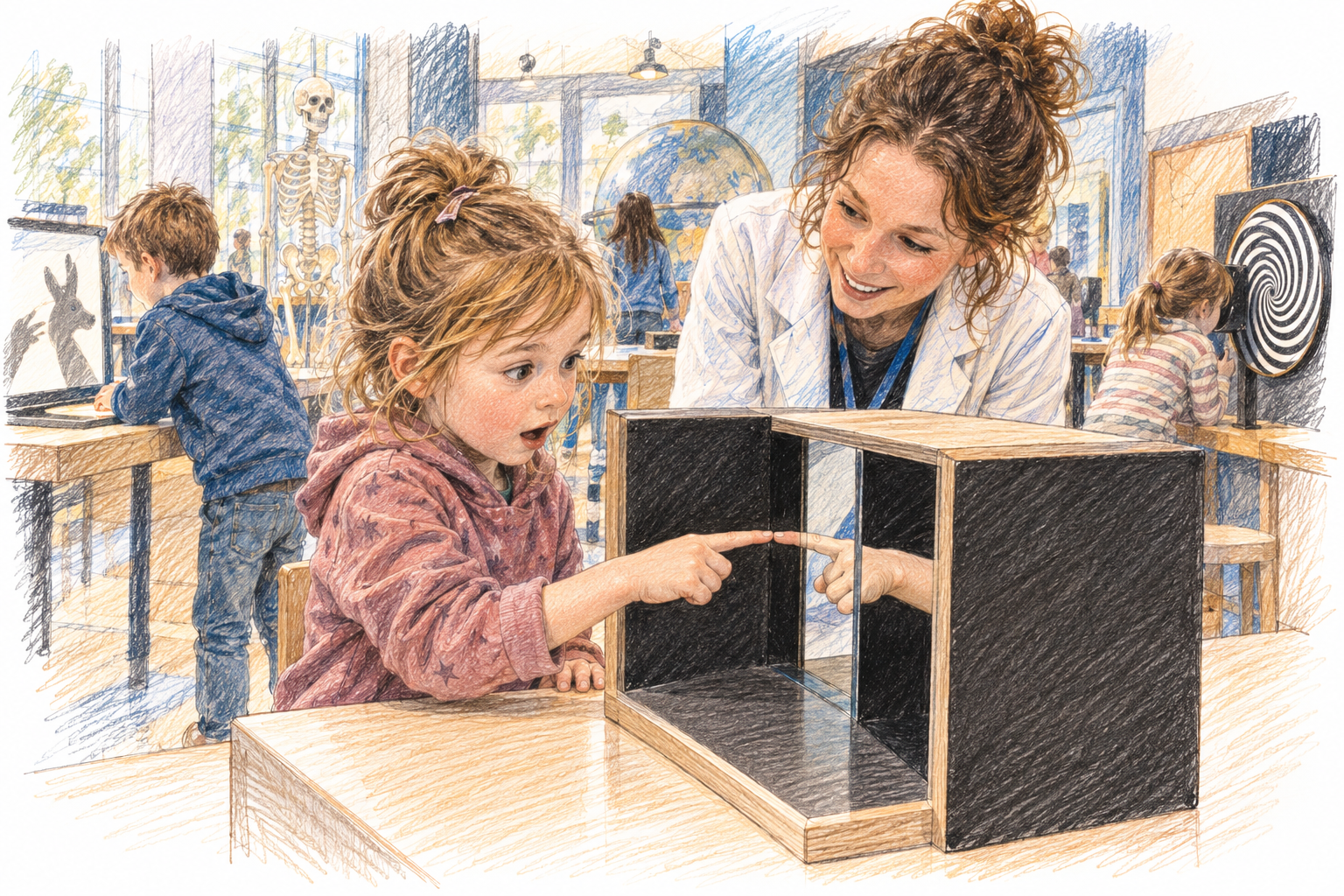
You are absolutely sure. You know what is about to happen. You have experienced something like this many times before, and there is no sensible reason why it should be different now.
Then it is.
For a brief moment, something feels wrong. Maybe you laugh. Maybe you want to know how that can be. Maybe you are six years old and do not think about it at all. You simply say:
“Again!”
And that may be heard quite often this Sunday at Rijksmuseum Boerhaave in Leiden.
A museum messes with your brain
At the Brave Young Minds mini-festival, children aged six and over meet scientists and researchers. From 11 a.m. to 4 p.m. they can experiment, play, try things out and ask questions. The programme includes fear and stress, hypnosis, orientation and the ways in which our brains can be fooled.
At first, that sounds a little as if adults had decided to spend a Sunday creating as much confusion as possible in children’s heads. In fact, it is almost the opposite: our brains are constantly trying to create order.
When you walk down a staircase, you do not reconsider at every step how far to lower your foot. When someone throws you a ball, you do not consciously calculate its trajectory, speed and the exact moment to catch it. And when you open a familiar door, you are fairly certain what is behind it.
Your brain works with experience. It recognises patterns, fills in missing information and develops expectations about what is likely to happen next. Most of the time this works so well that you do not even notice how much your mind is doing for you.
Until the expectation is not met.
That cannot be right
That is precisely why perceptual illusions are so much fun. You see something and feel certain that you are right. Then you discover that things are different. Your first thought is probably not: “How fascinating! I should revise my current model of reality.”
More likely:
“Huh?”
That is a pretty good start. Your brain did not simply fail. It had reasons for its expectation. It used past experience, interpreted clues and produced a plausible prediction.
Only this time, reality did not match.
And in that small gap between what you expected and what actually happened, learning can begin.
Mistakes are more interesting than hits
Of course we also learn through repetition. Repeating something correctly can make us more confident, faster and more automatic. But things become especially interesting when something does not work.
You reach and miss. You cannot find your way. You are fooled. You are completely certain of an answer – and it is wrong.
Now there is something new to discover. Why did I think that? What did I miss? Should I try again in a different way?
A mistake alone does not automatically make anyone wiser. You can repeat the same mistake perfectly well. What matters is that something changes between attempt one and attempt two.
Sometimes all it takes is:
“Again!”
Six-year-olds do not have to write an essay about it
Perhaps that is the best thing about the idea behind Brave Young Minds. A six-year-old does not need to explain after an experiment what has just happened in their brain. They are allowed to be surprised, laugh, try something that does not work – and immediately try it again.
The explanation can come later. An older child may want to know why the illusion works. A teenager may begin to think about perception. An adult may remember situations in which they were absolutely certain – and still wrong.
The experience comes first.
An experiment does not have to explain its lesson to a child. It can give them an experience from which an insight may grow later.
Your brain is not a camera
That is not a bad reminder for adults either. We do not experience the world like a camera that simply records everything. Our brains organise, weigh, complete and compare. Experience allows us to react incredibly quickly. Habits save us thousands of tiny decisions every day.
But those same habits can make us keep looking in the same place. The same experience that helps us understand a situation instantly can also send us down the wrong path. And the same ability to build a sensible explanation from very little information can occasionally produce an explanation that sounds completely reasonable – and is still wrong.
That is not a particularly good reason to distrust your own brain. It is a very good reason to stay flexible.
A Sunday full of wrong expectations
That is why a trip into the world of confusion is more than a collection of amusing tricks. Anyone who experiences a confident expectation failing gains a small experience of uncertainty. Anyone who then tries again experiences something else as well: a wrong expectation does not have to stay wrong.
Our brains can learn. They can change habits, incorporate new experiences and adjust old expectations.
So at the end of a successful experiment, there probably is not a six-year-old junior neuroscientist standing in front of a brain atlas explaining the prefrontal cortex. There is simply a child.
Something has just happened that did not work the way it was supposed to. The child looks at the scientist. The scientist smiles.
And the child says:
“Again!”