Every River Has Two Banks
A river connects, a border divides: the Tornio Valley tells of Meänkieli, a shared past and the voices of Europe’s border regions at Voices of Europe in Oulu.
A river can bring people together. They travel along it, fish in it and live on its banks. And sometimes someone draws a national border straight through it. Yet every river has two banks – and on both sides live people whose memories, languages and stories cannot simply be separated by a line on a map.
At Voices of Europe – Every Border Has a Sound, attention turns this Tuesday from Oulu to the Tornio Valley in northern Finland and Sweden. The day is called “River and Sea Cultures”. Talks, an exhibition, a Living Library, discussions, dance and folk music explore what a border does to a shared landscape and to the people who live there.
Before the River Became a Border
The Tornio River has not always marked the border between Finland and Sweden. For roughly six centuries, the lands on both sides belonged to the same kingdom. People in the Tornio Valley lived along the same river, traded with one another, married across the water and shared fishing grounds and transport routes. The river was not the edge of two states but the centre of a common landscape.
Tornio developed early into a trading centre of the north. The river still shapes the region so profoundly that local people also call it Väylä, meaning the route or waterway. Fishing, commerce, languages, dialects and regional traditions form part of a culture whose history cannot be neatly divided into a Finnish half and a Swedish half.
Then came 1809.
A Line Through a Shared Landscape
Sweden lost its war against Russia, Finland became part of the Russian Empire, and a national border now ran through the Tornio Valley. The Tornio River, and farther north the Muonio River, became the dividing line. What looked unambiguous on a map divided land and water, families and church congregations in real life. A population that had previously been predominantly Finnish-speaking suddenly found itself living in two countries.
But a border could not turn neighbours into strangers overnight. People continued trading, visiting relatives and living alongside a river that separated them politically while still connecting them in everyday life. Today Tornio and Haparanda even tell this story together: the Tornio Valley Museum works across the border and explicitly devotes its permanent exhibition to the history of both sides – covering border trade, smuggling, cross-border marriages, food, music, local identity, languages and dialects.
The border remained. But some things on its opposite banks began to develop differently.
Our Language
This is particularly clear in Meänkieli. The name literally means “our language”. Its roots lie in the Finnish varieties spoken on both sides of the Tornio Valley even before the border was drawn in 1809. Afterwards, those varieties continued developing in different political and linguistic environments.
On the Swedish side, deliberate policies of Swedish assimilation followed in the late nineteenth and twentieth centuries. Swedish became the language of instruction; in some places children were not even allowed to speak Meänkieli during school breaks. Eventually many parents stopped passing the language on to their children. Today Meänkieli is one of Sweden’s recognised national minority languages – not merely preserved through language projects, but increasingly heard in everyday life again.
Pajala offers an example. At the annual Kväänifästi, Tornedalians, Kvens and Lantalaiset come together. Theatre, music, crafts, food, workshops and language activities all have their place, as does Meän pirtti, a meeting place during Pajala’s major market. In 2026 the festival ran from 1 to 5 July. Its programme ranged from a theatre premiere and language workshops to activities where children and adults could use Meänkieli quite naturally. The aim is not only to preserve a language: it should be spoken, sung and celebrated.
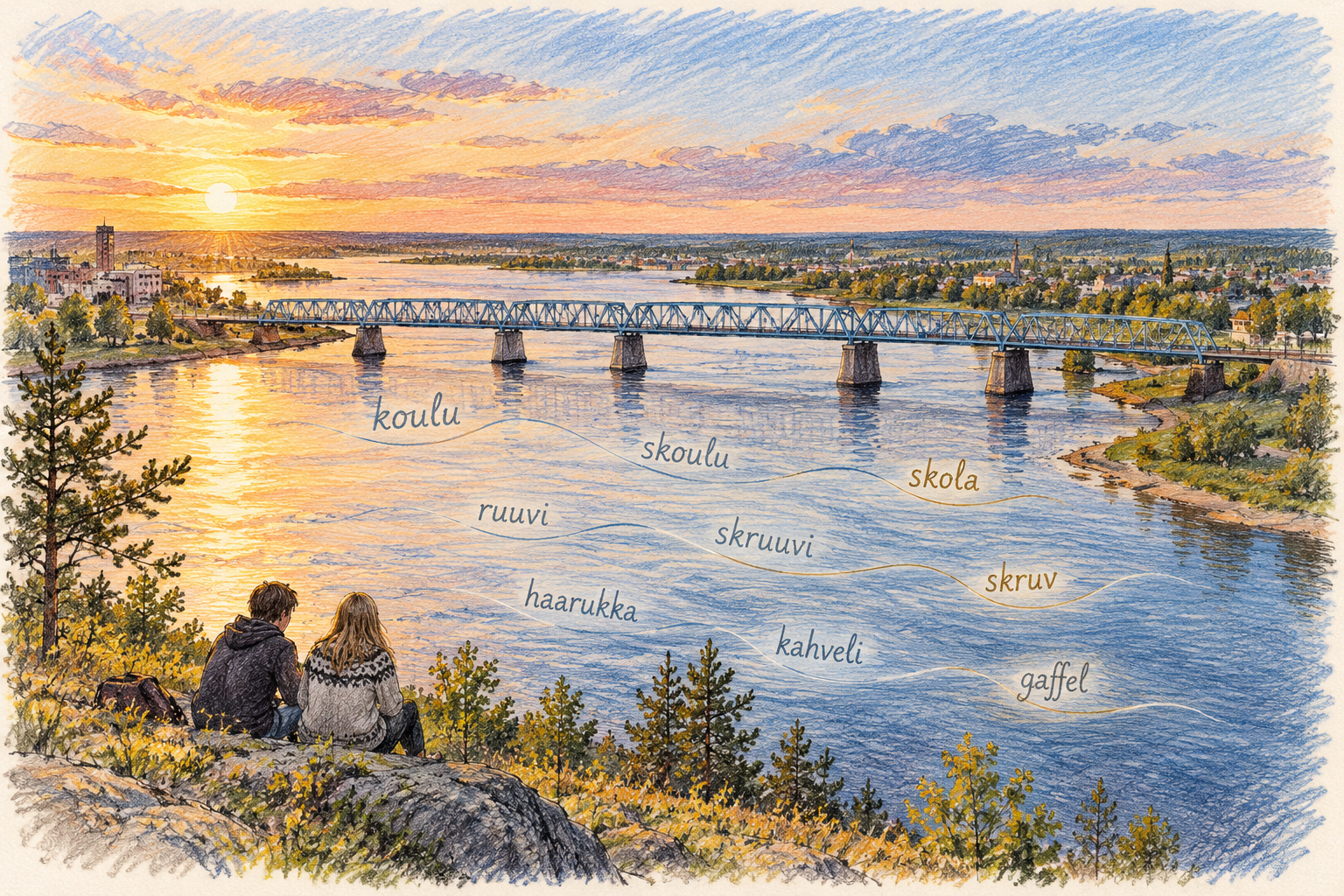
Sometimes the different linguistic paths of the two banks can be traced in individual words. A fork is haarukka in standard Finnish; kahveli is also documented in Meänkieli, noticeably close to Swedish gaffel. For glass or window glass, Meänkieli uses klasi, while standard Finnish has forms such as ikkunalasi and Swedish uses glas.
The story grows more interesting where Finnish also reveals the family resemblance. A screw is ruuvi in Finnish; kruuvi and, regionally, skruuvi are recorded in Meänkieli; in Swedish it is skruv. For school, Finnish has koulu; regional Meänkieli also has the documented form skoulu, compared with Swedish skola. In these sequences of words, one can almost watch language contact at work: a word travels, adjusts to a different sound system and develops a little differently on each side. A single word can be a tiny map.
What the Border Could Not Divide
The shared heritage goes beyond language. Family ties reach across the river, regional traditions belong to both banks, and the history of fishing, trade and daily life is hard to tell within the boundaries of a single state. The Tornio Valley Museum has made precisely this shared perspective its guiding principle.
That does not mean two hundred years of separate political development have left no trace. School systems, administrations, and majority and minority languages followed different paths. All the more remarkable, then, is how much has remained in common. Today Tornio and Haparanda work closely together as twin towns; their organised cross-border cooperation dates back to 1987 and encompasses shared facilities as well as international projects.
Proximity alone, however, is not enough. Connections survive only when people nurture them.
Connections Need to Be Maintained
This is where the story of Voices of Europe begins. The event week is organised by the Bothnian Arc, a cross-border network around the northern Gulf of Bothnia, and the Association of European Border Regions. Network coordinator Satu Haapanen brought the idea for the Oulu conference into the European border-regions network. Her aim was to ensure that not only capital cities and major centres are heard, but also border communities and their linguistic and cultural minorities.
In Oulu, people from the Tornio Valley and the Bothnian Arc therefore meet participants from other European border regions, including Schleswig-Holstein, the Basque Country, Bavaria, Tyrol and Alsace. For Haapanen, practical cooperation is not just a cultural project: transport, education, the environment and the economy are part of it too. Border regions can learn from one another because many of their challenges look different but share something essential.
Communities working to sustain a minority language need not repeat mistakes made elsewhere when they share their experiences. A school can exchange ideas with a partner school. Artists can develop joint projects. Municipalities can adopt solutions that have already worked elsewhere. Networking sounds like meetings and organisational charts – but in reality it achieves something profoundly human: it keeps contact from breaking down.
Borrowing People Instead of Books
On Tuesday, that idea becomes tangible in Oulu. The day begins by exploring the changing identities of the Tornio Valley. A dance workshop and an exhibition on the cultural heritage of river and coastal regions follow. In the early afternoon, a Living Library opens around the question of what Tornio Valley identity means to the people who live there.
In a living library, there are no books sitting on shelves. People share their experiences. Afterwards, a discussion considers life along a water border today and tomorrow, before music from the Tornio Valley and coastal regions fills the afternoon. Abstract terms such as minority, identity or border region suddenly become personal: a language a grandmother still spoke; a song from the opposite bank; a word that sounds slightly different in the neighbouring country; or the discovery that people along a completely different European border have lived through similar experiences.
That is the strength of this event week. Voices of Europe does not simply want to talk about minority languages but to make them audible. Finnish, Swedish, Meänkieli, Inari Sámi and other European and non-European languages are intended to sound alongside one another throughout the week.
Every River Has Two Banks
In 1809, a government could decide where a national border should run. It could turn the Tornio River into a dividing line on a map. But it could not decree that history ended on one bank and that an entirely new history began on the other.
More than two hundred years later, people still speak to one another across the water. Some of their words have grown apart; others still reveal the paths they once shared. Traditions are shared, a museum tells the history of both banks, and people from European border regions gather in Oulu so that common experiences can become new connections.
Connections do not endure simply because they once existed. They need care. Every river has two banks – and sometimes the most important task is to make sure the people on either side can still hear one another.