The code of an open city: Riga celebrates its 825th birthday
Riga is turning 825. Yet the city on the Daugava did not begin with its official foundation in 1201. Its birthday celebration tells of trade and conquest, changing rulers and a city that now wants to bring its many stories into conversation.
Can a city celebrate its 825th birthday even though it existed long before that date?
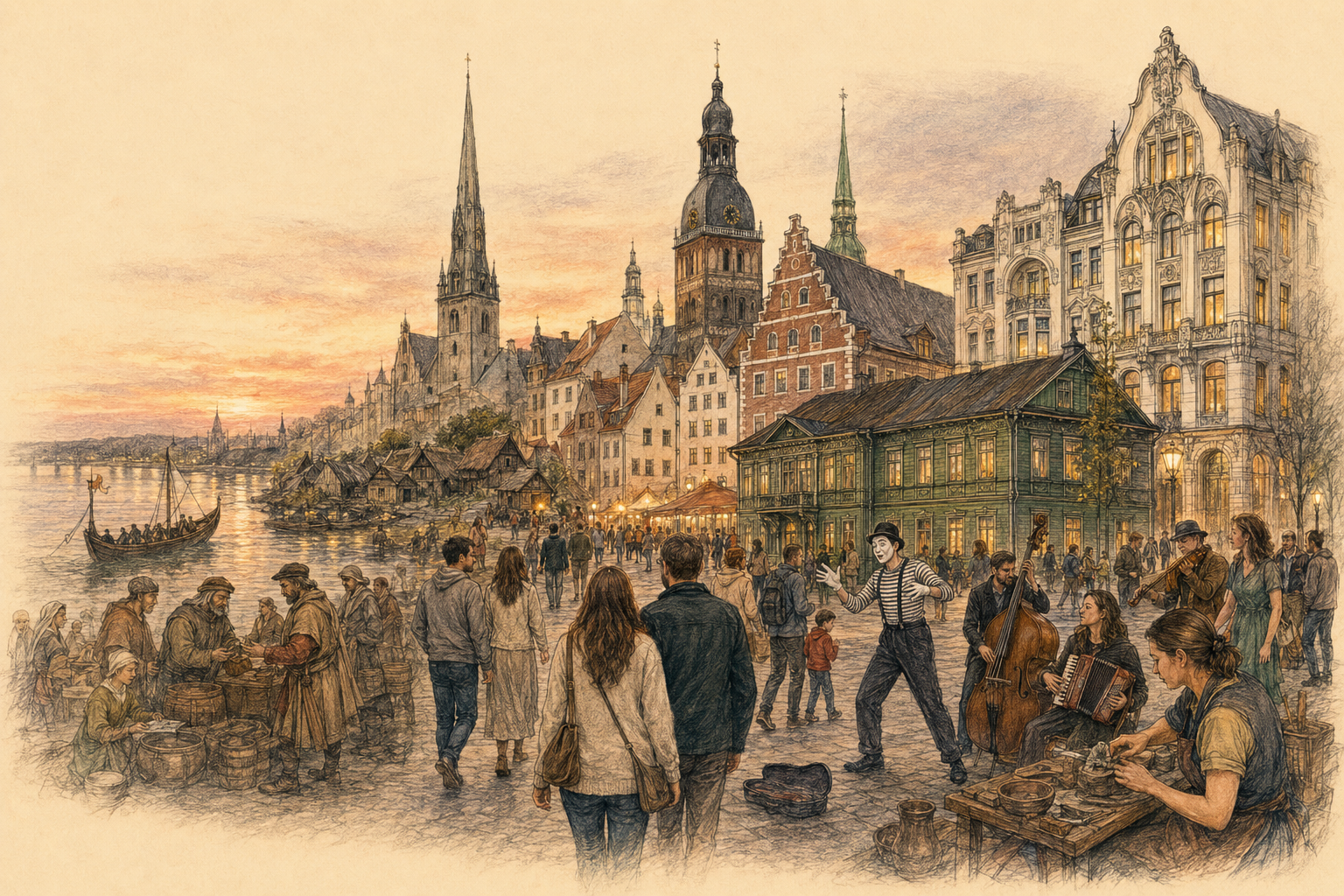
Riga is doing exactly that. On 15 August, the Old Town, parks and Daugava waterfront become stages, workshops and meeting places. Street musicians play among historic houses, mimes and dancers move across the squares, and craftspeople demonstrate Latvian traditions. International residents and visitors from Riga’s twin cities tell what connects them to the city.
The motto is “Open Riga! Code: 825”. It sounds like an invitation to solve a puzzle. Perhaps the key, however, is that Riga cannot be opened with a single story.
A foundation that was not the beginning
The official foundation year is 1201. Bishop Albert moved his seat to the Daugava and, after negotiations with the Livs who lived there, had a fortified town built. German merchants and settlers followed. Riga became a base for trade and Christian mission, but also for the violent subjugation of the Baltic population.
The anniversary therefore does not commemorate an empty place where a city suddenly appeared. People already lived and traded beside the Daugava. The river linked the interior with the Baltic Sea, attracting merchants as well as those seeking power over the region.
Riga soon became an important intermediary between East and West. It joined the Hanseatic League in 1282. Ships brought salt, cloth and metal goods and carried away wax, timber, furs and other products. Trade made Riga wealthy and brought languages and ideas into the city, but not equality. For centuries, origin and social rank determined political influence and economic opportunity.
A city under many rulers
Walking through Riga today means meeting those centuries in stone. Medieval lanes lead to merchants’ houses and large churches. Beyond the former walls stand wooden houses, broad boulevards and hundreds of Art Nouveau buildings. UNESCO describes Riga’s historic centre as a place where the encounter between East and West is particularly visible.
These layers did not emerge peacefully. Riga was governed at different times by Polish-Lithuanian, Swedish and Russian powers. The independent Republic of Latvia was proclaimed in the city in 1918. Soviet occupation followed in 1940, then German occupation during the Second World War and renewed incorporation into the Soviet Union. Both occupying regimes brought persecution, deportation and death.
Latvia fully restored its independence in 1991. Riga again became the capital of a sovereign state, but not the city it had been half a century earlier. People had been murdered, driven out or resettled there; languages, memories and senses of belonging had changed.
What language does Riga speak?
Latvian is the state language today. Yet Russian, Ukrainian, English and many other languages can also be heard in Riga’s streets. For centuries, Latvian, Baltic German, Russian, Jewish, Polish, Estonian, Lithuanian and other communities have lived alongside one another in Latvia.
This diversity is not merely a cheerful folkloric picture. A language can be home while also recalling domination, pressure to assimilate or loss. Since Russia’s attack on Ukraine, Latvia has debated particularly intensely what place Russian should occupy in public life.
An open city must hold this contradiction. Latvian needed protection in order to become the natural common language of the state again after decades of Russification. At the same time, many people speak Russian at home and in everyday life without supporting the policies of the Russian state.
Openness therefore does not mean forgetting history. It means refusing to reduce people to a language or an origin assigned to them.
The birthday belongs to the people
On 15 August, that polyphony becomes the programme. Street music, jazz, classical music, mime, clowning and Japanese-influenced Butoh movement theatre meet in the Old Town. Twin cities, international communities and Latvian regions introduce themselves in Vērmane Garden. Craftspeople display work from different parts of the country in Cathedral Square.
Riga is not celebrating only its old façades. It is opening squares, parks and streets to the people shaping its present. That suits a place whose history has always been marked by arrival, exchange and conflict.
A city cannot be opened like a door with a single code. The number 825 merely leads to the entrance. Beyond it lie the stories of Livs and merchants, conquerors and occupied people, those who stayed, those who were expelled and those who arrived later.
Perhaps this is the most honest form of a city birthday: Riga does not declare itself complete. It invites residents and visitors to write the next chapter together.