A robot in church, sharks in the deep and AI in the future
What do a robot in a church, deep-sea sharks and artificial intelligence have in common? At the British Science Festival in Southampton, they all lead to the same bigger question: what do we do with the knowledge and possibilities that research gives us?
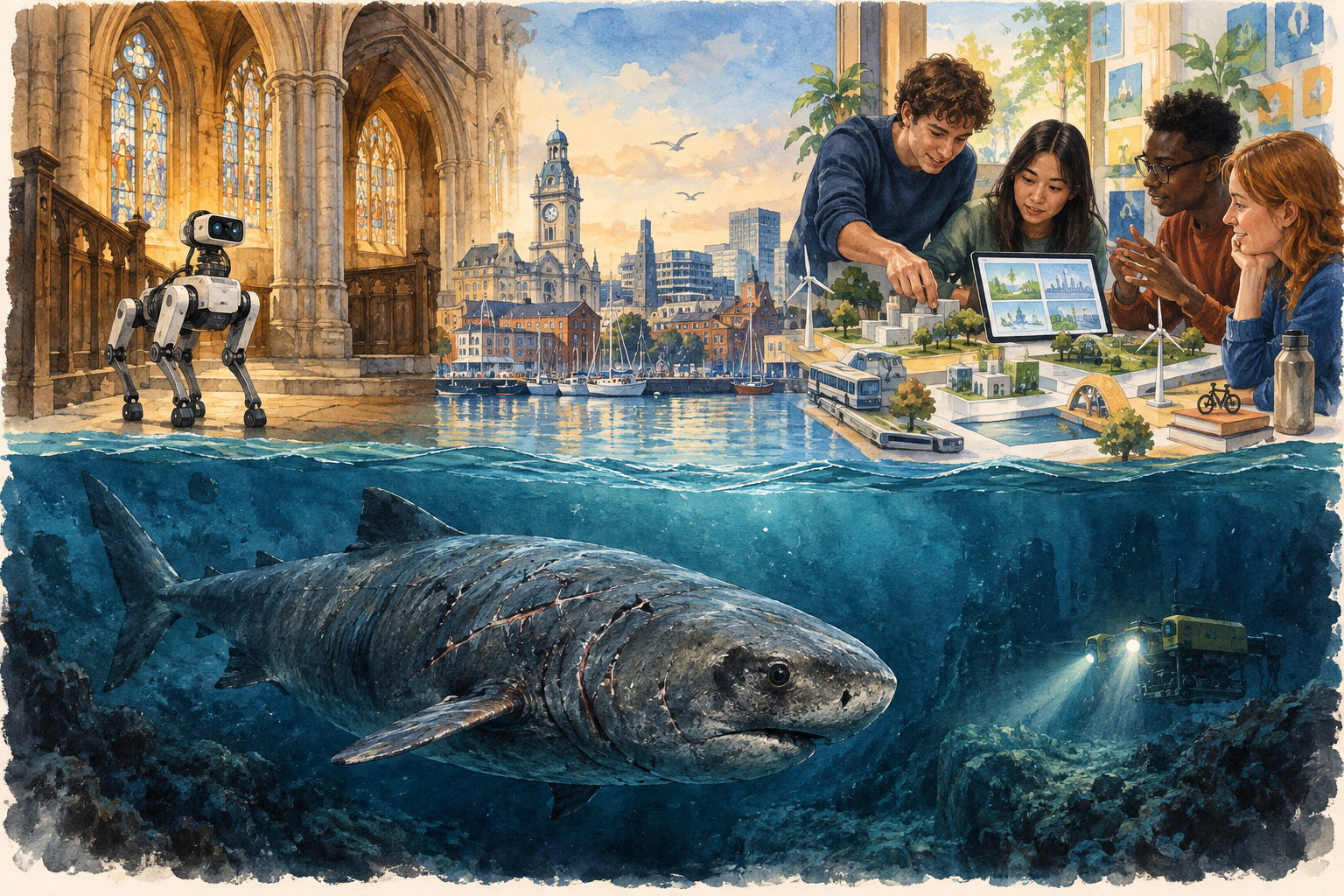
This morning, at the University of Southampton’s Centenary Building, it is possible to move between three very different visions of the future within a single hour. At 10.30 am, marine biologist Daniel Moore talks about large deep-sea sharks and how climate change and human activity are altering their habitat. At 11.30 am, engineer Andrew Blair tells the story of taking a robot into a centuries-old cathedral. At the same time, visitors in a workshop build models of what a world with artificial intelligence might look like.
This is how the 195th British Science Festival begins in Southampton on 16 September. More than 80 free events are spread across the university, theatres, galleries and other venues until Sunday. The festival is aimed particularly at young adults aged 16 to 30 who do not need to be science specialists. And this year, for the first time, young people from Southampton have helped shape the themes and formats in the programme.
A future that has already begun
What is striking about artificial intelligence here is that the festival does not pretend this is a future we are still waiting for. AI is already being used – for writing, searching and translating, in medicine and research, in images and music, on social networks and increasingly in personal conversations.
That is why AI runs through several days of the festival. Antonia Marcu of the University of Southampton will explain what today’s AI models can actually do, what they lack and how predictable their behaviour really is. Another event looks at teenagers, chatbots and digital relationships. In an installation, visitors can use generative AI to make their ideas for Southampton’s future visible. And on Saturday, computer scientist Dame Wendy Hall and BBC technology editor Zoe Kleinman discuss a remarkably simple question: Who is AI actually for?
That turns the familiar question “Is AI good or dangerous?” into something more interesting. The questions become concrete: who decides how it is used? What should it take over – and what should it not? How does it change relationships, work, medicine or culture? And what happens when people attribute abilities to a system that it does not actually possess?
Wednesday’s “Building future worlds and AI” workshop starts precisely there. Rory Miles of the University of Southampton and Matt Smith of the University of Portsmouth do not ask visitors to predict the future. They ask them to build models of possible future worlds themselves. Later in the festival, these designs will be exhibited and discussed further. The future therefore appears not as a finished technological development that will one day descend upon people, but as something they can help shape.
What is a robot doing in a church?
Andrew Blair’s “Holy Motherboard!” also begins with an apparently absurd situation. The University of Glasgow researcher has taken a robot into a centuries-old cathedral and explored what happens when new technology encounters a place steeped in tradition. At the festival, visitors can meet the robot themselves.
The church is more than an attractive backdrop. For centuries, people have asked questions there about meaning, responsibility and their own place in the world. Now a robot rolls in. Suddenly it becomes very clear that new technology does not arrive in an empty space. It encounters habits, expectations, rules and ideas about what it means to be human.
The next decision waits in the deep
Southampton is both a port city and a research city. It is home, among other institutions, to the National Oceanography Centre and the Southampton Marine and Maritime Institute. So another major strand of the festival leads beneath the surface of the sea.
Daniel Moore studies the largest sharks of the deep sea and asks what climate change and human activity are doing to these slow-living animals. A little later, Eva Stewart of the Natural History Museum presents another dilemma: mineral resources lie on the floor of the Pacific that could be used for technologies intended to replace fossil fuels. Yet extracting them could damage habitats about which we still know surprisingly little.
Here too, it is not enough to know what is technically possible. We have to decide what we want to do with that possibility – and what consequences we are prepared to accept.
Science does not end with the result
This idea runs strikingly through the festival. The organisers explicitly wanted more than lectures for people who are already enthusiastic about science. Many events are workshops, performances, installations or shared experiments. Part of the programme was selected with a youth panel of 16- to 18-year-olds from Southampton, whose perspective helped identify themes that feel new, relevant and accessible.
On the evening of the first day, the route finally leads back to the sea. In “The Ocean Remembers”, sound artist and nature beatboxer Jason Singh and trumpeter and composer Yazz Ahmed combine music, electronic soundscapes, voices and research from the Southampton Marine and Maritime Institute. The work explores, among other things, fish life, whales, microplastics in coral and humanity’s long maritime journeys.
It is a fitting end to a festival day that began with sharks, robots and models of the future: not with a final answer, but with another way of experiencing research.
The AI future has already begun. The deep sea is already changing. Robots have long since left the laboratory. So the more interesting question is not what will one day become possible – but what we want to do with what is already possible today.