A Screen for Survival: Sarajevo Opens Its Film Festival
One of Southeast Europe’s most important film festivals grew out of a basement cinema in besieged Sarajevo. On 14 August, its 32nd edition opens with Thomas and Erika Mann travelling through the ruins of Germany in 1949.
During the siege of Sarajevo, few would have counted cinema among the things a city needed in order to survive. It needed water, bread, medicine, electricity and a route through the streets that did not leave a person exposed to a sniper.
Yet a city consists of more than bodies that must be kept alive. It also consists of memories, ideas and the ability to imagine a different future. What happens when its people stop watching and telling stories together?
In Sarajevo, that question was answered not in an essay, but in a basement.
A cinema in besieged Sarajevo
From 1992 until early 1996, the Bosnian capital was almost completely encircled. Bosnian Serb army units shelled it from the surrounding hills. Homes, markets and queues were hit, while snipers targeted people fetching water, crossing a road or walking with their children. The international war crimes tribunal later found that attacks on civilians formed part of a deliberate campaign to terrorise the population.
Water, electricity and heating repeatedly failed. Food became scarce. For more than three years, daily life was accompanied by the knowledge that a window, an intersection or a few metres of exposed road could be fatal. Thousands of civilians were killed or wounded.
In February 1993, the Obala Art Centar opened the War Cinema Apollo in the midst of that city. Its auditorium was in the basement of the Academy of Performing Arts. A generator supplied power, and films were screened from videotapes brought into the besieged city by various routes.
Admission symbolically cost one cigarette. Cash had lost much of its meaning, and cigarettes had become a form of currency.
Audiences still had to reach the cinema. They left basements and flats, crossed dangerous streets and sat down together before a screen. The Apollo was almost always full. From February 1993 to December 1995 it presented film series, retrospectives and programmes from international festivals.
The danger did not disappear during a screening. Outside, the city remained under siege. But for a few hours the dark auditorium opened a space that the besiegers could not fully control: other landscapes, other voices and stories whose endings had not already been decided by war.
Cinema did not mean escaping reality. It meant refusing to be reduced within that reality to the role of victim.
The first festival before the war ended
The first Sarajevo Film Festival grew out of the basement cinema in 1995. The war had not yet ended; the Dayton Peace Agreement would only be negotiated a few weeks later.
From 27 October to 7 November, the Bosnian Cultural Centre showed 37 films from 15 countries. The principal works could be projected on 35mm film, while others still arrived on videotape. Around 15,000 people attended in a city still living with the siege.
The festival did not mean that everything was well again. That is precisely why it mattered. It was not founded after the war, when the city’s survival was already known, but at a moment when that future remained uncertain.
The organisers around Obala Art Centar wanted film to preserve Sarajevo’s civic and cosmopolitan spirit. They opposed the idea that people could be classified solely by origin, religion or supposed national belonging.
That initiative has grown into a festival drawing more than 100,000 paying visitors each year and serving as one of Southeast Europe’s most important meeting places for cinema. Its beginnings remain visible in its attention to stories from regions that outsiders too often notice only when war begins there.
From the basement to the summer sky
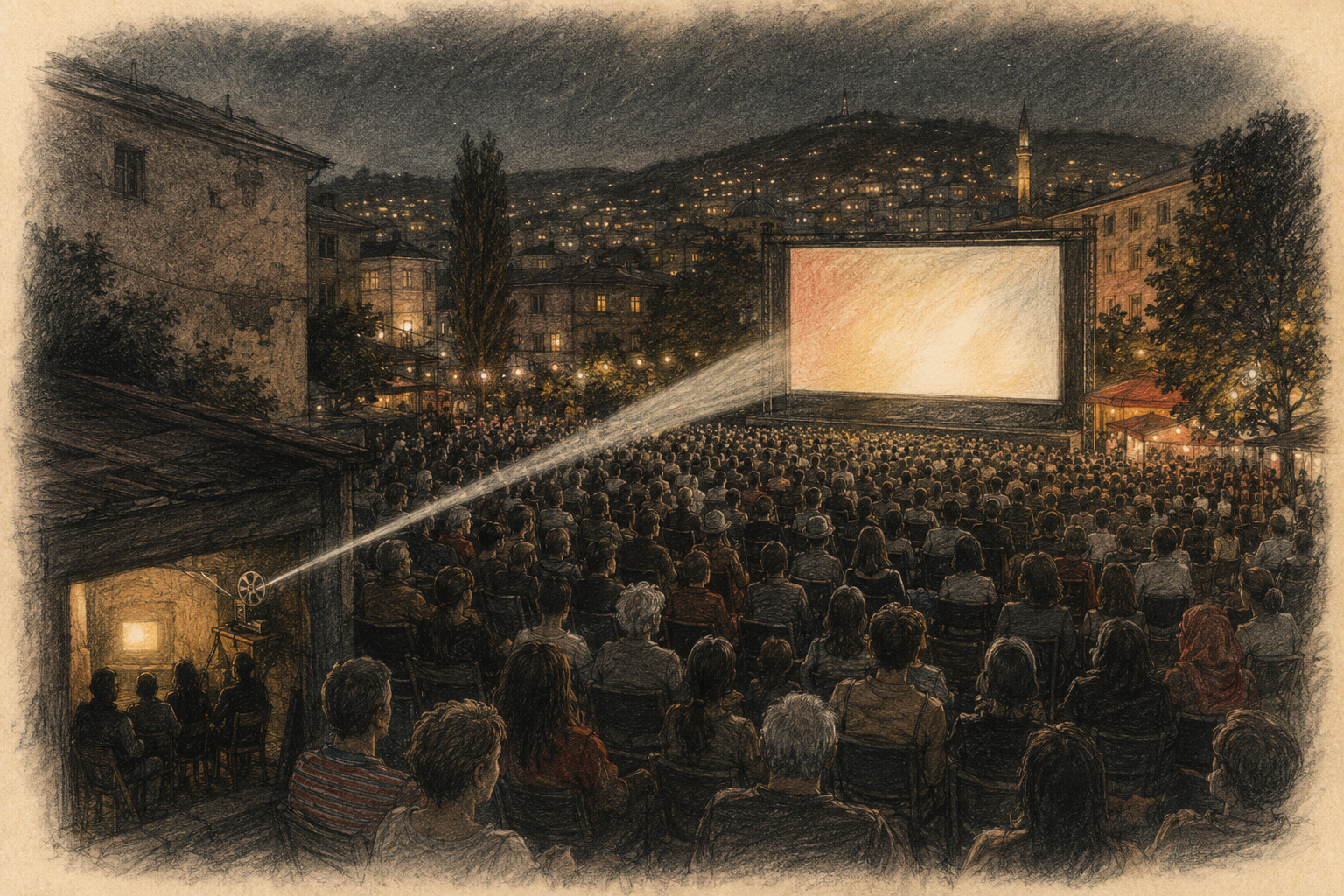
Today the festival has no single venue. Its screens are spread across Sarajevo, from the National Theatre beside the Miljacka to a large open-air cinema seating around 3,000 and smaller cinemas in different neighbourhoods. What began in a protected basement in 1993 has returned to public space. People no longer sit hidden before the screen. They watch films together beneath the open summer sky.
Thomas and Erika Mann return
The festival’s 32nd edition opens on Friday, 14 August, with the international premiere of Paweł Pawlikowski’s “Fatherland”. The Polish director, awarded Best Director at Cannes this spring, will present the film in Sarajevo.
Pawlikowski follows Thomas Mann and his daughter Erika through Germany in 1949. In a black Buick they travel from Frankfurt in the American occupation zone to Weimar in the Soviet zone. Between the two cities lie ruins and a country already dividing into two political systems only a few years after Nazi rule.
Many adult readers will know Thomas Mann as the author of “Buddenbrooks”, “The Magic Mountain” and “Mario and the Magician”. He received the Nobel Prize in Literature in 1929. After the Nazis came to power, he remained in exile and eventually lived in the United States, broadcasting addresses to Germans from there during the war.
Erika Mann was far more than a famous writer’s daughter. She was an actor, journalist and political writer. Her cabaret “Die Pfeffermühle” mocked the Nazis early on, and the regime stripped her of German citizenship. She worked as a correspondent during the Second World War and reported from Europe in 1945 and 1946, observing the Nuremberg Trials as the only woman correspondent.
Hanns Zischler plays Thomas Mann and Sandra Hüller plays Erika. The cast also includes August Diehl and Devid Striesow.
The 1949 journey is more than a writer’s homecoming. Mann encounters a country eager to honour him even though many Germans had rejected or ignored his warnings about Hitler. After being celebrated in Frankfurt, he travels to the Goethe festivities in Weimar, crossing the emerging Cold War line even before the two German states are formally founded.
Erika accompanies him as more than a daughter. She knows the ruined cities first-hand, has reported on war and its crimes and repeatedly presses her father for political clarity. Between them lie intimacy, dependence and contradiction, as well as the question of who owns a country: those who stayed, or also those forced to leave because they were persecuted?
That Sarajevo should open its festival with this film seems almost inevitable. A city that was destroyed, besieged and intended to be divided by ethnic categories looks at another country after a lost war. The two histories cannot be equated, yet they touch the same difficult question: how does a society live with its past after catastrophe without concealing it or misusing it in the present?
Films from a region that does not end at its borders
This year, 51 films compete for the Hearts of Sarajevo. Alongside feature, documentary, short and student films, the festival includes children’s and youth programmes and the “Dealing with the Past” strand, which asks how cinema can preserve memory and open conversations about violence, responsibility and denial.
Mexican actor and director Diego Luna will receive an Honorary Heart of Sarajevo. Iranian filmmaker Asghar Farhadi is the subject of a retrospective, and British actor Emily Watson chairs the feature-film jury.
More important than the individual names is the map visible in the programme. Productions from Bosnia and Herzegovina, Croatia, Serbia, Montenegro, North Macedonia, Kosovo, Albania, Slovenia, Romania and elsewhere meet without remaining sealed in national compartments. Many are co-productions that cross today’s borders.
The Serbian-Croatian project “Yugo Goes to America” is one example. The documentary “We Shall Live Together” looks at Mostar and at people who oppose nationalism and the city’s continuing division. The festival’s emerging-talent programmes also connect filmmakers from Sarajevo, Zagreb, Belgrade and other places.
Such collaboration does not solve political conflicts. But it contradicts the idea that the region’s stories can be neatly separated.
Peace is not the same as reconciliation
Three decades after the war, former adversaries have not simply become friends.
The Dayton Agreement ended the fighting in 1995, but also established a complex state order structured largely along ethnic lines. Bosnia and Herzegovina consists of the Federation of Bosnia and Herzegovina, Republika Srpska and the special Brčko District. Many offices, veto rights and responsibilities follow assignment to the three so-called constituent peoples.
This order initially secured peace, but it also carries part of the separation forward. Schools teach different versions of history. Some war crimes are relativised or denied. Nationalist politicians sustain distrust because it gives them power. Return, property and memory remain contested in many places.
In 2026, the High Representative for Bosnia and Herzegovina describes the security situation as stable but fragile. Secessionist threats and nationalist rhetoric show that the war has not entirely disappeared from politics.
It would therefore be too easy to tell the festival as a story of completed reconciliation. A shared film night does not repeal a constitution. A co-production does not erase survivors’ pain. And the duty to understand one another must never equate victims and perpetrators or obscure responsibility.
Yet it would be equally wrong to claim that only hostility exists between these societies.
People cross borders again, work together, fall in love, argue and make films. Young directors who did not experience the war inherit its consequences, but not necessarily its front lines. They tell stories about families with multiple affiliations, cities with contradictory memories and a generation unwilling to remain bound forever by the decisions of its parents and grandparents.
On the festival’s screens and behind the scenes, another map therefore takes shape. It is not without borders or wounds. But on it Sarajevo, Zagreb, Belgrade, Ljubljana, Skopje, Pristina and Podgorica appear not merely as capitals of separate states, but as places in a shared cinematic conversation.
Side by side before the screen
The Sarajevo Film Festival began in a besieged city whose residents sat together in the darkness of a basement cinema. They could not end the war outside. They did not know when the generator would fail or whether they would return home safely.
But they decided that images not made by the besiegers must continue to exist. They insisted on remaining spectators, artists and citizens.
Today international stars walk the red carpet, films premiere, awards are presented and new productions arranged. The festival has become larger, more professional and more glamorous. Beneath that glamour remains the memory of a generator, a handful of videotapes and people who risked their lives to go to the cinema.
Perhaps that is the festival’s real power. It does not claim that every wall has disappeared. It raises a screen before which people from different sides can sit next to one another again.