Museum crime scene: Berlin follows the clues all night
Forgeries, fossils, the black market and confiscated art: during the Long Night of Museums, Berlin becomes one enormous investigation scene tonight. But what can a museum object actually reveal about a crime?
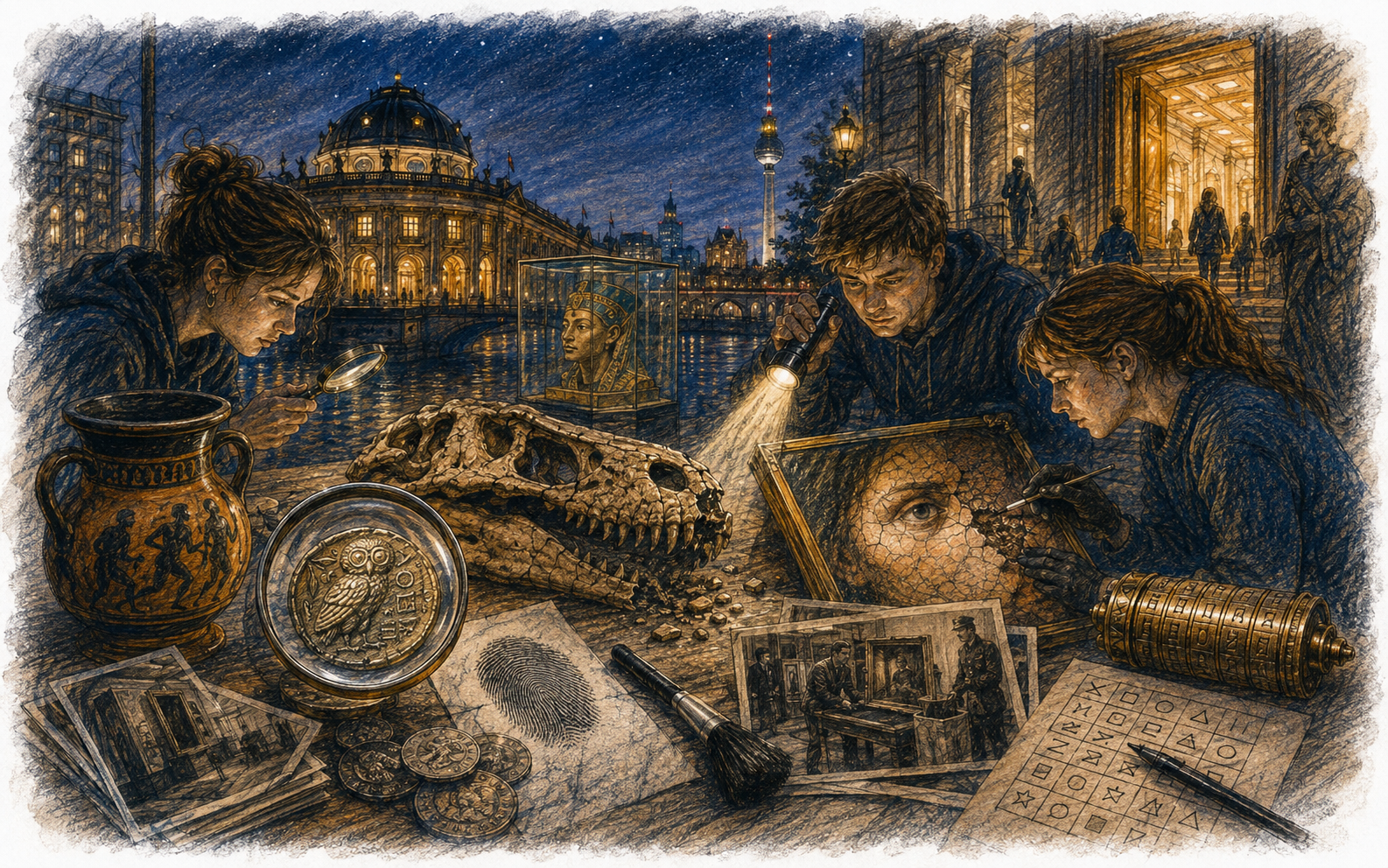
Tonight, Berlin is investigating.
Not only at a police station and not only at a crime scene. At 6 pm, a search for clues begins in 75 museums, exhibition venues, memorial sites and other cultural institutions and continues until 2 am.
The 44th Long Night of Museums takes place under the theme “Crime in Berlin”. More than 750 events explore forgery, theft, the black market, violence, cybercrime and the question of what objects can reveal about a crime.
At first, that sounds like a detective story.
But some of the most interesting investigators tonight do not carry badges.
They work in museums.
When a colour exposes the forger
At the Bode Museum, a tiny detail can determine whether an artwork is worth millions – or is part of a fraud.
Tonight René Allonge from the Berlin State Criminal Police Office's art crime unit and Stefan Simon from the Rathgen Research Laboratory discuss real cases of art theft and forgery.
One of them led to Wolfgang Beltracchi, one of Germany's best-known art forgers.
The decisive clue was not discovered during a spectacular chase.
It was hidden in the paint.
When scientists examined supposedly old paintings, they found pigments that had not even been available at the time the works were claimed to have been created.
A painting can therefore become a witness itself.
Someone only has to know what to look for.
Nearby, the investigation goes even further back in time. At the Münzkabinett, genuine coins sit beside counterfeits. False money has existed almost as long as minted money itself, and collectors' pieces have also been copied for centuries.
Under a microscope, in the material or in tool marks, differences can become visible that an untrained eye might never notice.
A crime scene millions of years old
A few kilometres away waits a case in which every human suspect can immediately be ruled out.
At the Museum für Naturkunde, fossils become evidence.
Bite marks, damaged bones and other changes can reveal what happened millions of years ago. Who fed here? What happened to an animal after it died? And which damage may have appeared much later?
The tour is appropriately called “Tatort Urzeit”.
Suddenly a fossil no longer looks like just an old bone.
It is a clue.
And the researchers' task is surprisingly similar to detective work: observe, compare, rule out possibilities and reconstruct a story from the few traces that remain.
Can the future be a crime scene too?
The Futurium reverses the direction.
There, the clues do not lead into the past but forward.
In “Tatort Zukunft”, devices, diseases and the consequences of our prosperity become suspicious cases. Visitors investigate which problems might arise and which decisions could prevent a development from becoming a future “crime scene”.
The word investigation suddenly takes on another meaning.
Normally investigators search for something that has already happened.
Here the challenge is to recognise warning signs in time, before something happens.
Perhaps this is the most unusual form of detective work of the entire night.
When the state itself becomes the perpetrator
But “Crime” in Berlin is not treated playfully everywhere.
At Schönhausen Palace, the focus is on artworks that were defamed as “degenerate” under National Socialism and confiscated from German museums.
Some of these works were subsequently stored at the palace.
Here the investigation does not lead to an individual thief or forger. It leads to a state that removed certain art from museums, persecuted artists and decided which works were allowed to remain publicly visible.
Stories like these also belong in museums.
An object can show more than how people once lived.
Sometimes its history also shows who held power, who abused it – and what was taken from others.
Museums full of suspects
Of course, there is also room for play tonight.
At the Deutschlandmuseum, visitors can discover which goods were especially valuable on the post-war black market. At the Museum für Kommunikation, families can draw facial composites, decode secret messages and track down a missing telephone.
Other museums turn their own collections into suspects.
Ancient sculptures tell stories of murder, violence and power. Musical instruments lead to illegal copies, scandals and strange rumours. Even historical medical instruments can be treated as “witnesses”.
A shared theme therefore does not produce one enormous crime story.
It creates hundreds of small cases.
Why museums?
Perhaps that is precisely why “Crime in Berlin” fits the Long Night of Museums so well.
Museums collect things.
But things do not enter display cases without histories.
Who made them?
Who owned them?
How did they get here?
Are they genuine?
What was done with them?
And sometimes even: should they be here at all?
These are questions museum researchers have to ask anyway.
Tonight they simply sound a little more like questions from a criminal investigation.
From 6 pm until 2 am, visitors can move between the participating venues, with a special shuttle service connecting different locations.
Anyone looking only for an entertaining detective story will probably find one.
But anyone who looks more closely will discover something else:
A museum is full of clues.
Some have been there for millions of years.
Some were deliberately erased.
And some may simply be waiting for someone to ask the right question.