The LIT does D&D
Twenty-eight young people are planning their own literature festival in Waterford. They choose guests, develop events and help run the festival themselves. “The LIT does D&D” is one of their ideas. By young people, for young people – an idea worth copying.
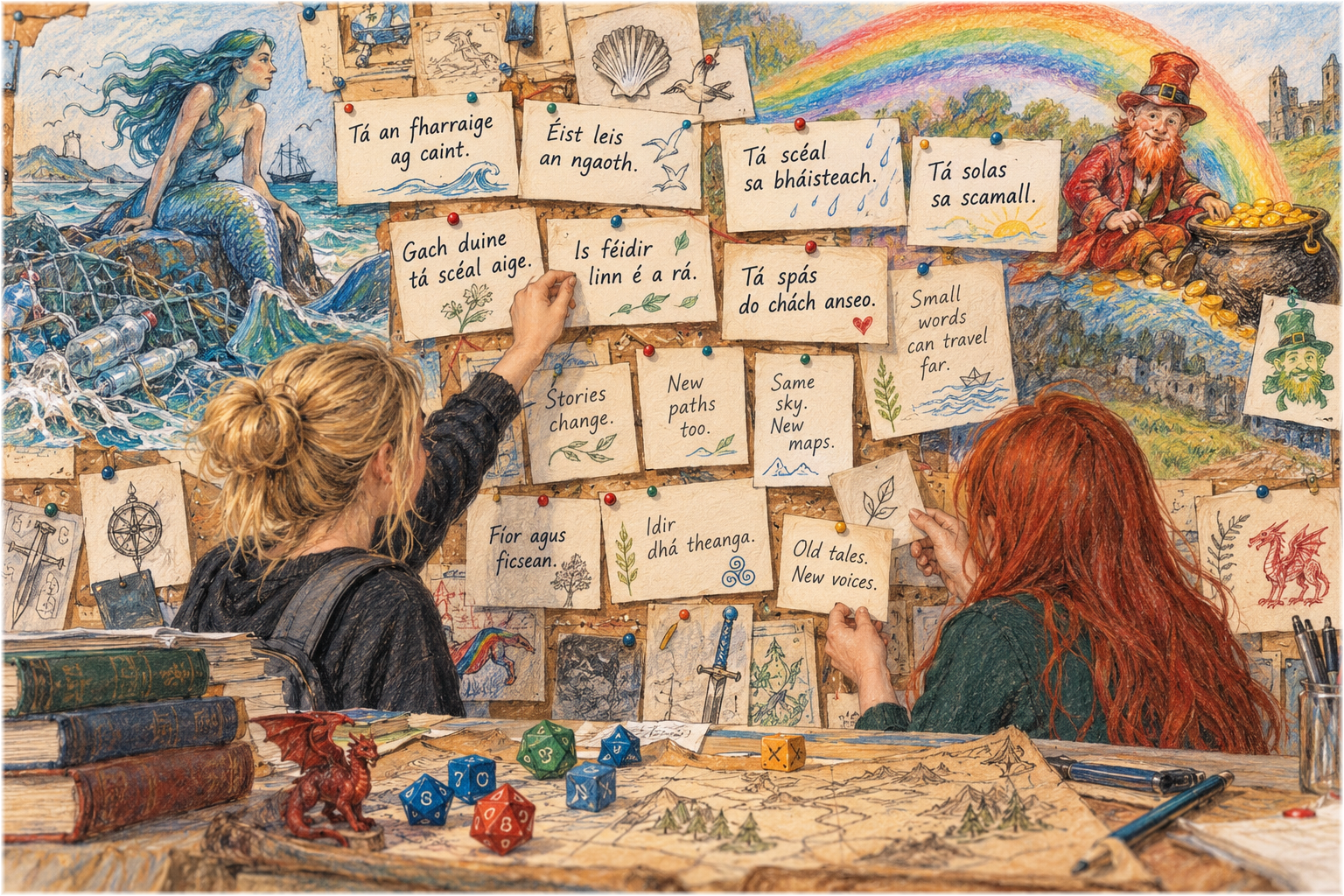
You have an idea for a literature festival: three hours of Dungeons & Dragons. Invent characters, build a world and create a story together. Now all you have to do is convince someone that it really belongs at a literature festival.
In Waterford, the answer might be rather short: why not?
This year, 28 young people aged 14 to 19 help decide what goes into the programme of youth literature festival The Lit. They choose guests, develop events and help run the festival. One of them is Gray Kennedy Rowe. Gray explicitly describes the young people's role as far from tokenistic: they really do help build the festival. And one of Gray's own ideas is now on the programme: “The Lit does D&D” – three hours of role-playing at Waterford City Library.
By young people, for young people
The Lit begins today with its gala, featuring stories and poems, a conversation with spoken-word artist Mikey Cullen and the Ollie Award for Artistic Citizenship. Three more days follow with workshops, conversations, an open mic and events that young people do not simply attend but help shape.
At first, that sounds like a literature festival. It becomes more interesting when you ask who decided what should happen there.
The Lit grew out of Waterford Youth Arts in 2017. Today, its concept is not merely to invite young people but to give them decisions to make. This year's group is the largest in the festival's history. That does not mean the adults disappear. In the official programme, the young organisers jokingly introduce them as “the adults” – the people who answer emails and buy snacks. That little description already says quite a lot about who is supposed to be at the centre of this festival.
Does D&D count as literature?
On Saturday, the answer is fairly clear: yes.
“The Lit does D&D” begins with how to build a campaign before the adventure itself gets under way. That is not as far removed from writing as it might sound. A character needs traits and a past. A world needs rules. Decisions change the plot. The difference is that the story is not already finished inside a book. Several people continue telling it together.
It fits that this particular event came from one of the young co-organisers. Gray says they entered the project feeling rather anxious and hoping to become more confident. Now one of their own ideas is part of the public festival programme. We do not know how it was proposed, discussed or approved internally. We do know that it will take place at the city library from 2 to 5 pm on Saturday. That is more than being allowed to join in. Giving someone responsibility also means giving them the chance to achieve something with an idea of their own.
And where is the pot of gold?
“Mythmaking in Modern Ireland” asks what happens when old figures live on in new stories. Ruth Ennis does this deliberately in “Shorelines”. Her mermaid Muireann flees a sea badly damaged by the climate crisis. Food is becoming scarce, and her twin sister dies in a fishing net. On land, Muireann encounters human cruelty and body shaming. An old story is given problems from the present.
Ellen Ryan approaches inherited stories from another direction. In “They Called Us Witch”, she tells the stories of ten real women from different cultures who were associated with magic – healers, seers, priestesses and other women who resisted oppression. Here too, the question is how we look at old stories today and whom we recognise in them.
And since we are in Ireland: where is the pot of gold at the end of the rainbow?
The leprechaun really is an old figure in Irish storytelling. But if you have just imagined a little red-bearded man in a green suit with a pot of gold beneath a rainbow, you have already arrived at a more modern version.
Older traditions describe the leprechaun, among other things, as a solitary shoemaker and do indeed connect him with hidden gold. We do not even have to take away his pot of gold: Ireland's Schools’ Collection includes, for example, a story about a captured leprechaun and a hidden pot full of gold. It is the familiar overall image that has not remained unchanged since ancient times. In the nineteenth century, leprechauns were often described as wearing red rather than green. The cheerful green fellow at the end of the rainbow was popularised especially through twentieth-century depictions.
That makes the leprechaun a surprisingly good example of mythmaking: an old figure does not disappear when people retell its story. But after enough retellings, the newer version can eventually look as though it had always been there.
Between two languages and a living wall
Elsewhere in Waterford, literature is interpreted rather broadly too. Joanne McCarthy writes in Irish and English. At the “Spark Open Mic”, young voices take the stage themselves. Children and teenagers can visit the “Clinic Leabhair” run by Children’s Books Ireland for book recommendations. And then there is a “Living Poetry Wall”.
The published programme does not tell us exactly what makes that wall living. So we will not invent an explanation. Somehow that seems rather appropriate for a festival where stories do not always have to be finished already.
When responsibility is worth taking
You can tell young people that they should take responsibility. Or you can give them something worth taking responsibility for.
That takes more than praise. Someone who develops an idea, invests time in it and stands behind it should at least have the opportunity to make something of it and experience a real sense of achievement. Not every idea has to work. Not every proposal has to be accepted. That, too, is part of genuine responsibility.
The Lit does not provide a ready-made instruction manual. We do not know, for example, how the 28 young organisers make decisions among themselves. But we can see what has emerged publicly: a festival programme in which a mermaid encounters the climate crisis, old stories are reconsidered, and one young person's idea becomes three hours of Dungeons & Dragons in the city library.
“You can take part” is a beginning. “You can help decide” goes further. And it becomes really interesting when someone looks at the result and no longer asks, “Who helped you do that?”, but instead: “How did you do that?”