Many Faces, Many Stories
A new production, “Romany Face – Romengi faca”, premieres at Müpa Budapest. The Duna Art Ensemble brings dance, music and poetry together to explore the rich variety of Roma traditions across the Carpathian Basin.
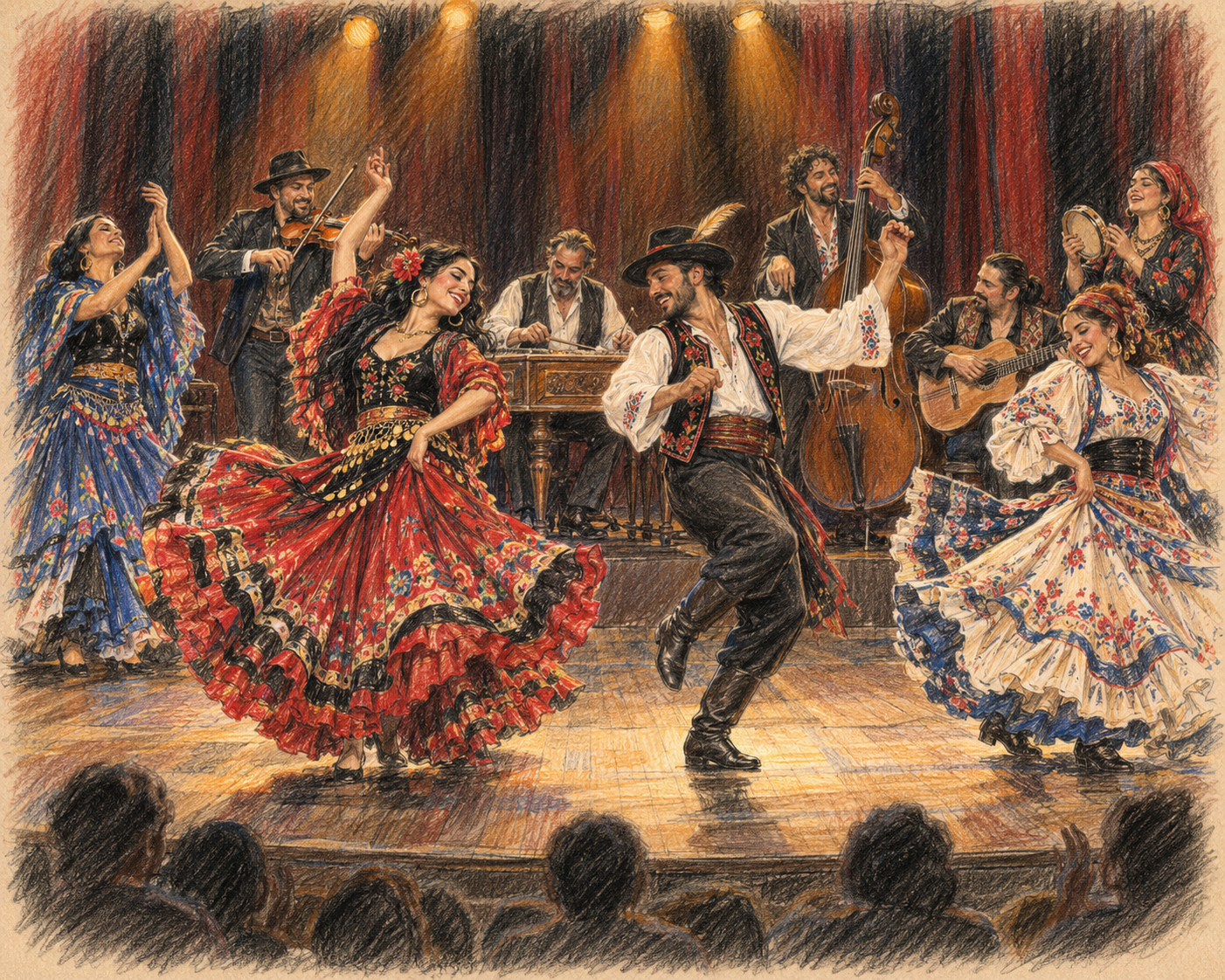
Budapest, 15 October 2026 – Can a single evening of dance tell the story of an entire culture? On Thursday, the Duna Art Ensemble sets out to explore that question at Müpa Budapest’s Festival Theatre. Its new production, “Romany Face – Romengi faca”, journeys through the many musical and dance traditions of Roma communities in the Carpathian Basin. The 7 pm premiere has already sold out.
On stage, the ensemble’s dancers will be joined by musicians from the Göncöl band. Poetry and visual art also inform the production. The performance is part of Liszt Fest, an annual celebration that brings together many forms of music and the performing arts.
The title can be read as “Faces of the Roma”. But how many faces can a culture have? And how do you begin to recognise their differences when you know so little about them?
One Stage, Many Traditions
Director and choreographer Zsolt Juhász has spent decades working with traditional dance and finding new ways to bring it to the stage. Born in Szeged in 1967, he initially studied sculpture. He had already started dancing as a child. He joined the Duna Art Ensemble in 1992 and has been its artistic director since 2007.
Founded in 1957, the company is one of Hungary’s long-established professional folk-dance ensembles. Its work ranges from preserving traditional dances to creating contemporary stage productions. It performs with the Göncöl band, whose musicians draw especially on inherited folk-music traditions.
For the new production, Juhász is collaborating with choreographers Tamás Farkas and Kristóf Fundák. István Szilvási, András Soós, Zoltán Dulai and Lőrinc Bubnó are responsible for the music. Sets, costumes, lighting and video art give the performance additional forms of expression.
Choosing which traditions to include, however, is anything but straightforward.
Lovari dance traditions differ from those of Boyash or Sinti communities. There are also cultural distinctions between Roma communities in Hungary and Transylvania. The Upper Tisza region, Somogy, the foothills of the Mátra mountains and villages in Transylvania have each developed their own approaches to dance and music.
To gather all of this under a single label is to miss a great deal. That is precisely why the ensemble wants to make variety visible: different movements, rhythms and musical traditions, shaped and passed on across generations.
More Than One Role
One of the performers is Hungarian actress Franciska Farkas. She became known for her leading role in the film “Viktória – A zürichi expressz”, as well as appearances in the television series “Aranyélet”.
Her route into acting was not a straight line. Before gaining wider recognition on screen, she worked in the social sector and became involved in theatre education. She later wrote and performed work of her own for the stage.
In interviews, Farkas has spoken repeatedly about how limiting it can be when people see only someone’s background or assign them a single social role. She wants to be recognised for her work as an actress, not defined solely by her Roma heritage.
That thought resonates with an evening devoted to the diversity of cultural identities. A face, after all, cannot tell you everything about a person. Nor does sharing a cultural background mean sharing precisely the same experiences, customs or beliefs.
How Farkas brings these ideas into the new production will become clear at the premiere.
When Tradition Takes the Stage
Dances and songs do not emerge in a vacuum. They belong to celebrations, families, villages and communities. People learn them from one another, adapt them and pass them on. Some elements endure for generations; others continue to change.
Once such traditions reach a large theatre stage, their setting changes too. A dance that began as part of a celebration becomes choreography. Music once played together in a community becomes part of a carefully shaped performance.
The artists must make choices. What should stay as close as possible to the original tradition? Where is there room for new forms? And how can the distinct character of each tradition survive when several come together in a single evening?
The Duna Art Ensemble has explored questions like these in earlier productions. “Romany Face” likewise aims to do more than reproduce historical dances: it brings movement, music, poetry and visual art into conversation.
That is the real artistic challenge: not presenting one supposedly uniform culture, but giving shape to a complex heritage that remains alive today.
An Evening to Spark Curiosity
Both Thursday’s premiere and Friday’s second performance are sold out. For ninety minutes, the Festival Theatre will become a meeting place for artistic traditions from across the Carpathian Basin.
Some audience members may encounter dances they have never seen before. Others may recognise melodies or movements from their own lives.
The ensemble invites everyone to watch and listen more closely. Behind a shared name, there can be many different stories.
And sometimes discovering a culture begins quite simply when someone starts to dance.