Why is there a rhinoceros in a church?
A huge white rhinoceros blocks the way inside St Nicholas Church in Zeitz. Itamar Gov’s installation connects Albrecht Dürer’s famous woodcut with Eugène Ionesco’s play and asks how images and conformity can shape our sense of reality.
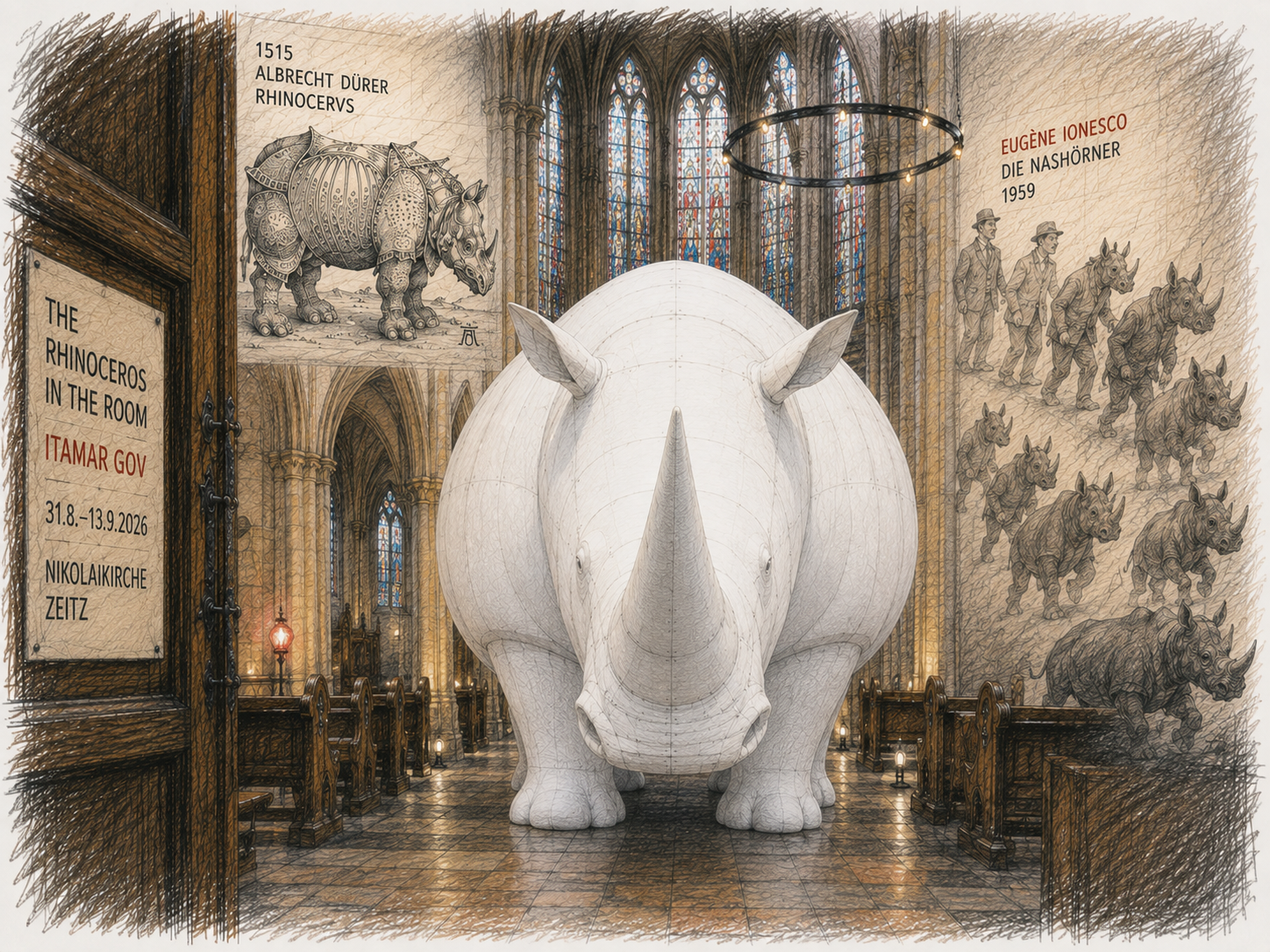
Anyone entering St Nicholas Church in Zeitz these days suddenly finds themselves facing a rather unusual obstacle: an enormous white rhinoceros, larger than life.
It stands right in the middle of the church, positioned so that it blocks both the view and the way through. The animal is accompanied by a multi-channel sound composition for eight cellos and voice. Artist Itamar Gov’s installation “The Rhinoceros in the Room” can be seen in Zeitz from 31 August to 13 September.
But why a rhinoceros?
A rhinoceros Dürer never saw
One clue takes us back more than 500 years – to Albrecht Dürer.
Dürer was born in Nuremberg in 1471 and became one of the best-known artists of the German Renaissance. He painted and drew, but he was also famous for his woodcuts and engravings. Prints like these could be reproduced in large numbers, allowing them to travel much farther across Europe than a single painting ever could.
Then, in 1515, something extraordinary happened: an Indian rhinoceros arrived in Lisbon. For most people in Europe at the time, an animal like this was completely unknown.
Dürer probably never saw the rhinoceros himself. Descriptions of it and a drawing did, however, reach Nuremberg. Using them, he created his famous woodcut “Rhinocerus”.
The result is impressive – but it does not look quite like a real rhinoceros. Dürer gave the animal skin that resembles a suit of armour and even added a small extra horn to its back.
And yet this was the image that became famous. For generations, it shaped the European idea of what a rhinoceros looked like.
Today, the story almost feels like an early example of the power of images: if we have never seen something for ourselves, how much can an image determine what we believe to be real?
Of course, Dürer was not deliberately spreading false information. He was working with the knowledge available to him. That is precisely what makes the story so interesting: an image does not have to be intended to deceive us in order to influence our idea of reality.
From Dürer to Itamar Gov
More than five centuries later, Itamar Gov picks up this story.
Gov was born in Tel Aviv in 1989, has lived in Berlin since 2010 and studied subjects including film, literature and history. There is no personal connection between him and Dürer, just as there is no known biographical link between Dürer and Zeitz.
The connection is the rhinoceros itself.
Gov’s art deals with history and memory, and with the ways facts, stories and imagination can merge into one another. Dürer’s rhinoceros is a particularly striking example: a real animal arrives in Europe, reports about it travel onwards, an artist turns them into an image – and that image then influences the imagination of other people for centuries.
In a way, the rhinoceros in Zeitz continues that journey.
It began in India, travelled via Lisbon and Dürer’s Nuremberg, and more than 500 years later has arrived as a work of art inside a church in Zeitz.
And then there are Ionesco’s rhinoceroses
But Gov also refers to another famous rhinoceros story.
In 1959, the French-Romanian playwright Eugène Ionesco published “Rhinoceros”. In the play, the inhabitants of a town gradually turn into rhinoceroses. Something that initially seems completely absurd becomes increasingly normal as more and more people undergo the transformation.
The play is often understood as an exploration of conformity and totalitarian thinking: what happens when more and more people follow a movement until hardly anyone is left willing to object?
That gives the enormous animal inside the church another layer of meaning.
Perhaps the rhinoceros is not simply something we are meant to look at.
Perhaps it is meant to get in the way.
You cannot simply look past it. It blocks your path. You have to change direction, confront it and ask yourself why it is there at all.
And suddenly, a rhinoceros in a church leads to some surprisingly current questions:
How do we form our ideas about reality? Why do we trust images? And what happens when everyone else seems to be moving in the same direction?
Perhaps that is exactly why this rhinoceros is so large.
It is not meant to be overlooked.