What emerges in between?
Nine young actors and performers, one young director and a training journey they have shared. Tonight in Rome, their work opens to an audience for the first time. The programme published so far does not yet reveal what has emerged from it.
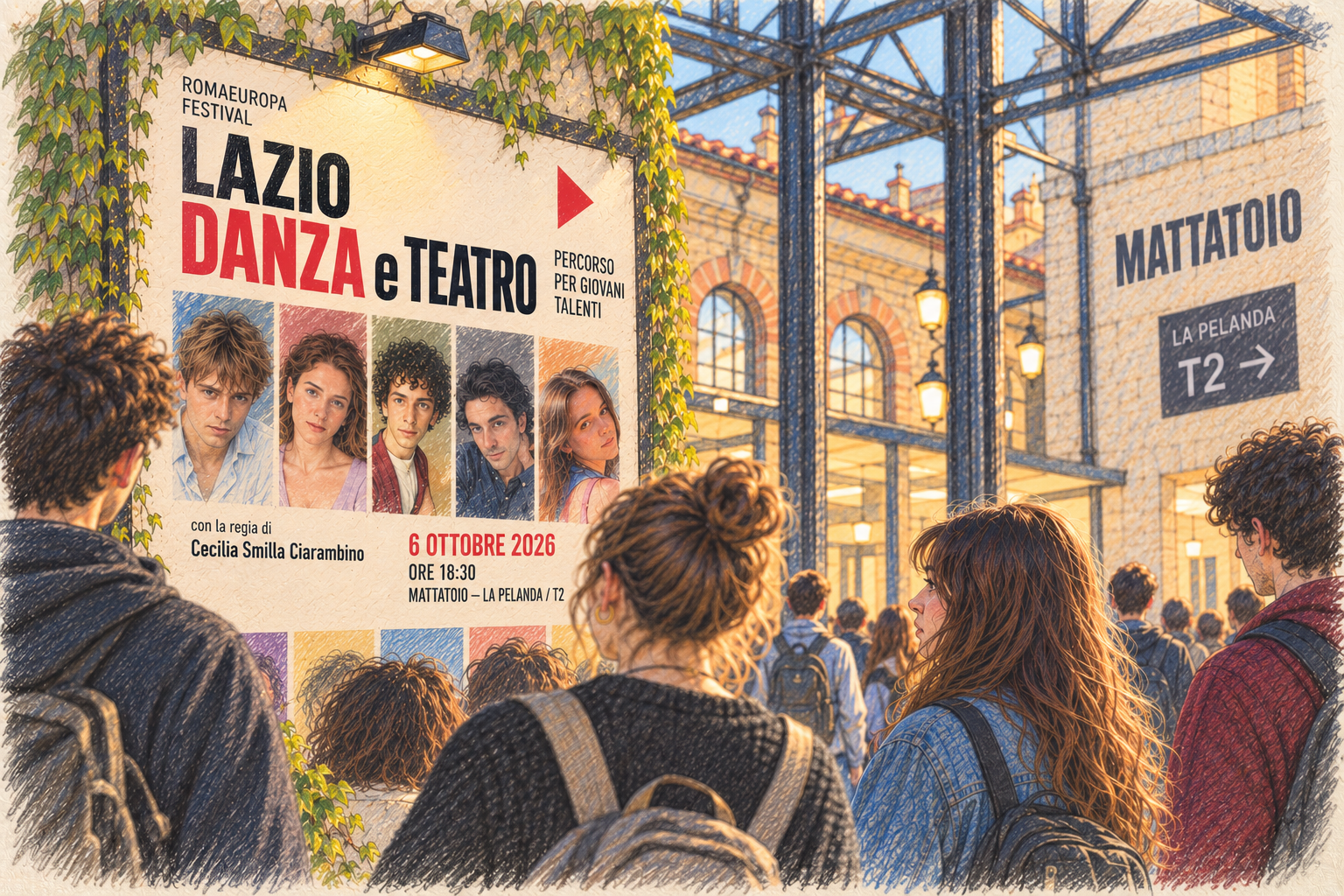
ROME – Nine young actors and performers. One young director. One sings baritone and plays piano and guitar; another has worked with masks, improvisation and biomechanics. The director, meanwhile, has explored Shakespeare and Brecht, assisted on Ibsen and Schiller productions and performed on stage herself. Tonight, all those paths meet an audience at the Mattatoio in Rome. What they will show there has not yet been revealed by the programme published so far.
That is unusual. Before a night at the theatre, you normally know at least the title of the piece. You may know the writer and sometimes even the story. With “Lazio Danza e Teatro”, what we know above all so far is who has been working together. That is precisely what makes it interesting.
What does Lazio want to achieve?
“Lazio Danza e Teatro” is new this year. The programme is supported by the Lazio Region and implemented by Lazio Innova. It is aimed at young people living or domiciled in Lazio who are active in classical or contemporary dance or theatre. Applicants had to be at least 14 and not yet 35.
The idea is not simply to find young artists for a single performance. Lazio describes a path that leads from nurturing talent through training and professional development to actual stage experience. Training, production and entry into the professional cultural world are meant to connect.
For the theatre strand, the numbers were remarkably precise: nine actors or performers and one director were sought. Alessio Curzi, Alessandra De Luca, Francesca D’Urso, Viola Figoli, Francesco Galliano, Giuliano Guadagno, Bianca Librizzi, Caterina Lucente and Luca Morciano were selected as performers. Cecilia Smilla Ciarambino took the directing place. Francesco Galliano joined after the originally selected Claudio Scagliarini withdrew.
The nine performers therefore came into the rehearsal room with experience of their own. And the selected director brought experience of her own as well.
A baritone and a Kostya
With two of them, we can trace those different paths particularly clearly. Alessio Curzi knows both theatre and working in front of a camera. He sings baritone and plays guitar and piano. His 2026 training record also contains two names that belong to the “Lazio Danza e Teatro” theatre programme: Fabiana Iacozzilli and Serena Autieri.
The connection is just as clear for Giuliano Guadagno. His profile also lists training with Iacozzilli and Autieri in 2026. But his set of skills looks rather different: contemporary dance, improvisation, mask work and biomechanics. In 2025 he played Kostya in Chekhov’s “The Seagull”.
Those two alone show how different the starting points within one group can be. A trained voice, musical instruments, physical work or masks may not even be clearly recognisable in the final result. But those experiences entered the rehearsal room with them. And the person waiting there was not simply a fully established director brought in to lead nine newcomers.
The director is being supported too
That makes Cecilia Smilla Ciarambino particularly interesting in this project. She was not hired as an experienced leader for nine emerging performers. The directing place itself was part of the open call – and Ciarambino was selected for it.
She was not starting from scratch, however. She studied directing at the Accademia Nazionale d’Arte Drammatica Silvio d’Amico. In 2024 she explored Shakespeare and developed “Quando esplode la bomba”, her own work based on texts by Bertolt Brecht. It was created at the Mattatoio – the very place to which she is now returning with “Lazio Danza e Teatro”. She also worked as an assistant director on Henrik Ibsen’s “The Comedy of Love”. The same year took her to Spoleto, where she assisted on Schiller’s “Mary Stuart”.
Two years later, the “Lazio Danza e Teatro” training programme brought the selected theatre group to Spoleto as well – this time to look behind the scenes of the Festival dei Due Mondi.
Ciarambino also knows theatre from the other side. At Festival Contaminazioni 2025 she developed “Motorino” with Massimo Villani. They did not merely write and direct it; they performed it themselves. The official description has “Massimo and Smilla” bringing themselves onto the stage and asking questions about love, friendship, religion and social values. The young director now working with nine performers therefore also knows what it is like to stand in front of an audience herself.
Two weeks are only part of the journey
There was no single theatre course between the selection and tonight. The programme for the ten included two weeks of training and mentoring with Fondazione Romaeuropa led by director and writer Fabiana Iacozzilli. A six-day masterclass in spoken and musical theatre under the artistic direction of Serena Autieri followed as another part of the programme.
The other side of the theatre business was included too. Producer and festival director Daniele Cipriani led two further sessions. At the Festival dei Due Mondi in Spoleto, the participants were also able to go behind the scenes and encounter different areas of professional theatre work.
That changes the question for tonight. It is not simply about what ten people developed together during a few rehearsals. Between their selection and this performance lie encounters with directing, acting, musical theatre, production and the workings of a festival.
A place that changed itself
The Mattatoio fits this story too. Rome’s former municipal slaughterhouse is now a home for contemporary art and the performing arts. The theatre sharing takes place in T2, in the La Pelanda area.
For Ciarambino, there is a small circle closing here. In 2024 she worked with Brecht’s texts at the Mattatoio. Now she returns with a group that did not even exist a few months ago.
6.30 pm – and something is still unknown
“Sharing Teatro” begins at the Mattatoio at 6.30 pm tonight. Admission is free. Surprisingly, the currently published event programme says little more about its content: so far it lists “Sharing Teatro”, the time and T2, but no separate title for the piece and no synopsis.
That does not mean there will be no title at 6.30 pm. One could still be published beforehand, appear on a programme sheet or be announced at the event. At the moment, we simply do not know it.
There is, however, a lot we already know. We know the ten people who were selected and, for some of them, the experiences they brought with them. We know the training journey they have shared. And we know that the director herself is part of this programme for emerging artists.
Only the question in the headline remains unanswered: what has emerged in between?