What can music do against a war?
On Thursday evening in Dortmund, musicians will share a stage even though their backgrounds, family histories and political experiences could separate them. The West-Eastern Divan Orchestra does not claim that music can end wars. That is precisely where the strength of this unusual orchestra lies.
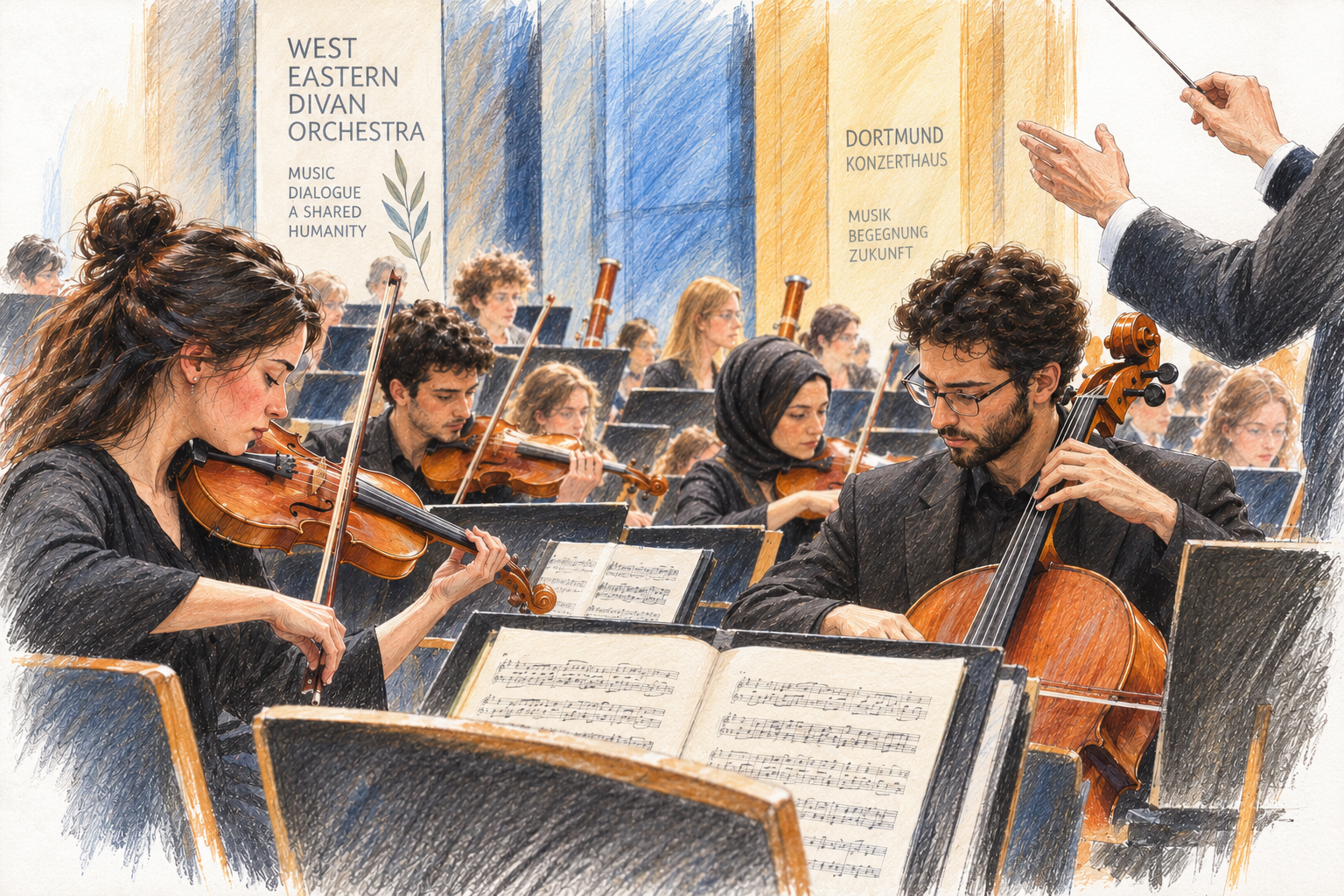
On Thursday at 7:30 p.m., Daniel Barenboim and the West-Eastern Divan Orchestra open the new season at Konzerthaus Dortmund. The programme includes Schubert’s Unfinished Symphony, the Prelude to Wagner’s Tristan und Isolde and Beethoven’s Third Symphony, the Eroica. The concert hall explicitly places its season opening “under the sign of peace”.
That is a large claim for a concert evening. While Beethoven is being played in one hall, people elsewhere are still dying. No orchestra can stop a missile, free a hostage or reverse a political decision. So what can music do against a war?
An orchestra where the opponent sits beside you
In 1999, Israeli conductor Daniel Barenboim and Palestinian literary scholar Edward Said founded the West-Eastern Divan Orchestra. It grew out of their conversations about music, culture and humanity, and from their search for another way of approaching the Israeli-Palestinian conflict. To this day, the orchestra brings together people from the Middle East, especially Israelis and Palestinians.
They do not have to forget their different stories. Nor do they have to agree politically. But something happens in an orchestra that is easily lost in political conflict: anyone who wants to play with someone else has to listen to them. A violin cannot decide that the cellist’s story is wrong. The violinist still has to hear what the cellist is playing, or the shared piece falls apart.
That is why conversations and workshops are also part of the orchestra’s work. During its February 2026 tour, rehearsals and concerts were accompanied by spaces for dialogue as well as one-to-one and small-group conversations using methods of nonviolent communication. Daniel Barenboim stresses an important distinction: dialogue does not mean adopting the other person’s point of view. It first creates a space in which that point of view can be expressed at all.
The hero who disappointed Beethoven
The fact that the Eroica closes the Dortmund evening adds another layer to the programme. Beethoven initially admired Napoleon Bonaparte and the republican ideals he associated with him. Napoleon’s name appeared on an early copy of the Third Symphony. When Napoleon declared himself emperor in 1804, Beethoven became disillusioned with his hunger for power and imperial ambitions. He erased Bonaparte’s name from the title page so forcefully that he left a hole in the paper.
Behind a symphony that became famous as “heroic”, then, lies a story about disappointment in a particular idea of the hero.
Two hundred years later, the work raises an uncomfortable question: who is actually the hero after a war? The person who started it? The person who won it? Or the soldier who comes home with a prosthesis, the family that has lost someone, the people rebuilding a house among ruins – or the person who refuses to see the human being on the other side as nothing but an enemy?
You do not have to tell the same story
The Israeli-Palestinian conflict shows especially clearly how powerful different memories can be. The same places can be connected to completely different family histories, losses and fears. Peace can hardly depend on everyone eventually telling the same story.
In 2025, the orchestra formulated a set of shared principles. What is striking is how cautiously it describes their meaning: they are not a solution, but an ethical compass. They include nonviolence, mutual recognition, equality, dialogue and the conviction that every human life has the same value and dignity. Different experiences and histories are not meant to be erased.
Understanding, then, does not begin when the other person admits that we are right. It begins when we can hear their story without having to give up our own.
What can Dortmund do?
Dortmund is far from the places where people fear for their lives. An audience cannot end a war from a concert hall there. But a society can decide what kind of spaces it creates: spaces where encounter remains possible, where disagreement can be endured, and where an Israeli and a Palestinian are not first of all representatives of two hostile sides, but two musicians who need to find the right entrance together.
The West-Eastern Divan Orchestra has been doing this for more than a quarter of a century. Even during the most recent violence, its musicians have continued to play together and talk to one another.
The orchestra’s most important achievement is not that it plays peace. It is that it proves people can remain together even when much around them pushes them apart.