What Does Reksio Say?
Bolek and Lolek needed hardly any words to tell stories. At the SOUNDESIGN festival in Bielsko-Biała, Reksio shows what happens when image, movement and sound tell a story together.
A person is standing onstage in the rain. Of course, it is not really raining. There is a roof overhead, their clothes are dry, and there may not even be a single prop onstage. Still, they hunch their shoulders. They lean into a wind that does not exist either. One hand holds something invisible above their head.
Then we hear the wind. Quietly at first, then more strongly. Perhaps a piano joins in. Individual notes turn into raindrops. The person onstage starts moving faster. So does the rain.
Nobody had to say: It’s raining.
Stories without words
Mime artists have been playing this game for a long time. They can open doors that are not there, walk into walls nobody has built, or carry heavy suitcases that weigh nothing. The audience sees more than a body on an empty stage. It fills in what is missing.
Film did not invent this ability, but it found a new way to use it. Even so-called silent film was by no means always silent in the cinema. Pianists, small ensembles and sometimes entire orchestras accompanied the images. Music could create tension, comment on a movement or warn us that something was about to go wrong.
Buster Keaton did not need to explain any of this. He could simply stand there and look on while the world collapsed around him. In time, animated characters learned to tell stories in much the same way.
Two boys with plenty to say
Anyone who grew up in Poland probably knows Bolek and Lolek anyway. But many children in East Germany and elsewhere in Europe also encountered the pair on television. They hardly needed to speak.
That did not mean they had nothing to say. Quite the opposite. It was usually easy to tell who had an idea, who rushed off, who became sceptical, who got annoyed and when a small idea was about to turn into a rather large disaster. A glance was enough, a movement, a sound.
Perhaps that was one reason the characters crossed borders so easily. A stumbling Lolek needs no subtitles. And a triumphant Bolek does not have to explain why he is feeling rather pleased with himself.
Later productions also gave Bolek and Lolek voices. For viewers who already knew the mostly silent characters, that could feel decidedly strange. Suddenly they were saying in words what their movements and actions had long been telling us.
And what does Reksio say?
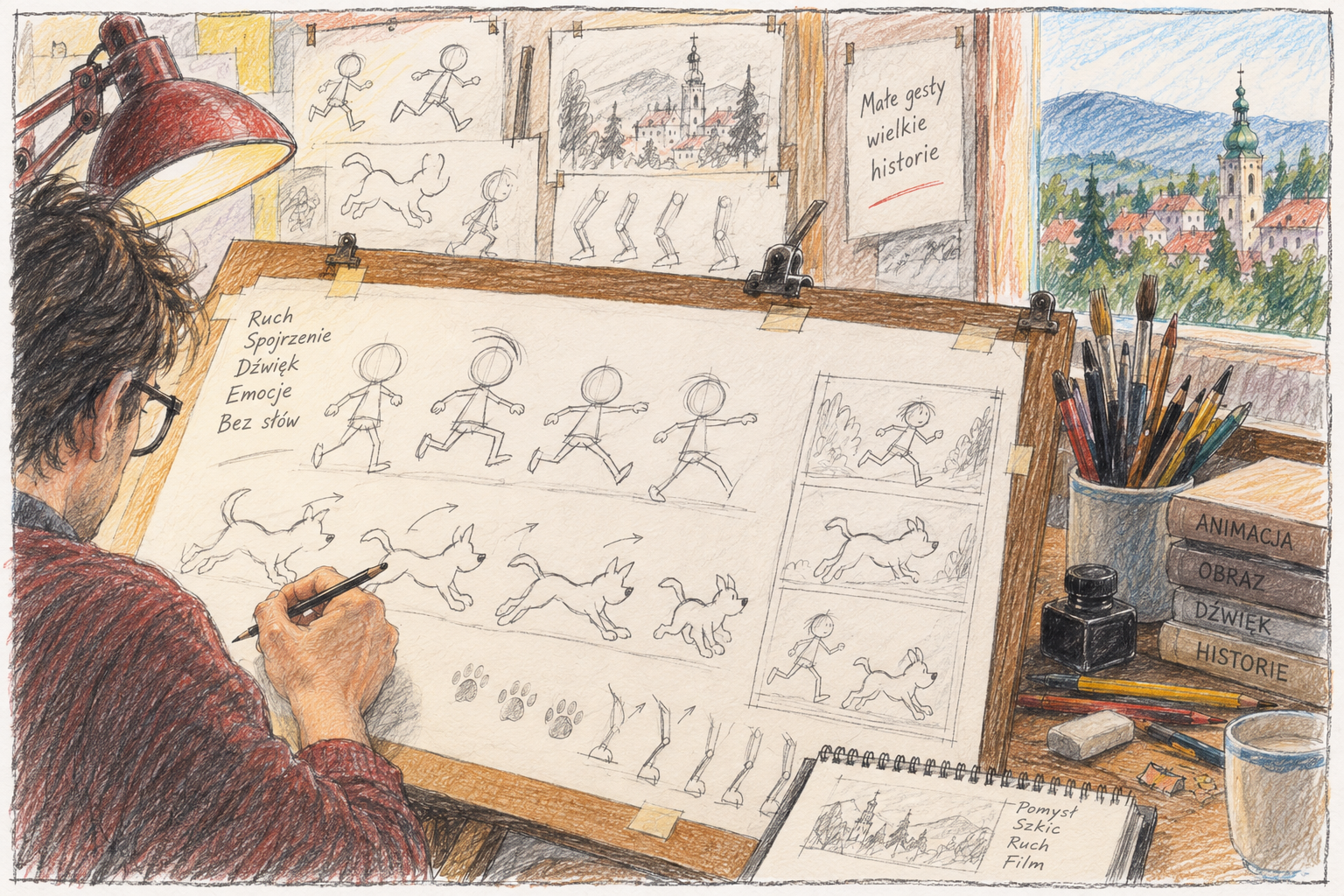
A few steps away in Bielsko-Biała, someone else is waiting: Reksio. Like Bolek and Lolek, the little dog was created at the city’s Studio Filmów Rysunkowych. And on 26 September 2026, he gets new musical companions at Kino Kreska: Polski Piach plays to Reksio.
The trio consists of Patryk Zakrocki, Piotr Mełech and Piotr Domagalski. Guitar, bass clarinet and basetla meet jazz, folk, improvisation and sounds that resist being placed neatly in a single category. At SOUNDESIGN, this is not merely background music. Sound gets the chance to retell images that already exist.
It is an intriguing experiment, because the pictures are already finished. Reksio moves, looks, runs, waits and reacts. But what changes when different musicians accompany those images?
A movement can suddenly seem funny when before it was merely quick. A glance can become a moment of suspense. A sound can make something important that we might otherwise have overlooked. And sometimes we notice a pause only when the music pauses too.
The image stays the same. Yet it tells the story a little differently.
Hearing what we see
That is precisely the idea behind the first edition of SOUNDESIGN, taking place in Bielsko-Biała from 26 to 28 September. Rather than simply presenting film music, it sets out to make us hear how music, composition and sound design interact with images. Bielsko-Biała is a fitting place for it: Bolek and Lolek and Reksio were created here, characters whose stories rely heavily on images, movement and sound.
After Reksio, Saturday’s journey continues. At 4:30 p.m., the focus turns to Henryk Kuźniak’s music for Sexmission (Seksmisja); in the evening, a concert by Moskwa and K-2 once again brings music and visual worlds together. SOUNDESIGN does not simply tell us that sound matters in film. It invites us to listen more closely for ourselves.
Sound design, after all, is not only there when a spaceship explodes, a monster roars or a film score warns us that something terrible is about to happen. Often it makes much less spectacular things perceptible: footsteps on gravel, a closing door, moving leaves, or the wind blowing through a park.
It takes little imagination now to watch a person walking through a park, leaning slightly forward into a wind that we would not hear at all – without sound design.