What Subtitles Can Say
Short films in many languages meet in Nicosia – all of them accessible through English subtitles. They tell stories of strangers, vanished borders and belonging. But what happens when even in the original language it is not entirely clear what a word or metaphor means?
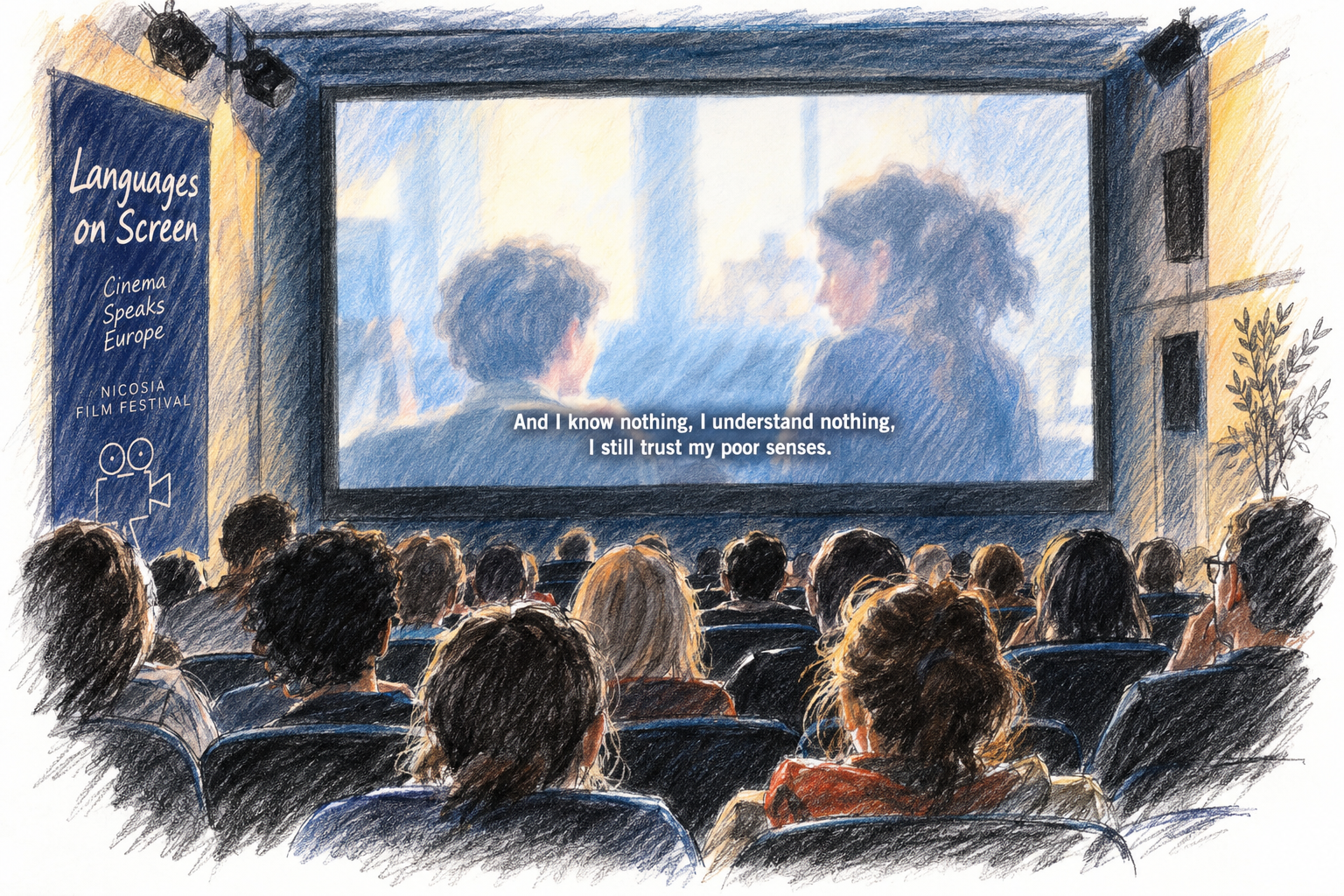
From 22 to 24 September, cinema in Nicosia speaks many languages. “Languages on Screen – Cinema Speaks Europe” brings together short films from different parts of Europe. Some are about borders, others about feeling like an outsider or finding a sense of belonging. And one quietly poses a difficult question: do we really understand the same thing simply because we hear the same words?
When strangers become neighbours
In the French film “Carpinchos”, everything begins with mistrust. A family of capybaras seeks shelter in a henhouse during hunting season. The chickens regard the newcomers as strangers who do not really belong there. But the young of both groups do not respect that division for long. Cautious contact grows into trust. A small animal story becomes a tale about how quickly “the others” can turn into someone with whom we share our space.
A very different border has just disappeared in “Sky Like Silk. Full of Oranges”. The German animated film looks at East Germans who, after the fall of the Berlin Wall, are suddenly free to travel. Mallorca in 1990 means sunshine and holidays, but also the experience of a freedom that had been out of reach only a short time before. Europe appears here not as a map, but as something deeply personal: the possibility of simply setting off.
In “Yu Ming Is Ainm Dom”, language itself becomes the key to belonging. A young man from China decides to emigrate to Ireland and prepares conscientiously by learning Irish. Only after arriving does he discover that the language he worked so hard to learn is not nearly as useful in everyday life as he expected. With humour, the film asks which language really belongs to a country – and whether belonging is as clear-cut as it can seem from afar.
“Purgatory” also brings different languages together. Young people talk about climate anxiety, loneliness, responsibility and a future handed down to them by earlier generations. Their languages differ; their concerns are strikingly similar. That creates common ground: what connects them is not the same origin, but similar questions.
Who has a place in the city?
The Spanish short film “Céntrico” shows that belonging also has a very material side. A family rents a flat in Madrid for a few days. What initially looks like a small ghost story leads to a very contemporary question: what happens to a city when homes increasingly become accommodation for visitors? The supposed haunting suddenly acquires another meaning, and the question of who is merely visiting a city and who can still afford to live there becomes much harder to answer.
When translation has to preserve uncertainty
Emi Buchwald’s “Nauka” (“Education”) is particularly well suited to a festival that brings Europe’s languages to the screen. Yet the film begins in the most ordinary way imaginable: Polish primary-school children are asked to learn a poem by Julian Tuwim by heart.
At home, their parents help. The children ask about words and images they do not understand. The adults explain metaphors, search for meanings and discover that literature cannot be solved like a maths problem. An image can mean several things. One explanation can lead to another. And sometimes an adult is no more certain of the meaning than the child they are trying to help.
In Nicosia, another layer is added. The Polish metaphors and the conversations about them reach the audience through English subtitles. Translation is therefore carrying a conversation about the fact that language itself is not always unambiguous.
That gives the subtitles an almost impossible task: they have to make it clear that something is not entirely clear – without smoothing away the uncertainty itself.
That is one of the most compelling ideas behind “Cinema Speaks Europe”: Europe speaks many languages, and we can try to translate them for one another. But translation alone does not guarantee understanding. Whether we have really understood the same thing in the end remains an open question between people.