When the Vltava suddenly sounds familiar in Stockholm
A South Korean pianist makes his Swedish debut, a French composer brings Basque roots together with jazz, and a Czech orchestra brings Smetana’s “Má vlast” to Stockholm. In the famous Vltava melody, Swedish listeners may hear something surprisingly familiar.
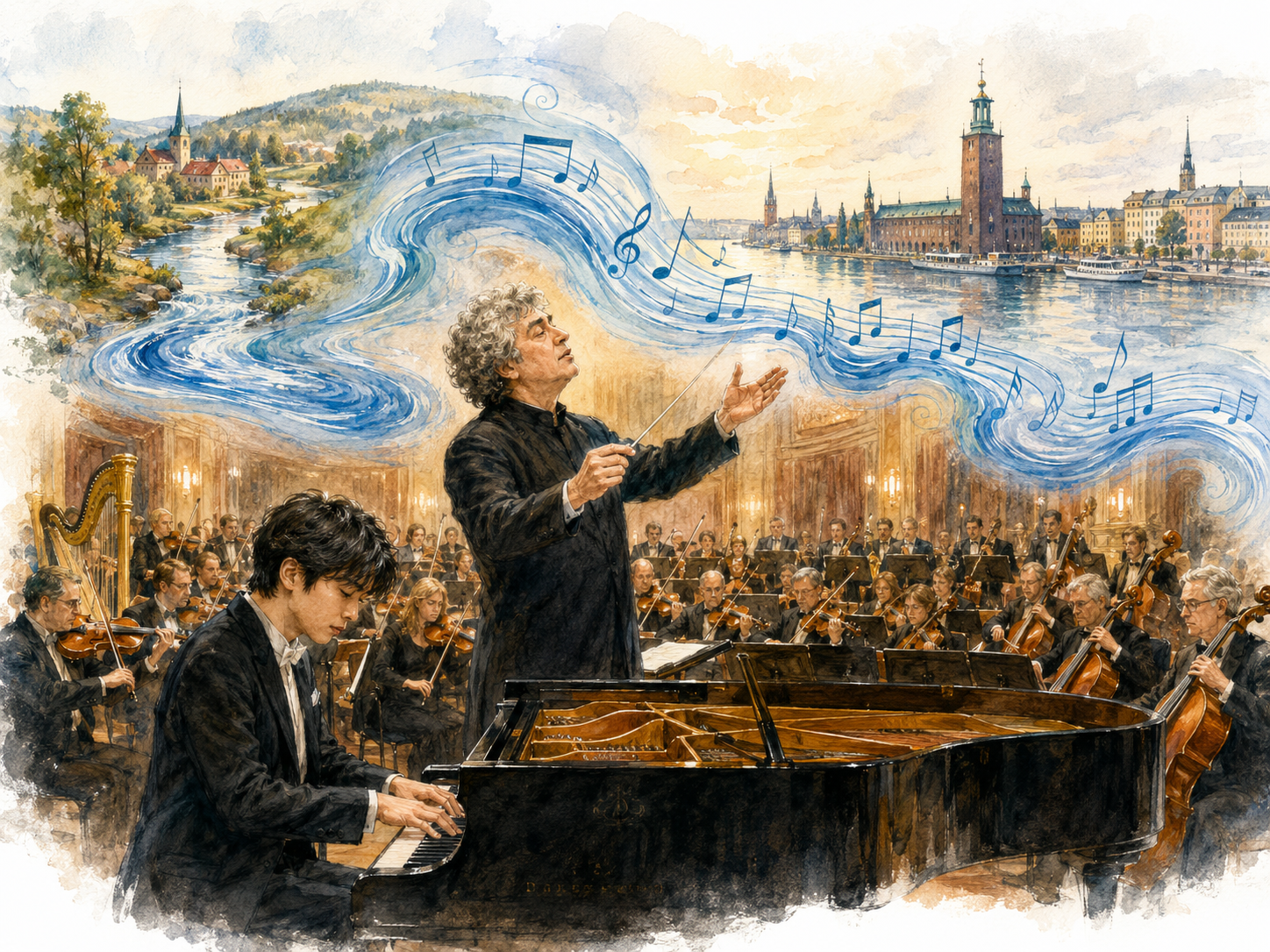
A South Korean pianist makes his Swedish debut. A French composer brings Basque memories and American jazz together. And a Czech orchestra performs a work about Bohemia whose most famous river melody may sound surprisingly familiar to Swedish listeners.
Tonight, 26 August, the concert at Stockholm’s Baltic Sea Festival is called “Dreams of freedom”. At 7 p.m. the Czech Philharmonic performs at Berwaldhallen under its Chief Conductor and Music Director Semyon Bychkov. The soloist in the first half is South Korean pianist Yunchan Lim. Maurice Ravel’s Piano Concerto in G major is followed by Bedřich Smetana’s complete cycle “Má vlast” – “My Country”.
The combination itself already tells a story that reaches far beyond a single place.
A pianist comes to Sweden for the first time
Yunchan Lim is only 22, but he is already among the most internationally sought-after pianists of his generation. In 2022, aged 18, he became the youngest winner in the history of the Van Cliburn International Piano Competition. His performance of Rachmaninoff’s Third Piano Concerto in particular subsequently made him known far beyond the usual classical-music audience.
Tonight Lim makes his Swedish debut in Stockholm.
And the work he brings with him already contains a small musical travel story of its own.
Maurice Ravel grew up in the French Basque Country near the Spanish border. His mother was Basque and had grown up in Madrid. The first sketches for what later became the Piano Concerto in G major date from 1906 and were influenced by Basque folk melodies.
When Ravel returned seriously to the concerto more than twenty years later, another experience had been added: during a tour of the United States he had encountered jazz and spirituals. Different musical experiences therefore meet in the finished work without any one of them disappearing completely.
A French piano concerto with Basque roots and traces of American music, played by a South Korean pianist in his first Swedish appearance: that is already a remarkable beginning for a concert called “Dreams of freedom”.
After the interval, however, the question of origins becomes even more explicit.
An orchestra carries a country with it
The Czech Philharmonic has existed for more than 130 years. Its country of origin is already present in its name, and the orchestra is closely connected with Czech musical history. Under Semyon Bychkov it has also made a new recording of “Má vlast”; that recording received the BBC Music Magazine Orchestral Award in 2025.
For the second half of tonight’s concert, orchestra and conductor have chosen one of those works in which origin itself becomes the subject.
Bedřich Smetana composed “Má vlast” between 1874 and 1879. The cycle consists of six symphonic poems. Castles, landscapes, legends, history and political memories of Bohemia become music.
Vyšehrad tells of Prague’s ancient castle hill. Šárka draws on a Bohemian legend. “From Bohemia’s Woods and Fields” paints a landscape. Tábor and Blaník refer to Hussite history and tradition.
And the second poem follows a river.
In Czech it is called “Vltava”.
In English, it is generally known by the same Czech name.
Even before tonight’s concert begins, Berwaldhallen is giving this work special attention. At 6 p.m., Sveriges Radio’s Johan Korssell and Lollo Collmar discuss “Má vlast” in a live podcast. One of their questions is particularly apt for this evening: can traces of Smetana’s time in Sweden be heard in the Vltava melody?
An hour later, the audience can continue listening for itself.
When the Vltava suddenly sounds Swedish
Smetana first lets the Vltava emerge from two sources. Flutes and later strings take over its movement. Eventually the broad, sweeping melody appears – one that many people today probably recognise even if Smetana’s name means little to them.
But that melody does not belong to the Vltava alone.
Berwaldhallen’s programme explicitly points out that it comes from a much older orally transmitted melodic tradition. Variants can be traced across centuries and countries. The examples include a Dutch version, the Czech folk song “Kočka leze dírou”, and a melody later used for “Hatikvah”, the national anthem of Israel.
And one of the related melodies is particularly well known in Sweden:
“Ack Värmeland du sköna”.
So something strange and at the same time rather beautiful happens in Stockholm tonight.
A Czech orchestra plays music about a Czech river – and part of the Swedish audience may recognise within it a melody they associate with Sweden.
Who owns it, then?
That is probably the wrong question.
Music passed on from person to person travels. People hear melodies, remember them, sing them on, alter their rhythm or words and carry them to other places. Sometimes later generations no longer know the route a melody has taken.
None of this makes Smetana’s Vltava less Czech. It still describes a particular river and remains part of a work deliberately called “My Country”.
But its history shows that cultural belonging and exchange do not have to be opposites.
A homeland does not have to be a wall
Perhaps this is where the most interesting connection with the title “Dreams of freedom” can be found.
“Má vlast” is music about homeland. Smetana wanted to make Bohemian landscapes, stories and memories audible. Today the Czech Philharmonic carries that work to Stockholm and performs it for another audience.
Yet one of the best-known musical images of Czech homeland contains a melody that had already been travelling for a very long time.
The same principle continues within “Má vlast” itself. In Tábor and Blaník, Smetana uses the old Hussite chorale “Ktož jsú Boží bojovníci”. Music remembers other music – and gives it a new meaning in a new context.
Perhaps that is one reason works like these can also be understood far from the places where they were created.
Tonight, a young pianist from South Korea sits at a piano in Stockholm and plays a French composer shaped by Basque and American influences. Afterwards, a Czech orchestra tells a musical story of Bohemia.
And eventually the Vltava begins to flow.
The river remains in Czechia.
The melody travelled on long ago.