When the Sun becomes a celestial canvas: eclipse and music in Catalonia
On 12 August the Sun will darken over parts of Spain. In Catalonia, a Jordi Savall Festival evening brings the rare celestial event together with the intimate sound of a theorbo.
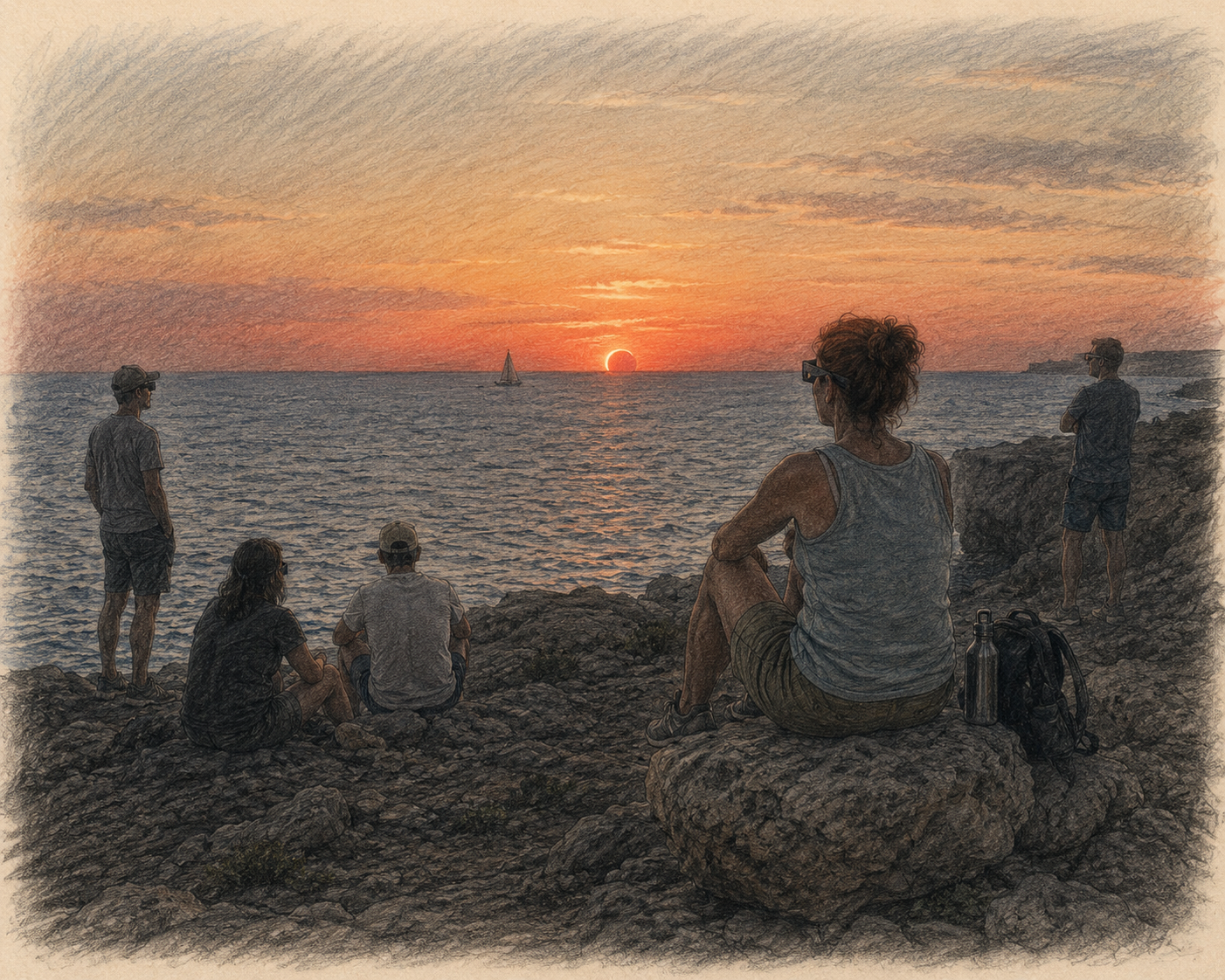
On Wednesday, 12 August 2026, the Moon’s shadow will cross northern Spain. In Catalonia, the Sun will already be low above the western horizon at the climax. With an unobstructed view and certified eclipse glasses, observers can watch the bright disc narrow to a slender crescent and then disappear completely for a few moments. Official guidance from Catalonia’s civil protection service explains how to watch safely.
On Menorca, the western horizon opens across the sea. People gather on the rocky plateau at Cala Blanca on summer evenings to watch the sunset. On 12 August the familiar scene will change: the light will become strange and muted before the Sun reaches the horizon. Perhaps a sailing boat will once again cross its glowing path. This setting needs no music; the sea, the wind and the astonished silence of the onlookers are enough.
Farther north-west, however, the eclipse will acquire a sound of its own. The Jordi Savall Festival presents concerts in Santes Creus, Montblanc, Valls and Alcover from 10 to 16 August. On the evening of the eclipse, Catalan musician Josep Maria Martí Duran will perform his programme “Ad Álgea” at a location initially kept secret. Guests meet at 6.30 pm in the Santes Creus car park and are taken from there to the observation and concert site. Admission includes certified eclipse glasses and a glass of cava.
Martí Duran plays the theorbo, a large plucked instrument with a long neck and deep bass strings. In “Ad Álgea” he transfers celebrated opera arias by George Frideric Handel and Henry Purcell to a single instrument. The music may include Handel’s “O Sleep, Why Dost Thou Leave Me?”, “Ombra mai fu” and “Lascia ch’io pianga”, Purcell’s “When I am laid in earth” and “If Love’s a Sweet Passion”, as well as works by Robert de Visée. The singer is absent, but the vocal line remains audible in the strings.
This restrained scoring suits the spectacle in the sky. The theorbo cannot compete with the eclipse, nor does it try. Its low, lingering tones give rhythm to the waiting. As the Moon covers the Sun, the horizon briefly becomes a natural stage.
The linked listening example presents Martí Duran’s “Ad Álgea”. Before 12 August, it offers a sense of how an aria without a singer becomes an intimate piece for theorbo. On Menorca only the sea answers; near Santes Creus, the strings do.