When the wall disappears: Thessaloniki asks what remains of graffiti
Orestis Pangalos has been part of the Greek graffiti scene since 1993. An exhibition in Thessaloniki now presents what he has collected over decades – and asks how we can preserve an art form whose impermanence is part of its nature.
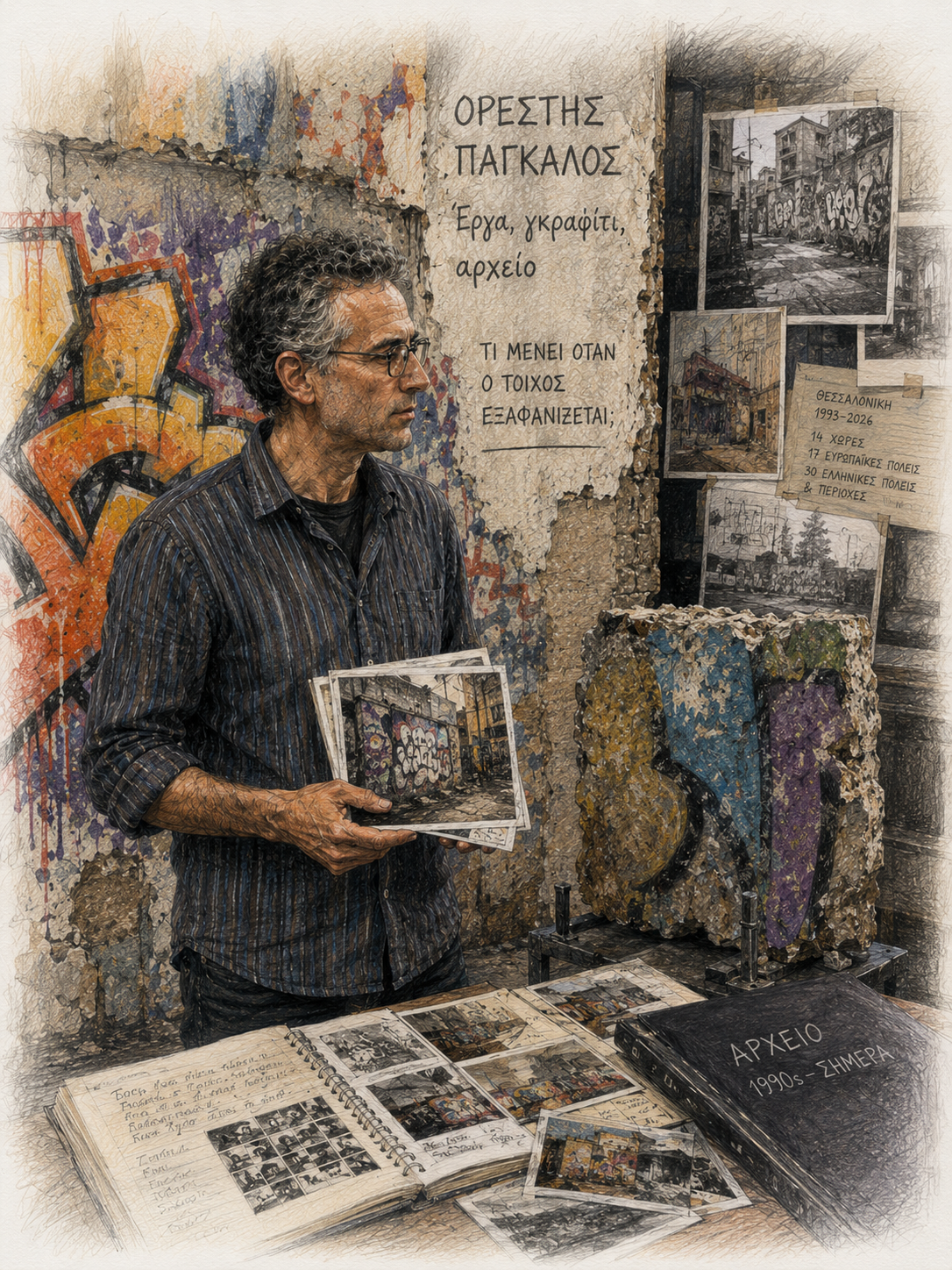
Orestis Pangalos does not know graffiti from books. He has been part of the Greek scene himself since 1993. He has painted, observed, photographed and collected – even when a wall had long since changed its appearance.
Today Pangalos is an architect, artist, art theorist and university lecturer. But when his exhibition “Orestis Pangalos. Works, graffiti, archive” opens at the MOMus Experimental Center for the Arts in Thessaloniki on Thursday evening, our guide into this world is first and foremost someone who has been part of it himself.
An art that is allowed to disappear
A painting in a museum can hang on the same wall for decades or centuries. Graffiti follows different rules.
A house wall is repainted. A building is demolished. Rain and sunlight change the colours. Someone places a new image over an older one. Sometimes a work remains visible for years; sometimes it lasts only a few days.
That does not necessarily mean something has gone wrong. Change is part of public space – and therefore part of the history of graffiti as well.
Perhaps this is where the special character of Pangalos’s collection begins. He did not wait until years later to look back and try to reconstruct what the Greek graffiti scene once looked like. He was there from the early 1990s and at the same time began preserving its traces. MOMus describes him today as one of the most influential figures in Greek graffiti and emphasises his decisive contribution to documenting its history.
More than 500 frozen moments
What emerged can hardly be described as an ordinary photographic archive.
The exhibition in Thessaloniki includes more than 500 photographs of graffiti and murals. There are also videos and projections, publications, historical documents and objects Pangalos collected from public spaces. The material spans around four decades, 14 countries, 17 European cities and 30 Greek cities and regions.
Every photograph preserves something that may no longer exist.
A wall may look completely different today. An image may have disappeared. Perhaps even the building itself is gone.
A photograph then becomes more than an image of a piece of graffiti. It becomes evidence that someone once left a trace in that place.
A piece of the street inside a museum
With some works, Pangalos went one step further.
Parts of his work were literally detached from pavements, benches, walls and steps. Something that was once inseparable from a public place can now be preserved as a fragment and displayed in a museum.
And that is where things become complicated.
If a piece of a painted wall is inside a museum, has the graffiti been saved?
Or is precisely what mattered most now missing: the street, the building, the people walking past, the other images nearby – and the possibility that everything might look different again tomorrow?
The exhibition does not offer a simple answer. Nor does it try to tell a complete history of graffiti. Photographs, objects, publications, artworks and fragments of the urban landscape stand side by side. MOMus describes them as different forms of memory. Together they create a new human geography of Thessaloniki.
Who owns a city's memory?
Perhaps that is why the exhibition ultimately tells us about more than graffiti.
Cities are constantly changing. Shops disappear, buildings are altered and squares suddenly look different. At first, many of these things do not seem important enough to preserve.
Only years later do we realise that a piece of memory disappeared with them.
Pangalos collected some of these memories before they were lost. Not from the distance of a researcher trying decades later to reconstruct a vanished youth culture, but as someone who was there himself.
That makes his perspective special.
And it brings us back to the question at the heart of the exhibition:
What remains of graffiti when the wall disappears?
Perhaps a photograph. Perhaps a piece of concrete. Perhaps the memory of a place.
And sometimes, perhaps all it takes is someone who looks in time.