When a rocket gives the signal to enter the water
On 11 September, thousands of people in La Aldea de San Nicolás rush into a coastal pool at the sound of a rocket to catch mullet. Día del Charco brings together ancient fishing practices, island history and a festival that not even a bishop could stop.
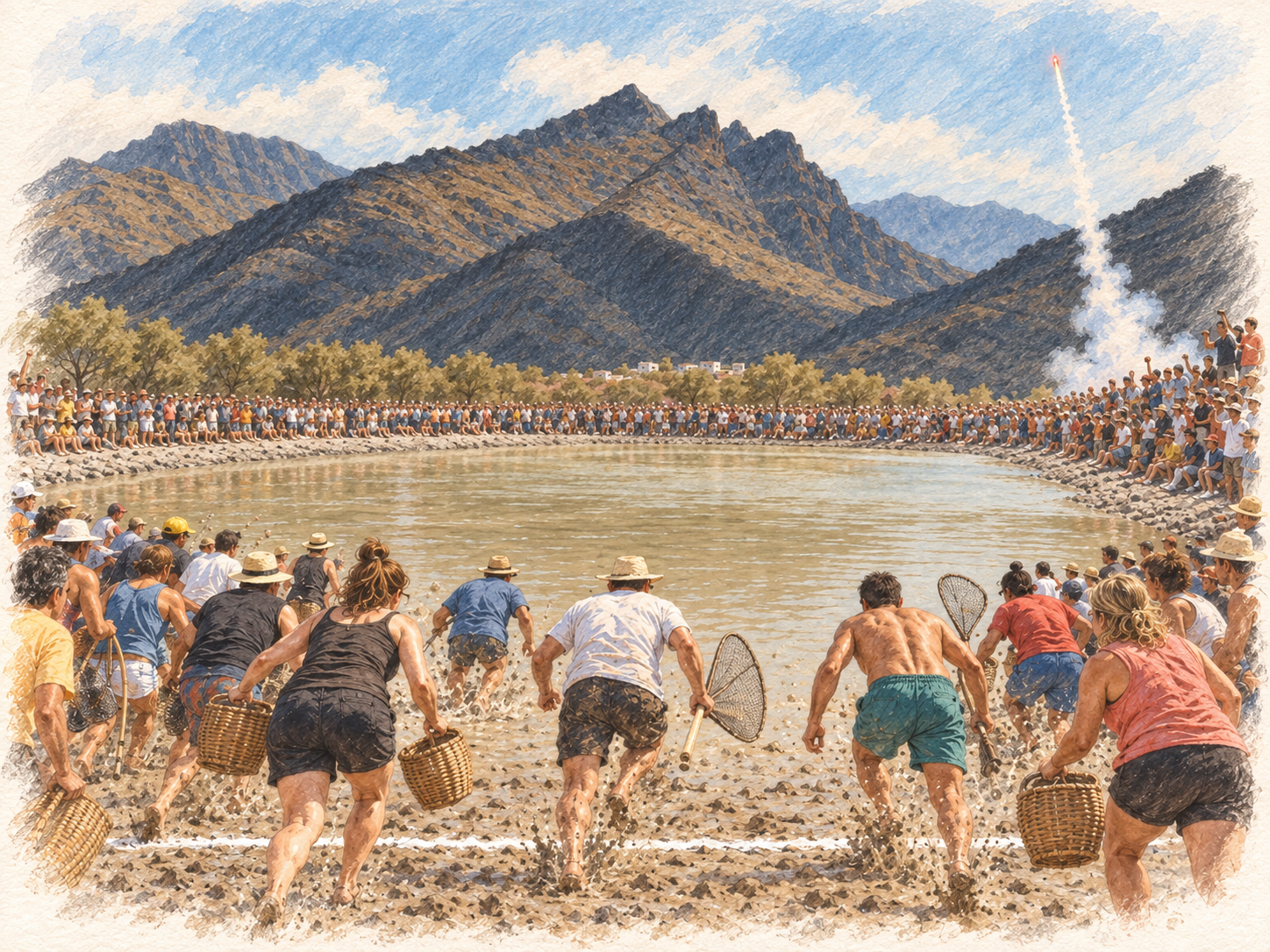
At five in the afternoon, the water is still calm. Around a coastal pool on the western side of Gran Canaria, people wait behind a white line of lime. No one is allowed to cross it. Some are holding baskets or landing nets, others have nothing at all, and many are wearing ordinary clothes. Then a rocket shoots into the sky – and suddenly everyone starts running.
On 11 September 2026, La Aldea de San Nicolás once again celebrates Día del Charco. At 5 p.m. the most unusual part of the festival begins: thousands of people charge into the shallow, muddy water and try to catch mullet. The traditional starting signal is a volador, a firework rocket. Only after it has been launched may anyone cross the lime line.
At first sight, it looks like one enormous water game. Behind the commotion, however, lies a story much older than the festival in its present form.
Why does everyone go into the water fully dressed?
The Charco is neither a swimming pool nor an artificial festival arena. At the mouth of the Barranco de La Aldea, right beside the sea, a shallow wetland forms over a muddy, stony bed. Among the fish living there are lisas, or mullet. Once a year, for a short time, the pool becomes a place for collective fishing.
After the rocket signal, the waiting crowd crosses the lime line all at once. Some try to catch fish with their bare hands; others use baskets or guelderas. A gueldera is a traditional Canarian fishing tool: a long pole with a ring and a net bag at the end, much like a large hand-held landing net. Ordinary fishing nets, by contrast, are expressly forbidden.
And yes: people really do go into the water wearing their clothes. By now that is as much a part of the tradition as the mass start itself. Getting one another wet is part of the fun too, although today's rules protect anyone who stays behind the white line: they may not be thrown into the water against their will.
Catching fish without chasing them through the water
The tradition points back to much older fishing methods in the Canary Islands. Gran Canaria's pre-Hispanic inhabitants already used a technique later known as embarbascado. The milky sap of certain spurges, especially cardón and tabaiba, was introduced into shallow coastal waters. Substances in the sap impaired the fish, making them easier to collect by hand or with simple fishing tools. Methods of this kind remained known on Gran Canaria for a long time and were still practised in some places into the twentieth century.
Today's Día del Charco, of course, involves no plant sap being put into the water. What survives is the idea of collective fishing in a limited stretch of shallow water. The festival is therefore not an exact re-enactment of a pre-Hispanic technique, but a living tradition that preserves the memory of older ways of fishing.
That is precisely what distinguishes it from a historical pageant. There are no costumed performers behind a barrier. Thousands of people take part themselves.
A bishop has a problem
We know that the occasion was already rather exuberant centuries ago thanks, of all people, to someone who strongly disapproved of it. In 1766, Bishop Delgado y Venegas visited the area. His orders are among the earliest written records of the festival, and what he saw clearly did not fit comfortably with his ideas of decency.
Women and men went into the water together, and some of the men were apparently wearing considerably less than the bishop thought proper. He therefore threatened fines and even excommunication. Women were not to enter the Charco together with men, and men were certainly not to strip completely in front of them.
There was, however, one major flaw in the ban: the festival did not disappear. More than 250 years later, women and men still enter the water together – only now they do it fully dressed.
A festival between different eras
Día del Charco is now part of the Fiestas de San Nicolás de Tolentino. The main festival days follow one another: Bajada de la Rama takes place on 9 September, San Nicolás is celebrated on the 10th, and on the 11th people head for the Charco. Music, dancing and gathering together are as much part of the day as the collective fishing at 5 p.m.
Different layers of history meet in La Aldea. The name San Nicolás and the religious celebrations belong to the island's Christian history, while collective fishing recalls much older ways of life on the Canarian coast. Right beside the Charco is Los Caserones, an important archaeological site with traces of pre-Hispanic settlement.
Landscape, archaeology and a tradition still practised by local people come together within a very small area. For that reason, El Charco is protected today as a cultural site of special ethnological interest.
And who catches the biggest fish?
Even a centuries-old tradition is not entirely free of competition. In previous years, prizes have been awarded for catching the most mullet or for landing the largest or heaviest fish. But that is probably not the main reason why thousands of people come to La Aldea each year.
Most will go home without a record-breaking fish. What they do get is a moment that happens only once a year: people stand packed together behind a white line, wait for the bang of a rocket, and then run into the same muddy water where generations before them caught fish.
At Día del Charco, history is not put on as a show. At five in the afternoon, you simply run straight into it.