When a handbag becomes a greenhouse
At the first Helsinki Circus Festival, Finnish contemporary circus meets potato crowns, greenhouse handbags, wheels of death and hobby horses. What has become of the traditional circus?
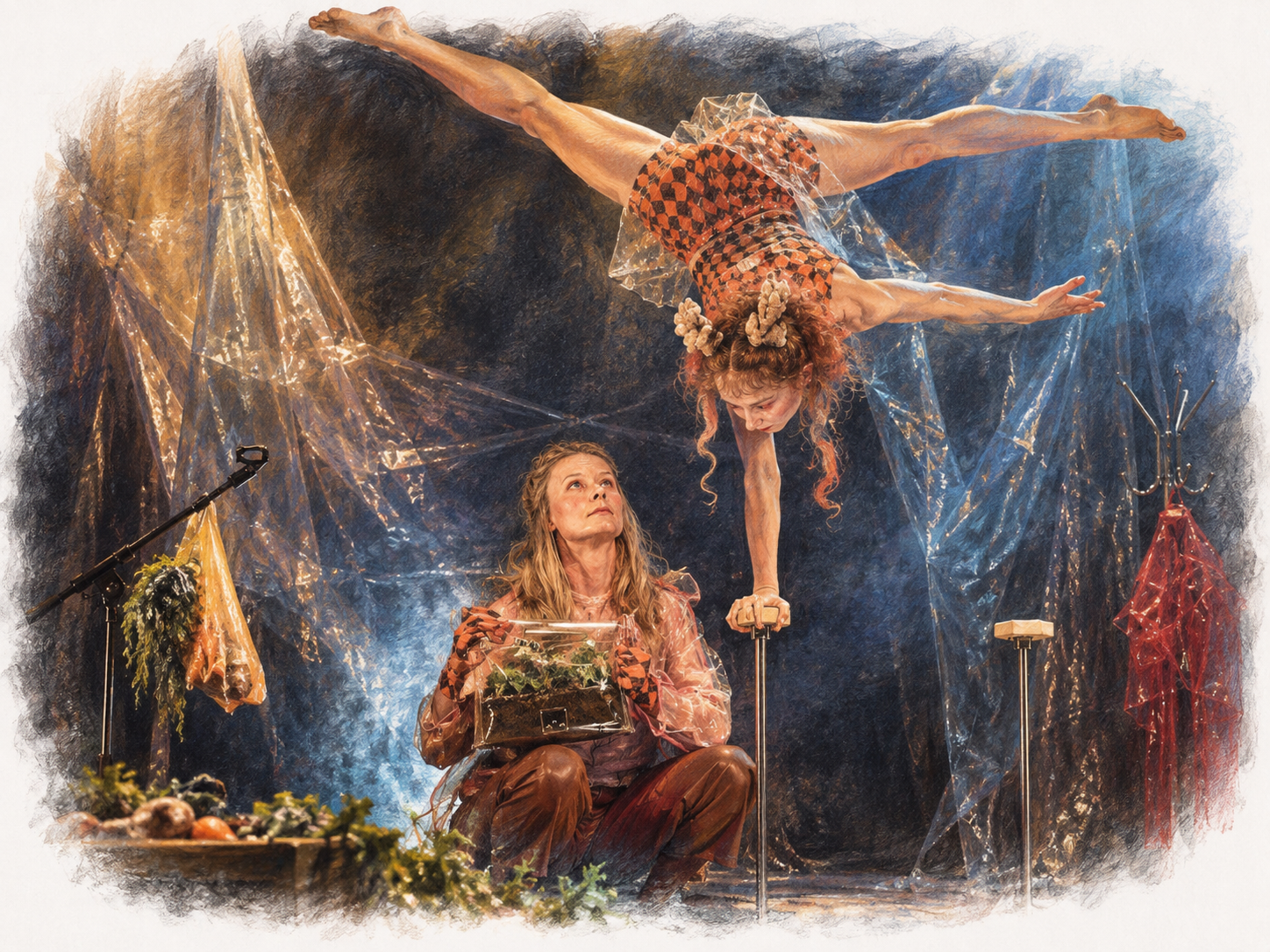
A potato becomes a crown. A handbag becomes a greenhouse. Two performers balance on swinging trapezes, wrestle with ginger horns and end up in the mud as well.
Welcome to the circus.
Anyone who hears that word and first thinks of lions behind bars, elephants in the ring and a trainer with a whip will be searching for quite a while at the Helsinki Circus Festival. When the festival opens its doors and its big top for the first time on 10 September 2026, it presents a very different world: Finnish contemporary circus.
Over four days, 13 productions are on the programme. There is street circus and acrobatics, comedy and performance art, new magic and shows for children. Performances take place in several Helsinki cultural centres, on streets and squares – and, in thoroughly traditional fashion, in a large circus tent at Suvilahti, a former industrial area of the Finnish capital.
Is this still circus?
The potato crown and the greenhouse handbag belong to Memoirs of Mud. Finnish performer Inka Pehkonen and British hand-balancer Imogen Huzel move between an artificial, sterile world and a very muddy version of nature. They use their bodies, trapezes and strange objects to play with the contrast between nature and artificiality. The show needs no spoken language.
It is a long way from the traditional sequence of animal acts, juggler, clown and high-wire number.
And yet much of it feels surprisingly familiar.
There is physical control and risk. There is the pleasure of surprise. People fly through the air, balance, juggle and make audiences laugh. Even the circus tent is still there.
Only the boundaries with theatre, dance, music and visual art have become much more porous.
That can be seen especially clearly on opening day. While Memoirs of Mud is performed at Cultural Centre Caisa, nine acrobats and a jazz drummer take the stage in the circus tent for Ensembled. Arctic Ensemble works, among other things, with the Korean Double Cradle, a form of aerial acrobatics that is rare even in international circus. Later that evening, Nonstop Paradise combines circus with performance, sound and video art.
Here, circus is less a fixed collection of acts than a way of telling stories and exploring ideas with bodies, objects, space and risk.
And where are the horses?
They have not disappeared entirely.
One of Finland's best-known circus companies is actually called Race Horse Company.
Anyone expecting to find horses in the stable will, however, be disappointed. Founded in 2008, the company became known for highly physical, unruly productions. Chaos, black humour and acrobatics are part of its trademark. With works such as Petit Mal and Super Sunday, it toured internationally; its founders received Finland's State Prize for Circus Art in 2016. At the festival, Race Horse Company presents Spinsane – two performers, Hannu Abonce and Sylvain Briani-Colin, hurtling around and inside a so-called wheel of death.
But the horse story gets even better.
Kalle Lehto of Race Horse Company really did create a horse circus: Chevalier – Hobbyhorse Circus.
His horses need neither stables nor hay.
They are hobby horses.
Lehto deliberately draws on the tradition of the old horse circus. He juggles and balances with hobby horses, adds acrobatics and combines it all with the aesthetics of silent film. The hobby horses take on the roles once performed by real circus horses in the ring. The production premiered in 2019 and is still touring internationally in 2026.
That such an idea comes from Finland is rather fitting. Hobbyhorsing has long since developed its own scene there. Chevalier is not part of the Helsinki Circus Festival programme itself – but it shows particularly well how playfully Finnish contemporary circus can deal with its own traditions.
The old hands keep the wheel turning
Because this kind of circus is no longer new.
Race Horse Company has been working in this field for almost two decades. Other groups at the festival are younger but already have international experience. Arctic Ensemble was founded in 2018; its members have toured in Japan and have also appeared in Cirque du Soleil productions.
So the first Helsinki Circus Festival is not presenting an art form that has only just been invented. It shows how far it has already developed.
The traditional image of the circus has not disappeared completely. It remains in the tent, in the acrobatics, in risk, in humour and in that moment when someone does something that makes the audience instinctively hold its breath.
Only what makes people marvel has changed.
Today, sometimes all it takes is a potato for a crown, a handbag for a greenhouse – or a circus horse on a wooden stick.