When stories travel across the sea: how Iceland gives its books new languages
In Iceland, the children’s book is called “Tjörnin”. In Germany it became “Ein Teich für uns”, in the Netherlands “De vijver” and in Lithuania “KŪDRA”. The pond remains the same, but translators help its story reach new readers.
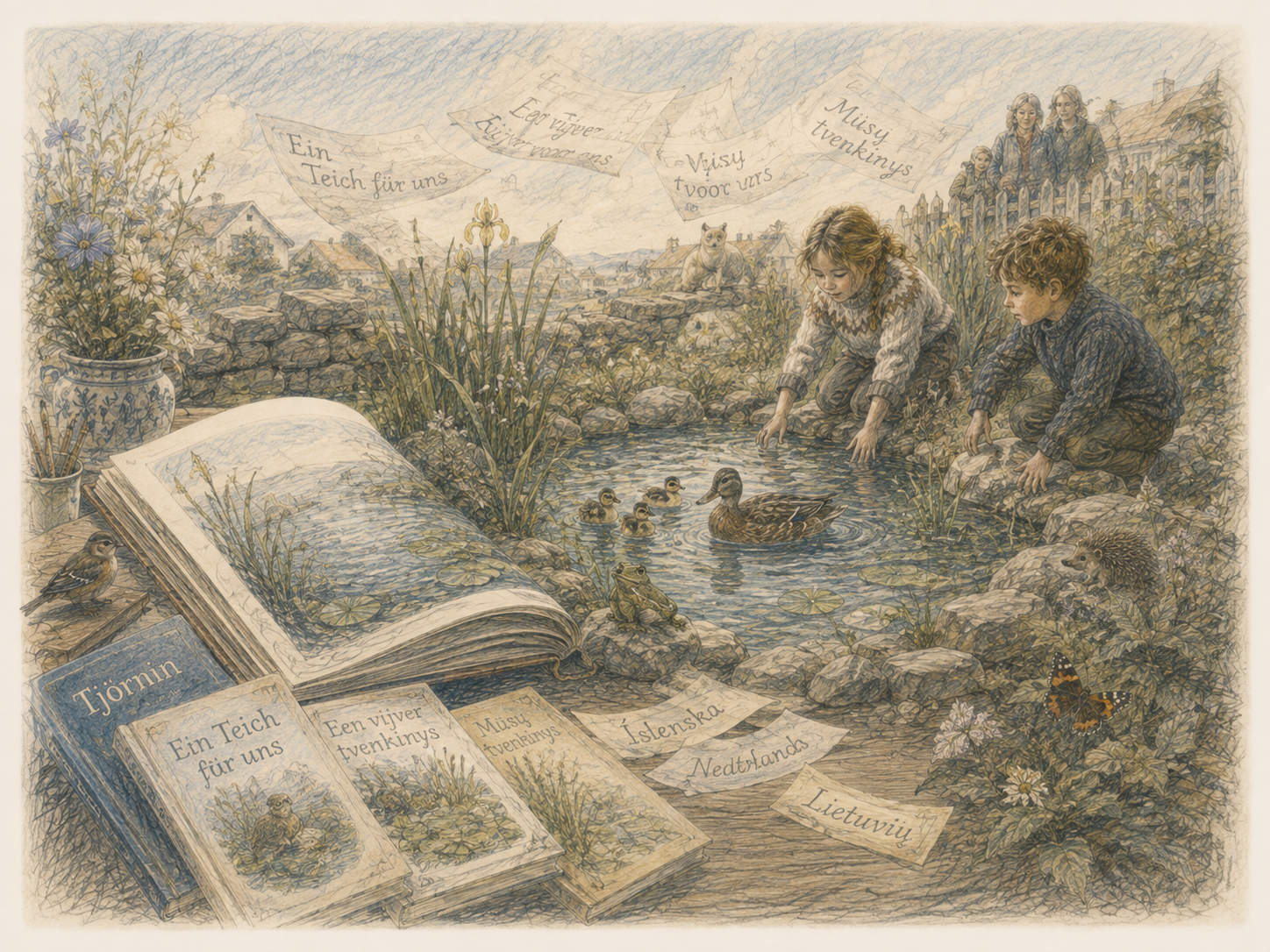
A pond sets off on a journey
A pond cannot usually travel very far.
This one manages it anyway.
In Iceland, Rán Flygenring’s children’s book is called “Tjörnin”. Two children discover a strange hollow in their garden and eventually decide to turn it into a pond. Soon plants and animals arrive, but so do other people. A small idea grows into questions about nature, freedom, living together and the art of compromise.
The story did not stay in Iceland.
In the Netherlands it appeared as “De vijver”. Since February 2026, German children have been able to read it as “Ein Teich für uns”, translated by Anika Wolff. In June, the Lithuanian edition “KŪDRA” joined them.
The garden remains the same. So does the pond.
Only the words change.
A book is written once again
That is exactly where the translator’s work begins.
An Icelandic sentence cannot simply be moved word by word into another language. A joke should still be funny. A child should still sound like a child. An unusual sentence should not suddenly become ordinary merely because there is no exact equivalent for it.
Translating a book therefore means repeatedly asking: what does this sentence say, and what does it do to the reader?
The story should sound natural in its new language without losing the sense that it came from somewhere else.
It is quiet work. The author’s name is usually the first one people notice on a cover. Yet between the Icelandic original and a child reading the story in German, Dutch or Lithuanian stands someone who has had to make new linguistic decisions throughout the book.
Iceland builds bridges for its books
In 2026, the Icelandic Literature Center is placing particular emphasis on children’s and young adult literature in its international work. Foreign publishers can receive support for translating and publishing Icelandic books.
This year, grants for children’s and YA books can cover up to 70 percent of translation costs, with a maximum of 500,000 Icelandic krónur. Under certain conditions, illustrated children’s books can also receive partial support for printing costs. The next application deadline is 15 September.
It is not enough simply to suggest an interesting book. The foreign publisher must already have acquired the rights and signed a contract with the translator. The translator’s experience is also considered, and translators are normally expected to work into their native language.
Between an Icelandic book and an edition in another country, therefore, stands an entire chain of people: author and illustrator, publisher, rights holder, translator and finally another publisher convinced that the story deserves new readers.
A small language, many readers
For literature from Iceland, this work matters greatly. A book published only in Icelandic initially reaches only a small proportion of the people outside the country who might enjoy its story.
Translation changes that.
It does not make the Icelandic language itself larger. But it reduces the distance between a story and its possible readers.
Suddenly children in Hamburg, Amsterdam or Vilnius can stand beside the same pond. They can laugh at the same characters, become annoyed with the same adults or argue about who the pond really belongs to.
And while reading, they may even forget for a while that the book was originally written in a language they do not understand.
The pond remains
Perhaps that is the strange thing about translation.
Almost every word is replaced, yet the aim is to lose as little as possible.
“Tjörnin”, “De vijver”, “Ein Teich für uns” and “KŪDRA” look different on a book cover. Behind them, however, the same story is waiting.
A pond can therefore travel from Iceland to other countries without ever leaving its garden.
The story remains.
The words make the journey.