When courtyards sound again: ten years of WarszeMuzik in Warsaw
WarszeMuzik brings chamber music to surviving Warsaw courtyards and the Umschlagplatz memorial. The history of Jewish life, the destruction of the Second World War and the everyday life of the present-day city become audible together.
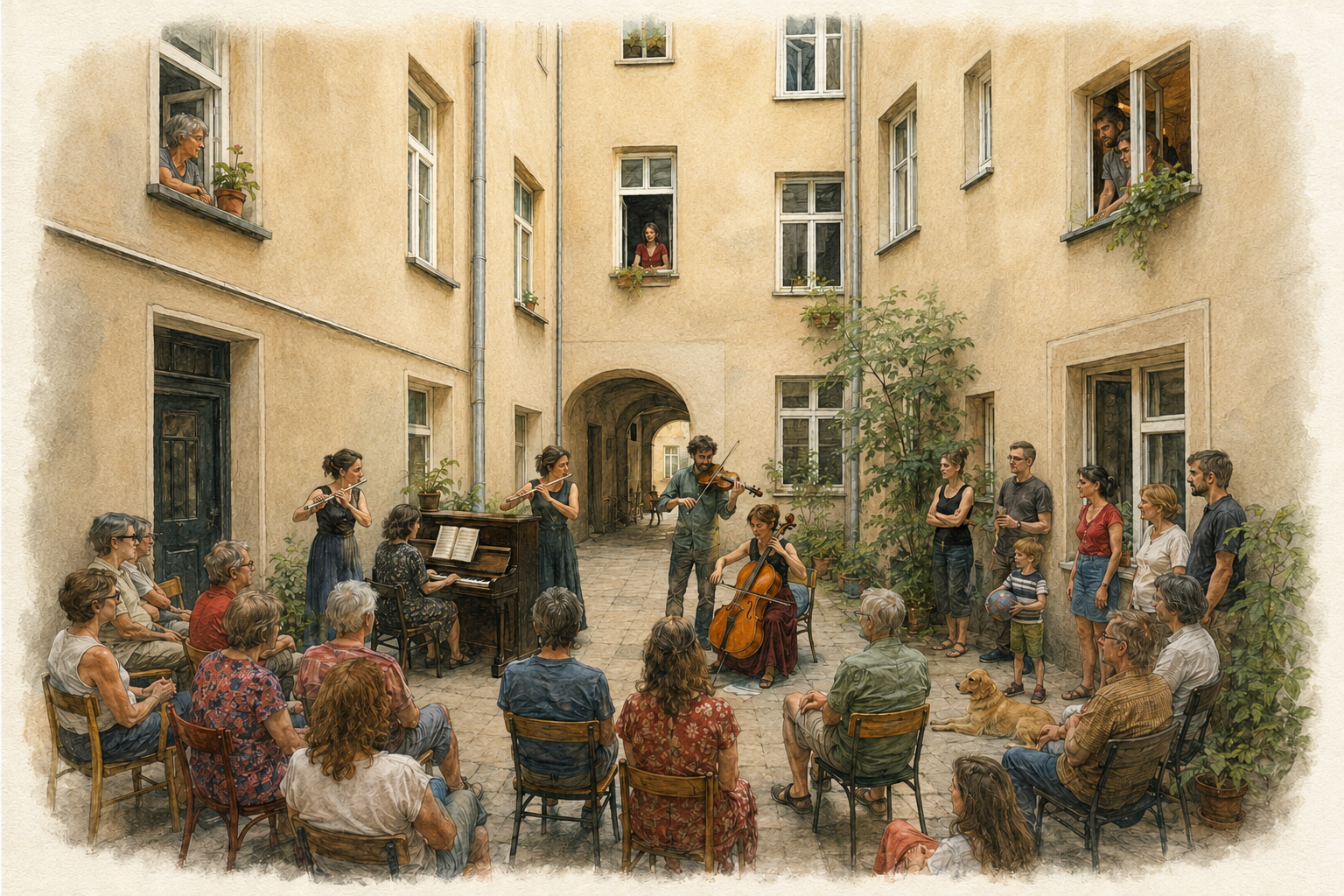
From 1 to 30 August 2026, Warsaw is hosting the tenth edition of WarszeMuzik. Founded by flautist Ania Karpowicz and pianist Marek Bracha, the festival takes chamber music beyond the concert hall and into surviving pre-war courtyards, memorial sites and the everyday life of the city.
Before the Second World War, the courtyards of Warsaw’s tenement houses were densely used living spaces. Apartments, workshops and small businesses stood close together. Children played, neighbours met, and a substantial part of the city’s Jewish life also took place in these buildings and courtyards.
During the German occupation, many of these places became part of the Warsaw Ghetto. Overcrowding, hunger, persecution and life in hiding places and bunkers transformed them fundamentally. After the Warsaw Ghetto Uprising, large parts of the district were burned and destroyed.
After the war, a new Muranów was built on and partly from the rubble. New residents moved in, while traces of the earlier Jewish life were buried or destroyed in many places and only made visible again decades later. The surviving courtyards are therefore not unchanged remnants. Repaired plaster, renewed utility lines and alterations from different decades show that they remain inhabited, maintained and adapted to new needs.
One of the festival’s recurring venues is the Umschlagplatz. The area on Stawki Street originally formed part of a railway freight and transshipment site. During the German occupation, it became the assembly point for deportations from the Warsaw Ghetto. From July 1942, hundreds of thousands of Jewish people were deported from there, mainly to the Treblinka extermination camp. The POLIN Museum recalls the so-called Great Liquidation Action.
WarszeMuzik does not attempt to reconstruct the sound of pre-war Warsaw. Instead, the music creates connections between the places, the composers’ biographies and the contemporary city. The sounds of the courtyards remain audible: footsteps, voices, open windows or children playing may become part of the concert experience. The festival’s two albums likewise combine chamber music with field recordings made in old Warsaw tenement houses.
On 9 August, pianist Eiby Zieleniec performs works by Mieczysław Wajnberg, Józef Koffler, Joseph Achron and Zvi Avni at the Umschlagplatz memorial. On 15 August, Chmielna 122 hosts a premiere for clarinet, voice and a venue explicitly described as a “living courtyard.” The complete WarszeMuzik 2026 programme shows how the festival connects historical music, new compositions, guided walks and conversations.
The festival does not turn remembrance into a closed exhibition. The past and present-day Warsaw share the same space – and sometimes the same sounds.