When Kasper has relatives all across Europe
On Warsaw’s New Town Market Square, old European hand-puppet traditions meet. Kasper, Gašparko and Punch have more in common than their names suggest.
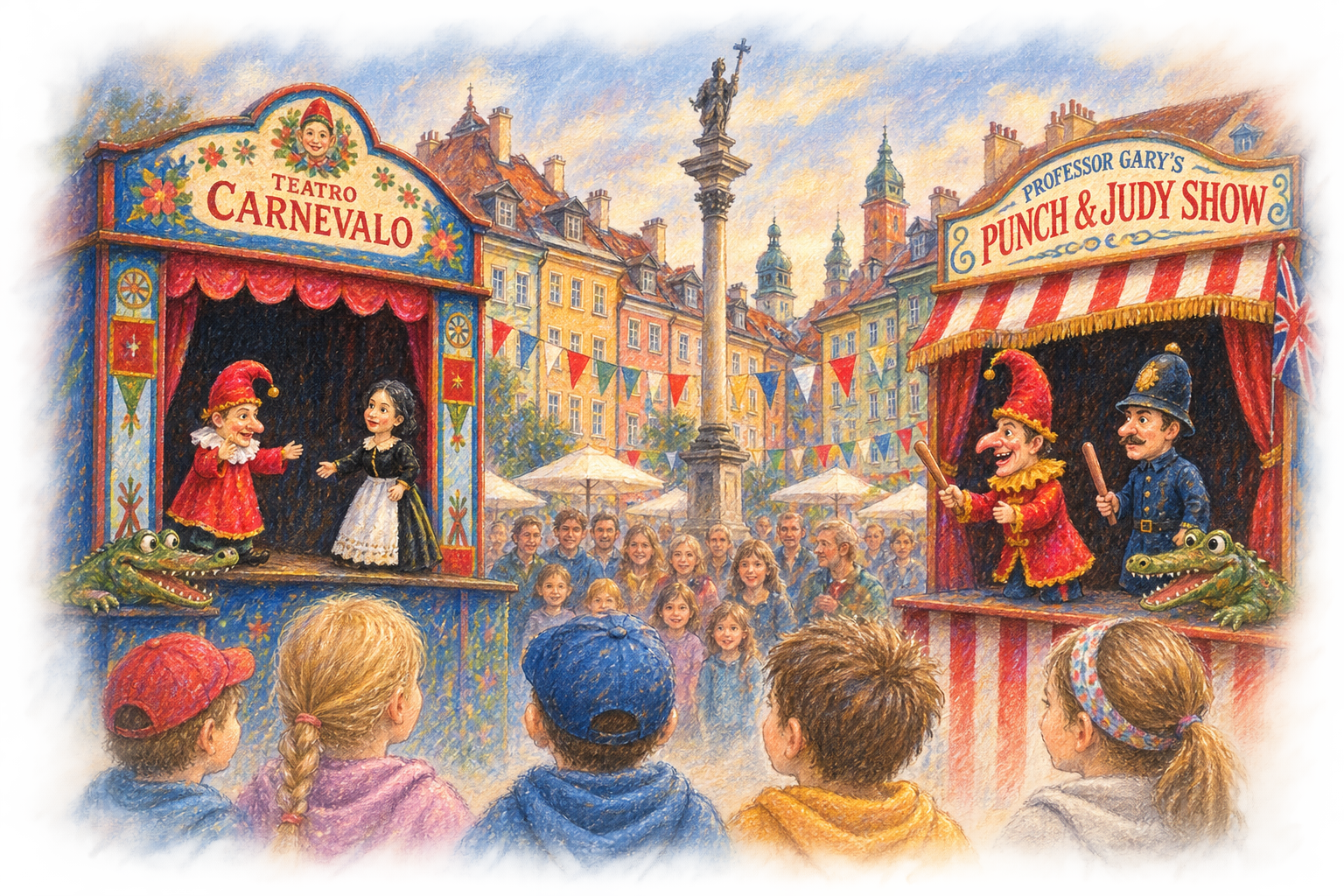
On Warsaw’s Rynek Nowego Miasta this Sunday, characters appear who may seem strangely familiar to many visitors. There is a small fellow with a striking nose and a big mouth. A policeman tries to keep order. And sooner or later, even a crocodile appears.
Anyone who grew up with Kasper-style puppet theatre may recognise the cast. Only some of the names are different here.
At the international “Lalka na Scenie” festival, puppeteers from several European countries meet. One of its defining artists is Slovak performer Ivan Gontko, who is also the festival’s artistic director. From Britain comes Gary Wilson with Professor Gary’s Punch & Judy Show. Suddenly, on a square in Warsaw, something becomes visible that goes far beyond a single performance:
How similar Europe’s old hand-puppet traditions can be.
Kasper, Gašparko and Punch
Even the main characters seem related. In Germany there is Kasper or Kasperle, in Slovakia Gašparko, in the Czech lands Kašpárek, and in Britain Mr Punch has been fighting his way through stories for centuries.
They are not simply the same character with different names. Each theatre tradition developed its own history. Yet the leading figures often play remarkably similar roles: they are cheeky, unimpressed by authority, constantly getting into trouble and often speak more directly to the audience than the sensible characters around them.
It becomes even more surprising when you look at the supporting cast. Comparing performances of Gašparko with Punch and Judy reveals more than a mischievous hero. The policeman and the crocodile are familiar opponents in both worlds.
Apparently it is not just one character that travelled through Europe’s cultural history. An entire idea of how these stories work seems to have travelled with it.
A puppet that outlives generations
Gontko’s theatre world includes a special Gašparko figure. The Warsaw organisers describe a puppet more than one hundred years old in his care, which has become a symbol of the festival.
That changes how we think about “tradition”. A figure like this has not had the same performer for a century. People take it over, move it, give it a voice and character, and eventually pass it on.
The puppet remains.
That thought fits 2026 particularly well: Hurvínek, one of the best-known Czech puppet characters, also turns one hundred this year. Together with his older stage father Spejbl, he was once well known in Germany too. Many young people today may barely know them, but in the Czech Republic they remain part of a living theatre tradition.
A puppet can therefore outlive several generations of its audience and still behave at the next performance as if everything were happening for the very first time.
Why does this piece of wood suddenly seem alive?
Something strange happens in puppet theatre.
Of course, everyone knows the figure is not alive. You can see painted features, fabric, wood and perhaps even the performer’s hand. Yet after only a few moments, viewers often stop thinking: Someone is moving a puppet.
Instead they think: What is he going to do now?
Suddenly the character is curious, angry, cowardly or overconfident. It is frightened by the crocodile. It picks a fight with the policeman. And the audience responds as though it really had a will of its own.
Europe even turned this idea into one of its most famous stories. In Carlo Collodi’s “Pinocchio”, a wooden figure truly becomes a living being. What fiction makes real there is what puppeteers attempt on stage every day: giving an inanimate object a personality for a few minutes.
No fairy is required. Movement, rhythm, voice, good timing – and an audience willing to play along – are enough.
When the crocodile crosses borders
Perhaps this also helps explain why such characters have crossed borders so easily. You do not need to understand every word to realise that the policeman means trouble or that something is about to happen when a crocodile suddenly appears behind the hero.
Kasper, Gašparko, Kašpárek and Punch naturally have their own histories. That is exactly why their similarities are so interesting. Regional traditions grew out of a shared European theatre world, changing over time while still preserving traces of their kinship.
At the Warsaw festival, such traditions stand side by side again. Ivan Gontko brings his experience of Slovak puppet theatre, Gary Wilson the British world of Punch and Judy, while other artists from Poland and the Czech Republic present their own forms of play.
Perhaps a crocodile is therefore a surprisingly good symbol of European cultural history.
It needs no passport.
And whenever a small stage goes up and a cheeky fellow sticks his head out, the crocodile may already have arrived before him.