When music simply crosses borders
A 61-square-kilometre state, three towers on a mountain – and a lot of music on Saturday. At Musikfest Adriatica, ensembles from Austria, Switzerland and Italy meet in San Marino, a republic that has spent centuries balancing independence with close ties to its neighbours.
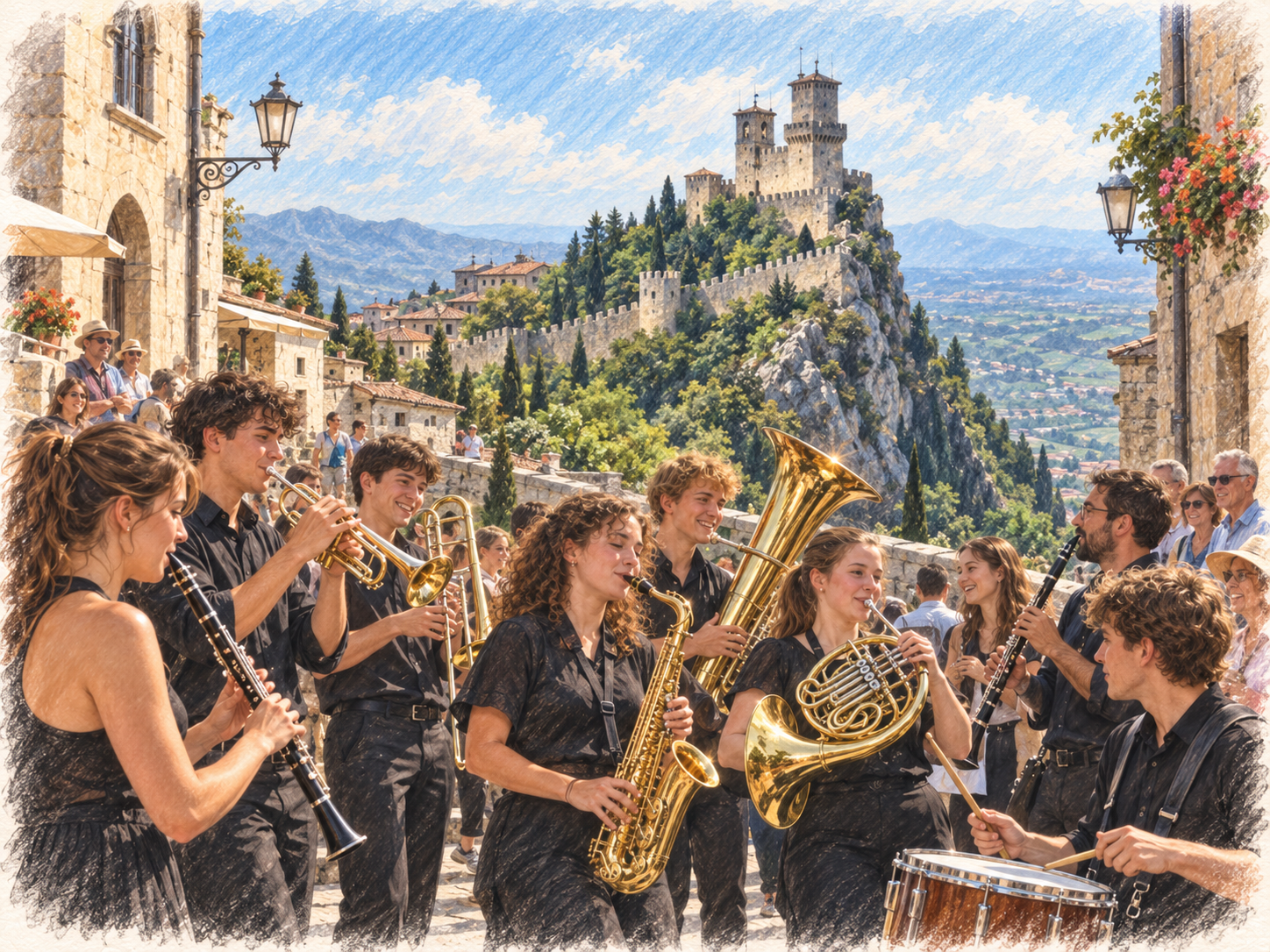
A 61-square-kilometre state, three towers on a mountain – and a lot of music on Saturday. At Musikfest Adriatica, ensembles from Austria, Switzerland and Italy meet in San Marino, a republic that has spent centuries balancing independence with close ties to its neighbours.
San Marino is small enough for the number to look almost like a typo: the entire republic covers just 61.19 square kilometres. Above it rises the 755-metre Monte Titano, crowned by the historic capital, its walls and its famous fortress towers. The country is completely surrounded by Italy, between Emilia-Romagna and Marche, yet it is not part of Italy. The historic centre and Monte Titano are listed as a UNESCO World Heritage Site as testimony to a free republic whose continuity reaches back to the Middle Ages. On 12 September 2026, however, this old cityscape will acquire a rather modern soundtrack.
Four bands and one very small republic
From 11:30 am to 1:30 pm, Musikfest Adriatica will make its way through the old town. The route begins in Piazza Sant’Agata, passes places including the Cava dei Balestrieri and Piazza della Libertà, and returns to its starting point. The announced ensembles are Jugendkapelle Hartberg and Jugendkapelle Staatz from Austria, Musikgesellschaft Müswangen from Switzerland, and Banda Giovanile Città di Rimini from Italy. The festival itself presents the event not as a competition, but as a chance to meet people and share music and culture in a friendly, borderless atmosphere.
Anyone who hears “brass band” and immediately thinks only of marches and polkas is missing quite a lot. Jugendkapelle Hartberg belongs to the town’s music school, founded as far back as 1892 and now training hundreds of young musicians in numerous ensembles. Its musical range was clear in 2026, when the youth orchestra’s Brass Big Band performed music by Tina Turner, Pink Floyd and Coldplay. Musikgesellschaft Müswangen, meanwhile, was founded in 1931 in a small Swiss village and now has 46 members. So this is not simply a meeting of four interchangeable bands, but of very different musical cultures – from the youth wind orchestra of an Austrian music school to a Swiss association that has been part of village life for almost a century.
Tradition is not the same as standing still
That is especially clear in the other two ensembles. Jugendkapelle Staatz was founded in 1962 as a boys’ band; girls have played in it since 1970, and over the decades concert tours have repeatedly taken the orchestra abroad. Banda Giovanile Città di Rimini, by contrast, has existed only since 2012. It brings together roughly 25 to 35 children and teenagers aged between eight and 18. They practise not only concert pieces but also choreographed marches, preparing to move on later to the historic Banda Città di Rimini – a musical institution whose history reaches back to 1828. Tradition here does not mean playing the same thing forever. It works only if a new generation actually wants to pick up an instrument.
San Marino provides a fitting stage for all of this. Drive up from Italy and you do cross a national border, but you do not stop at a conventional border post: San Marino has no regular border formalities for travellers who have entered Italy legally. It is therefore possible to pass almost unnoticed from the European Union into a sovereign state with its own laws and institutions, one that uses the euro and is closely woven into the everyday life of its Italian surroundings. A mobile phone, however, may suddenly remind you that a border really does run here. San Marino is not part of the EU/EEA “Roam Like at Home” area. Whether calls and mobile data are nevertheless charged as they are at home depends on the provider and tariff. On Saturday, musicians from Austria and Switzerland will arrive at this almost invisible border as well. Some come from EU countries, others do not – on the piazza, nobody needs to think about it.
So what are the agreements for?
Europe does not work entirely without rules, of course. Right now, San Marino is reshaping its relationship with the European Union. In July 2026, the Council of the EU authorised the signing and provisional application of a wide-ranging association agreement with San Marino and Andorra. It is intended to integrate San Marino to a large extent into an enlarged European internal market while creating common rules in areas such as services, financial markets, consumer protection, education, research, the environment and culture. Another step in the signing process is expected in September. San Marino will not become an EU member as a result, but legally it is set to become even more closely connected to the space with which its daily life is already deeply intertwined.
The music festival needs neither negotiations nor treaty articles for that kind of connection. For two hours, trumpets, horns, clarinets, percussion and people who have learned to listen to one another are enough. In a republic that has insisted for centuries on remaining independent while living right in the middle of Italy, it is a remarkably apt image: Culture connects across borders. Agreements take care of the rest.