Speech is silver, silence is golden
What does a person say when they say nothing at all? At the Sconfinare festival in Bellinzona, actor Fabrizio Gifuni and language scholar Stefano Bartezzaghi meet to explore what silence can mean.
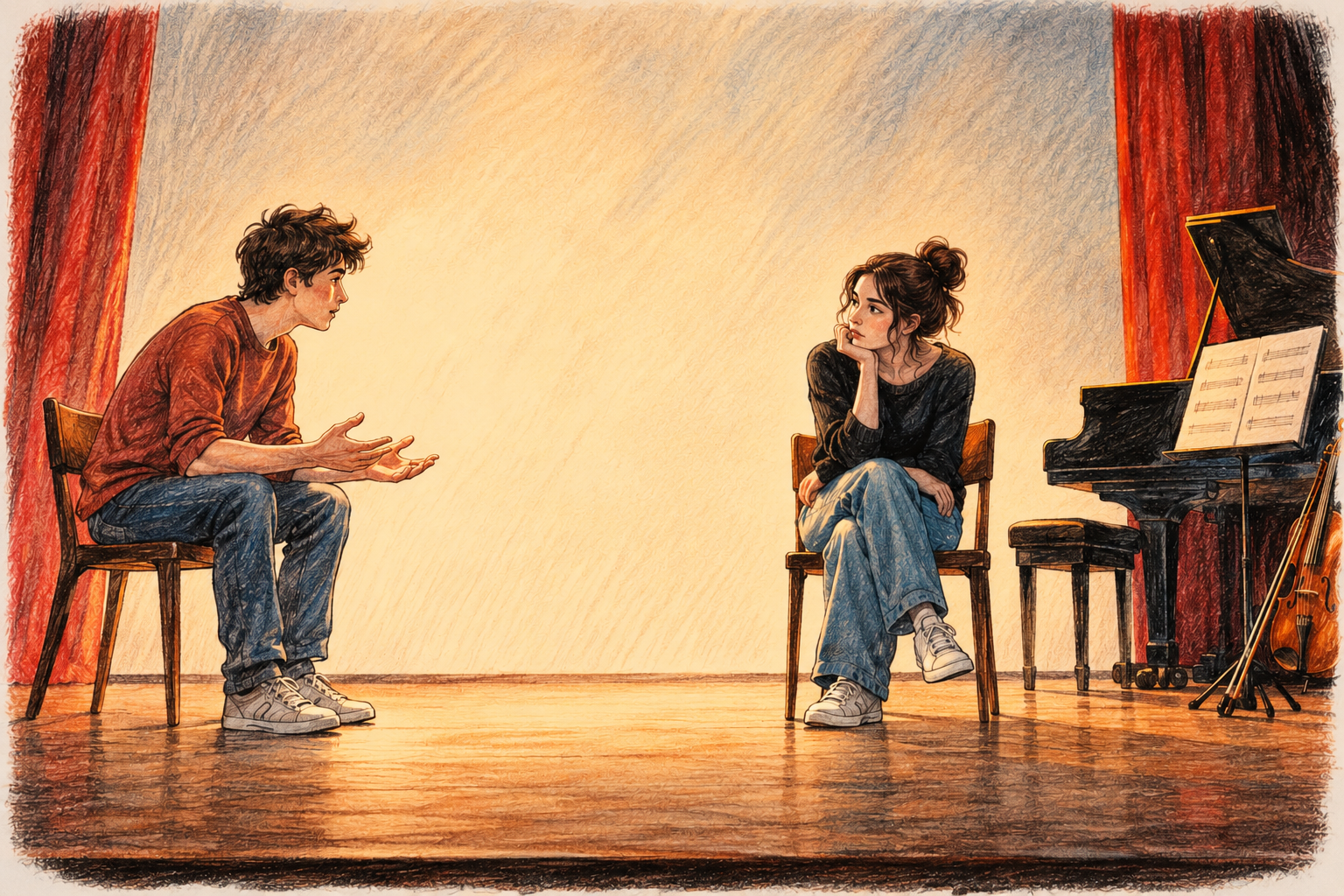
Imagine someone saying to you, “I believe you.” Now imagine the same sentence again. This time there is a pause after “I”. A glance to one side. Perhaps a breath.
“I … believe you.”
The words are exactly the same. Yet suddenly there may be something else in the room: doubt, perhaps. Uncertainty. Disappointment. Or simply someone searching for the right thought. And then the other person says nothing at all. What does that mean?
When saying nothing says quite a lot
“Speech is silver, silence is golden,” says an English proverb. Other languages have their own ways of expressing a similar idea. Spanish is less precious and rather more vivid: En boca cerrada no entran moscas – flies do not enter a closed mouth.
But silence is not quite that simple. People may fall silent because they cannot find the words. Because they are disappointed or angry. Because they feel helpless, frightened or ashamed. Sometimes people are silent out of consideration. Sometimes out of fascination. And there are people with whom you can sit in silence without a single second becoming uncomfortable.
Silence is not necessarily expressionless either. A glance, the position of someone's shoulders, hands that suddenly do not know where to go, or the distance someone keeps can tell a story that their mouth is not telling. But this language is not unambiguous. Silence does not come with subtitles. We have to interpret it – and we can get it wrong.
A pause is not nothing
Musicians know this rather well. A rest is not simply a hole between two notes. It belongs to the rhythm of a piece. A short pause can change a bar; a long one can build tension. Silence before an entrance can even make us listen more closely for the next note. Why should acting be any different?
That is exactly what two people who approach language from very different directions are discussing today at the Sconfinare festival in Bellinzona: actor Fabrizio Gifuni and linguist and semiotician Stefano Bartezzaghi. The festival asks what happens to a written sentence when it passes through an actor's body, voice and face – and when silence itself becomes part of the story. The conversation begins at 6.30 p.m. and is followed by a screening of Human Capital (Il capitale umano).
Two words about silence
Bartezzaghi works with language, signs, wordplay and the meanings we give things. Yet when asked about silence in a 2026 interview, his answer was remarkably short. He recalled something his grandmother used to tell her grandchildren in Neapolitan. His paraphrase was that beneath the tongue lies a treasure: you should open your mouth to say something meaningful – and sometimes it is right to remain silent.
The interviewer then asked him when silence was more eloquent. Bartezzaghi replied:
“Quasi sempre.”
Almost always. Apparently, there was no need to say more.
First the voice, then the breath
Gifuni approaches the same question from another direction. For him, voice and body cannot be separated in acting. Asked once how he manages to get so close to a character, he described an unusual route: first he listens for the character's voice. Then he searches for their breath. Through the breath, he reaches the body.
That gives a pause a physical dimension too. An actor does not stop acting simply because there is no line on the page. They continue to breathe. They look. They stand or move. The other actor responds. The audience watches. Facial expression and posture can become the words that nobody is saying.
And sometimes silence can acquire a distinctly uncomfortable meaning.
A silence that is not golden
Gifuni knows this from his own theatre work. One of his projects even carries silence in its title: Con il vostro irridente silenzio – “With your mocking silence”. In it, he works with the letters and writings produced by Italian politician Aldo Moro during his 55 days in captivity in 1978. Gifuni describes an almost inverted relationship between words and silence: Moro produced a stream of words while others disputed, distorted, mocked or refused to hear them.
That is a very different silence from two friends sitting together with no need to speak. And different again from an audience watching a stage in rapt attention. Silence can mean closeness, but also distance. Consideration or rejection. Reflection or uncertainty.
Perhaps, then, the most important question is not immediately why someone is silent, but this:
What do you think you hear when someone says nothing?