When city planning starts making music
Almost 1,200 years ago, Vikings reached Dublin by way of the Liffey. At the first Liffey Festival, the city is showing how plans for a livelier riverfront can turn into paddle strokes, ships, stories and music.
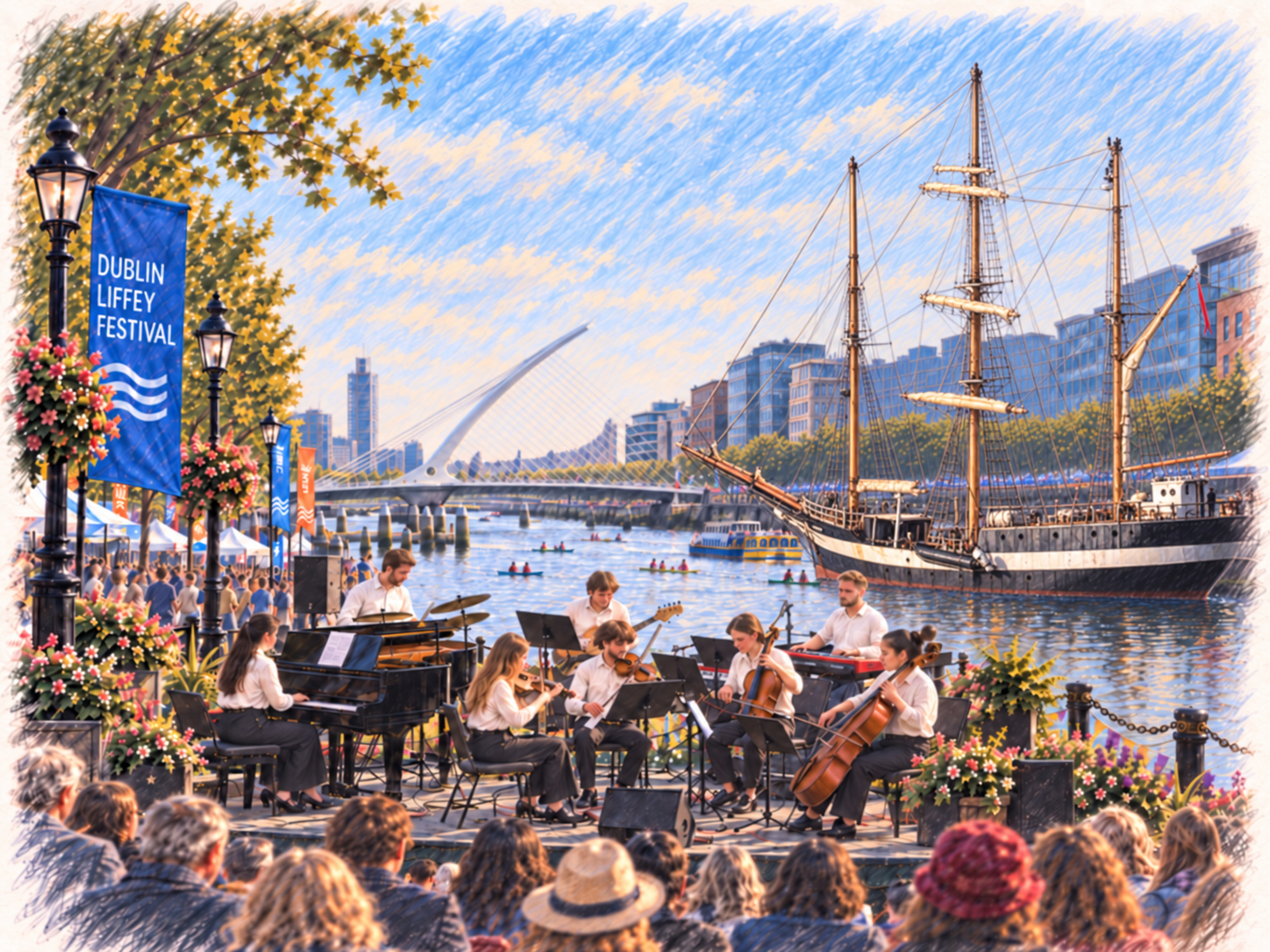
Almost 1,200 years ago, Vikings sail up the Liffey in their ships. They find a ford, traces of earlier settlement and a dark pool of water – and quickly realise that this is a useful place to be. On 13 September 2026, Dublin tells a very different story about the same river at its first Liffey Festival: with paddles, ships, music and city planning that suddenly becomes visibly alive.
Almost 1,200 years ago, Vikings reach the area around the Liffey. It is far from empty: there are traces of earlier settlement and a place by a ford. What interests the newcomers most is the location. Their ships can reach it from the sea, while the river opens routes further inland. Around 841, they establish a fortified ship-base known as a longphort. Nearby lies a dark pool fed by the River Poddle where it meets the Liffey. In Irish it is called Dubh Linn – “black pool”. Say the name aloud and you can already hear where the story is heading: through later forms of the name, it becomes Dublin.
A familiar river takes on a new role
On 13 September 2026, the Liffey takes on a new role. At the first Dublin City Council Liffey Festival, it is not only the river that runs through Dublin but also a stage, a meeting place and a thread running through the city’s story. The two-day festival on 12 and 13 September stretches across Custom House Quay, George’s Dock, Sir John Rogerson’s Quay and the river itself. Visitors can paddle, board ships, hear stories about Vikings, archaeology and dock workers, watch street theatre or try water sports. Sunday also brings aerial acrobatics and jetpack displays. For the finale, local boats, rowing clubs and community vessels gather at Custom House Quay and travel together towards Dublin Port.
The fact that Dublin is launching such a festival now is less accidental than it may first appear. The city’s 2022–2028 development plan explicitly recognises the Liffey as an important urban space. It aims to strengthen the river’s civic, historical, cultural and ecological connections while expanding opportunities for recreation and activity both beside and on the water. In the Docklands, new pontoons and additional water-based uses are explicitly part of the development objectives. In September 2025, the Quayside Project also opened at North Wall Quay, including a new water-sports centre. Words such as “access”, “recreation” and “public realm” in a planning document suddenly acquired very real pontoons, doors and routes down to the water.
When plans turn into paddle strokes
That is why the festival is more than an attractive event beside the river. It offers a chance to see what happens when a city genuinely brings its planning goals to life. The ambition to improve access to the water becomes people in kayaks and traditional Irish currachs. The idea of cultural use becomes stories about the harbour and concerts on the quays. And the goal of strengthening the relationship between city and river becomes a weekend in which Dublin can also be experienced from the Liffey itself.
At Sir John Rogerson’s Quay there is also a ship that has already lived several lives. The Pelican of London was built in France in 1948 as an Arctic fishing trawler. She later worked as a coastal cargo vessel and, between 1995 and 2007, underwent a major reconstruction that gave her the form of a three-masted sailing ship. In the years that followed she was used, among other things, for youth sail training and for educational and scientific voyages. At the Liffey Festival she is one of the announced visiting vessels; selected ships will be open for free public visits. What lies at the quay, then, is not a decorative replica but a working ship with a history that runs from fishing to freight and finally to learning at sea.
A concert hall without a roof
For Sunday’s finale, Dublin has also chosen an ensemble that fits the idea unusually well. Glasshouse is based in Dublin and, since 2016, has repeatedly sought out unusual spaces for music. The ensemble creates new arrangements of contemporary music, has worked with music by Ólafur Arnalds, Sufjan Stevens, Bon Iver, Kate Bush, Prince, David Bowie and Ryuichi Sakamoto, among others, while also commissioning new work from Irish artists. At the Liffey Festival, Glasshouse will provide an eight-piece instrumental and vocal backdrop to the flotilla. An ensemble that likes to take music out of the conventional concert hall is being given a venue no theatre could reproduce: the river itself.
Almost 1,200 years ago, newcomers recognised that waterways, harbour access and location made this place special. Since then, Dubh Linn has become a European capital, the trading port has become a modern port city, and some of the old riverbanks have become quays, streets and Docklands. The Liffey never disappeared. What is new is what Dublin is trying with it this weekend: telling the city’s history, opening ships, making sport possible, performing music – and showing that long-term ideas for a city can eventually become very tangible experiences. When music carries across the water on Sunday, you will not just hear a festival. You will see city planning come to life out on the river.