Who gets to tell what happened?
Gernika was bombed on 26 April 1937. Almost immediately, a struggle began over what had supposedly happened. Nearly ninety years later, young people from four European countries are searching for their own response through rap, voice and movement.
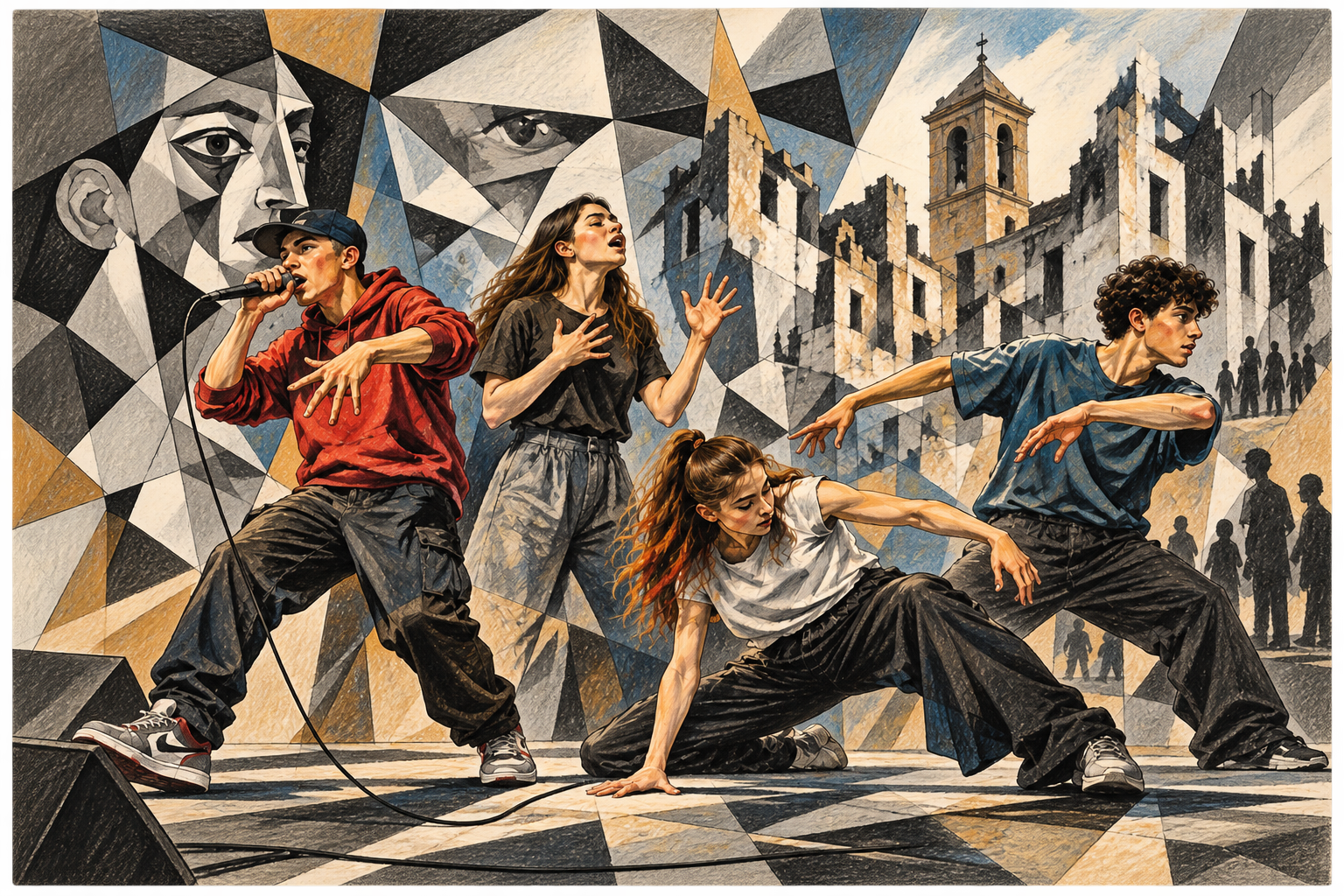
A town lies in ruins. People are dead, injured or fleeing. And even before all the victims have been recovered, there are already two stories about what happened.
On 26 April 1937, German and Italian air forces bombed Gernika in support of Franco's Nationalist forces. Afterwards, the Nationalist side denied responsibility and spread the claim that the town had been destroyed by the Republicans or by its own inhabitants. Foreign journalists reported the air raid, helping to prevent that version from taking complete hold. Under Franco's later dictatorship, memory of the bombing continued to be suppressed.
So this was not only an attack on a town. A struggle also began over who was allowed to tell its story.
A painting without aeroplanes
One man in Paris followed the news particularly closely.
Pablo Picasso had already been commissioned by the government of the Spanish Republic to create a large work for the Spanish Pavilion at the Paris International Exposition. At first, however, he was working with a different subject. Then news and photographs from Gernika reached him. On 1 May 1937, Picasso began work on “Guernica”.
The strange thing is that anyone looking to the almost eight-metre-wide painting for an explanation of the attack will not find one. It does not say which army was responsible. There is no map and no timeline. Picasso does not even show the aircraft that bombed Gernika.
Instead, we see a mother with her dead child, a wounded horse, a bull, distorted faces, a dismembered body and people filled with fear.
For someone who had little understanding of modern art in 1937, this was hardly the easiest way to learn about Gernika. The lie was much easier to understand: the other side had destroyed the town themselves.
Picasso's painting worked differently. It could not prove which aircraft had flown over Gernika. There were eyewitnesses, journalists, photographs and other sources for that. But it gave the horror an image that could travel. “Guernica” became a symbol against the violence of war far beyond the specific attack.
Today the original hangs in the Museo Reina Sofía in Madrid. Its name, however, still leads back to a small Basque town.
And there, a new response is taking shape.
Four schools, almost 200 applications
Since 3 October, young people from Estonia, Greece, Italy and Spain have been working together in Gernika. They are aged 16 to 19 and come from four schools selected for “Sound in the Silence 2026”: Põlva Gymnasium in Estonia, Gymnasio me Lykeiakes Takseis Xirokampiou Lakonias in Greece, Liceo Carlo Tenca in Italy and Sarriguren Secondary School in Spain.
The field was large: almost 200 schools from across Europe applied.
For a week, the students have been exploring the bombing, the experiences of civilians, displacement, memory and the disinformation that surrounded the attack from the beginning. They are not working only with history books. Historical sources, personal testimonies and the town itself are starting points for their work.
The accompanying workshops for teachers also explicitly address “Gernika and Fake News” and the ways historical narratives can be constructed and manipulated.
That fits remarkably well with a history in which two completely different accounts were already competing to be believed in 1937.
What do you make from that?
The students could simply be asked to prepare a presentation.
That is not what happens.
American hip-hop artist Dan Wolf, the project's artistic director, works with them on creative writing and rap. Choreographer and dancer Kat Rampackova leads movement and dance. Sean Palmer, a performer, musician and composer, works with voice, sound and musicality. From these different forms of expression, the students develop texts, sound and choreography together.
When the project week began on 3 October, this performance did not yet exist. Only over the past few days have encounters with the place, the sources and the stories turned into original words, movements and sounds.
That is what makes it exciting. The students are not supposed to reenact Picasso's “Guernica”. They have to find their own form.
Picasso had paint, canvas and forms that many people in 1937 first had to decipher. These young people have language, bodies, rhythm and voice.
Yet both face a similar question:
How do you tell what happened when others have already tried to change the story?
Tonight
Today, 10 October, the results of this week become public. The final performance begins at 6 pm in Gernika, moving through the town's streets and into the Peace Museum. Afterwards, the audience, students, artists, teachers and organisers can discuss the work together. Admission is free.
As we prepare this article, we do not yet know the individual texts and scenes. We do not know whether someone will rap while others remain silent, whether a movement will evoke a destroyed place, whether a line from a historical testimony will appear, or whether the students have developed something we would never have imagined.
That is theirs to decide.
Because “Sound in the Silence” does not only ask these young people what happened in Gernika in 1937. It gives them something more difficult to do: they have to decide how they want to tell it.
Picasso needed an enormous canvas for that in 1937.
Tonight we will see and hear what four groups of young Europeans need.